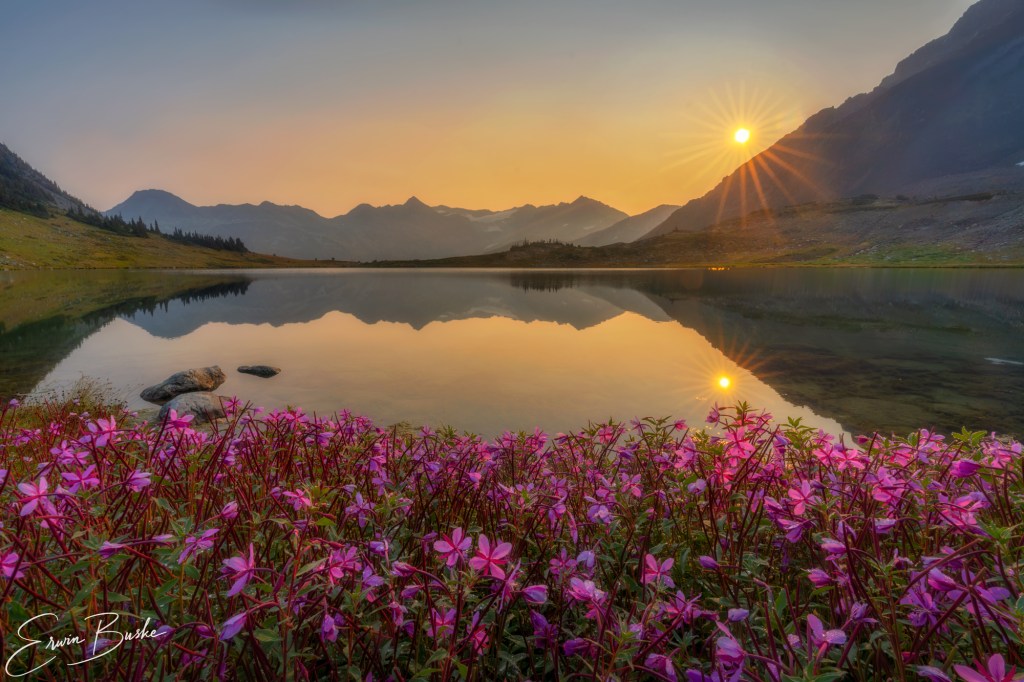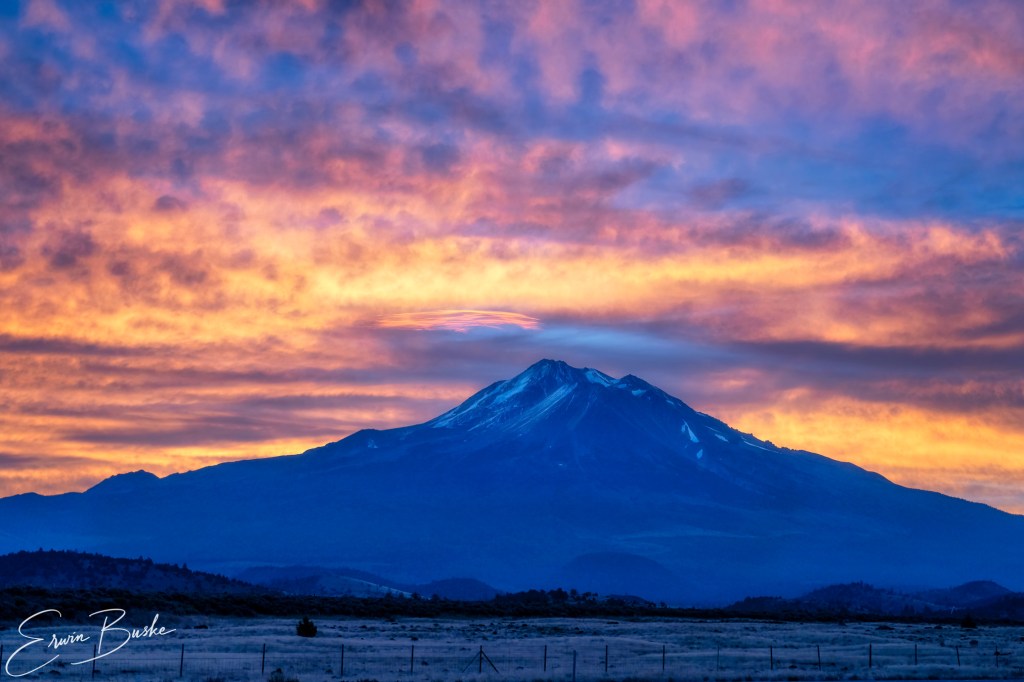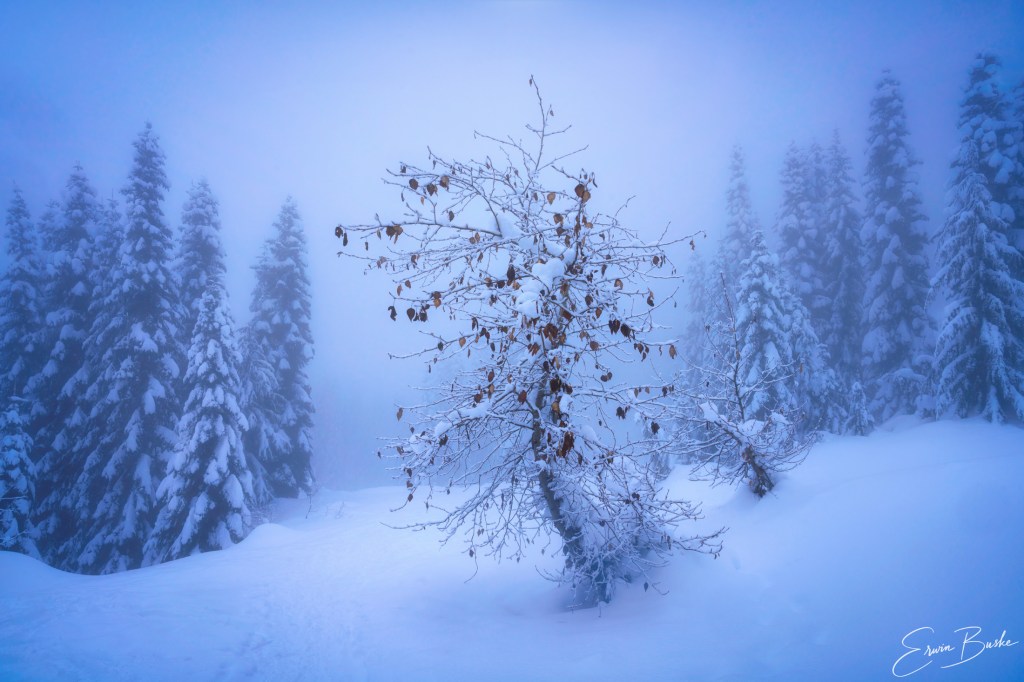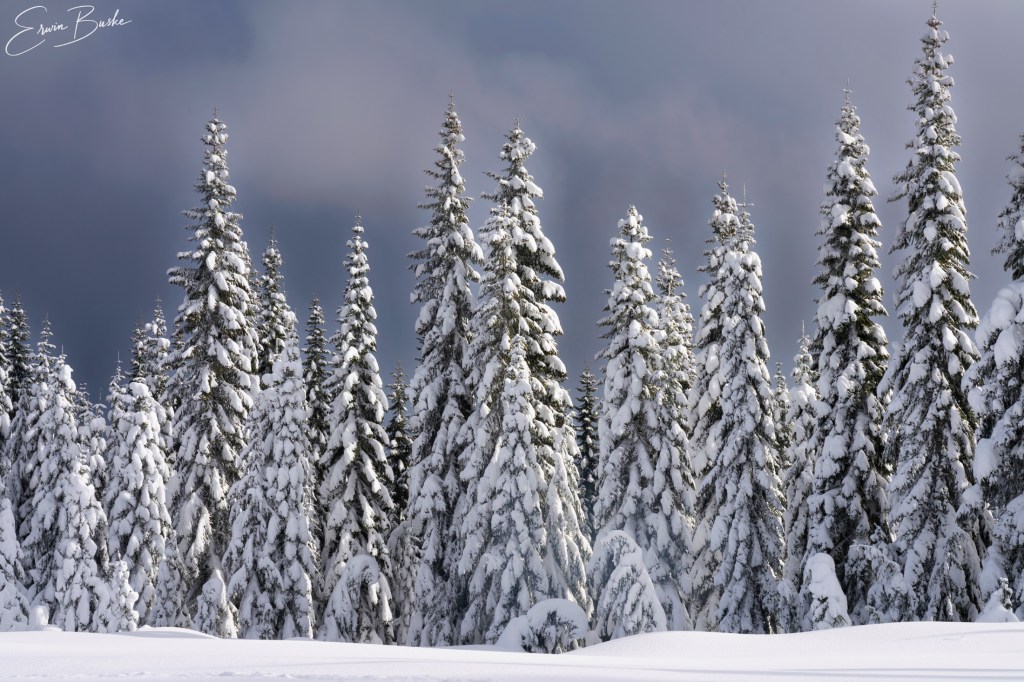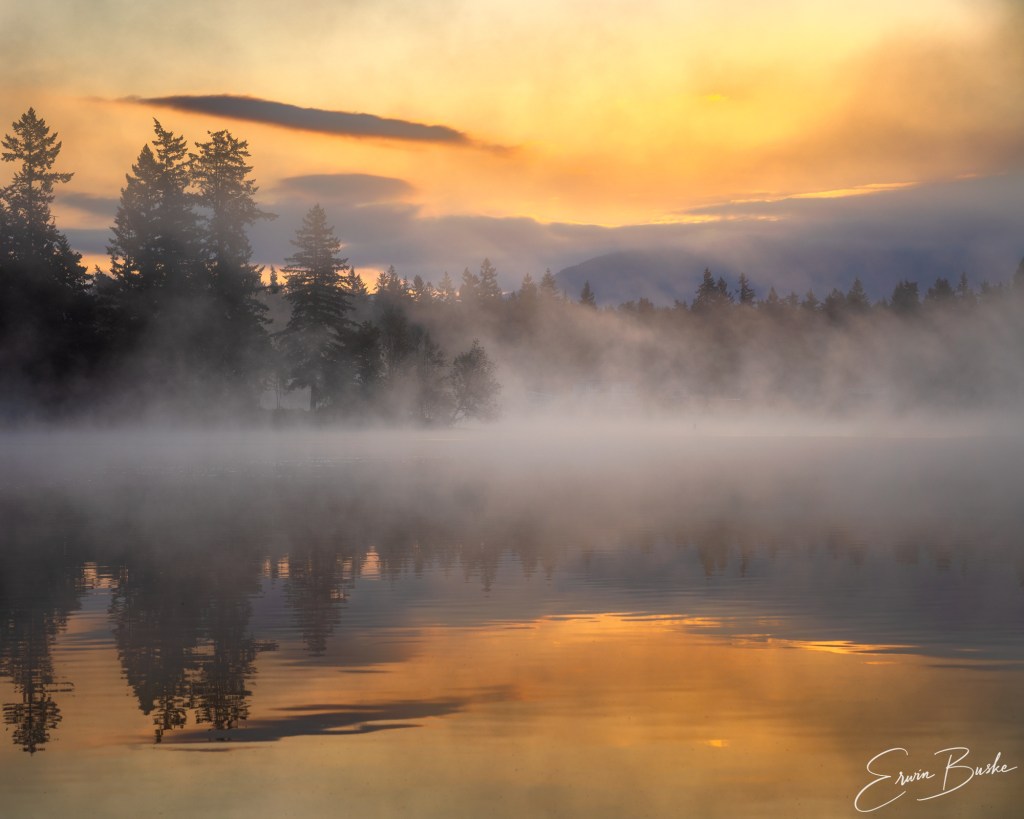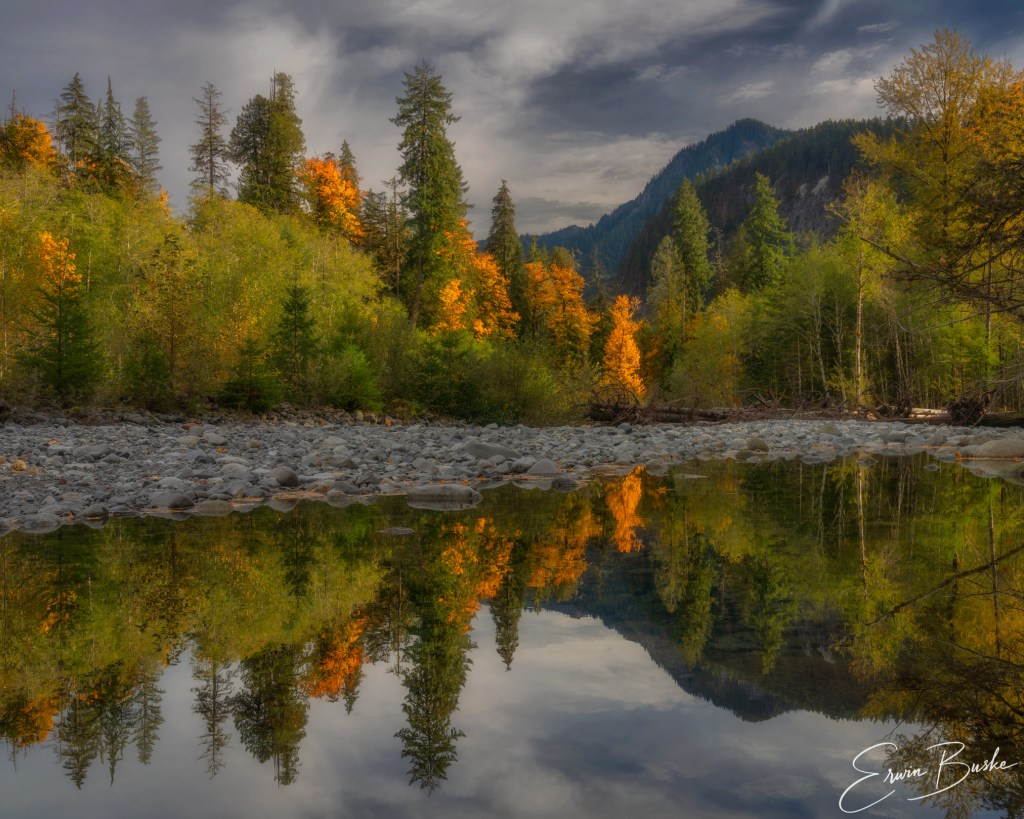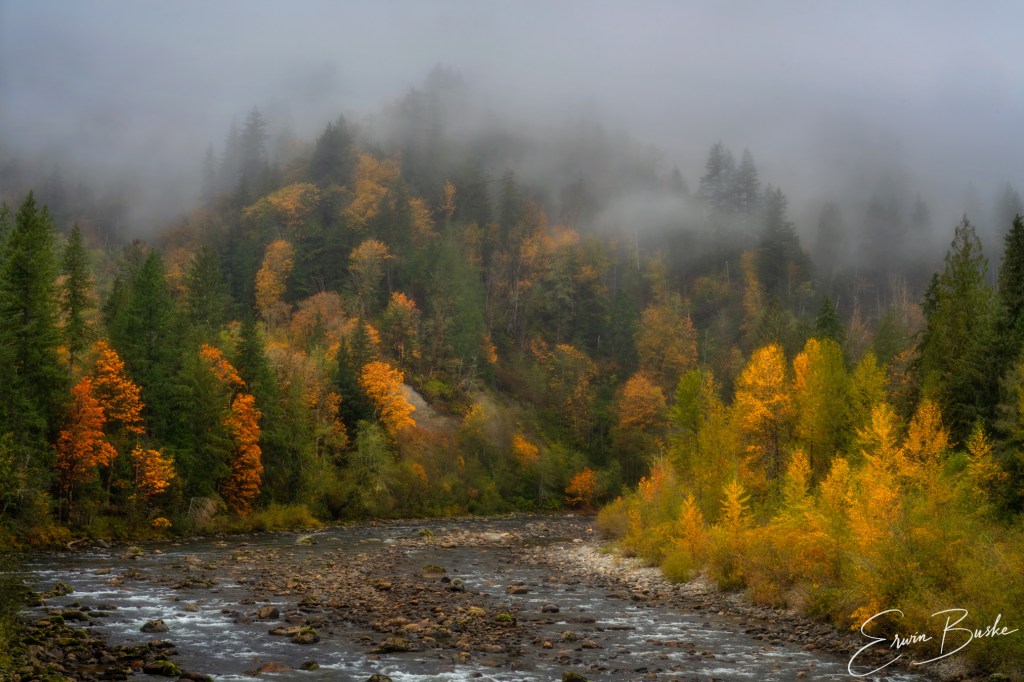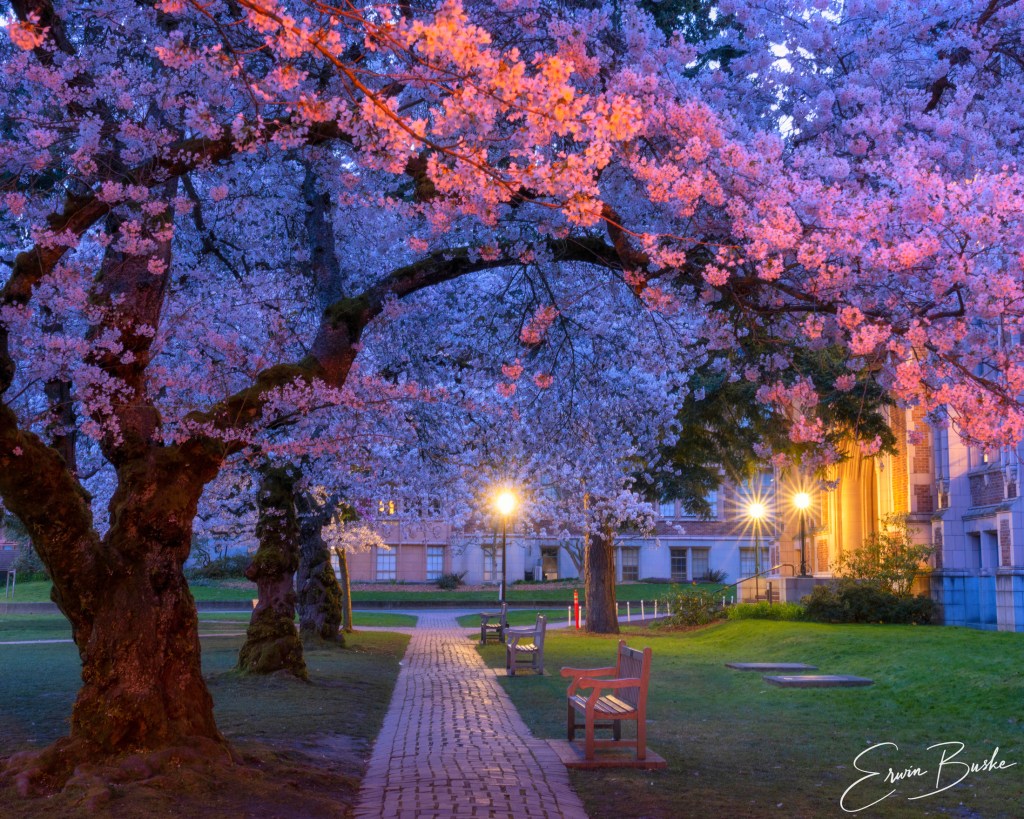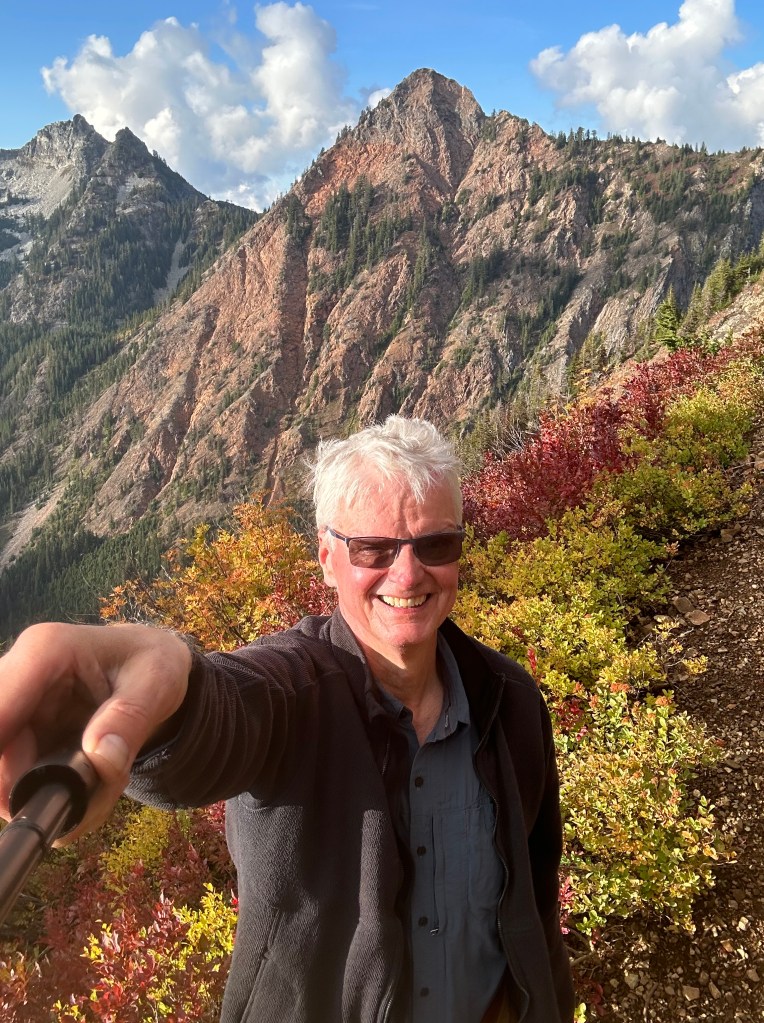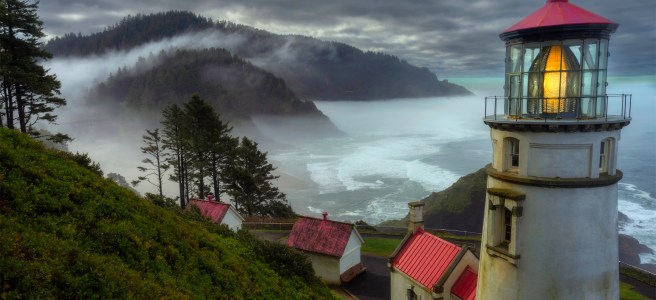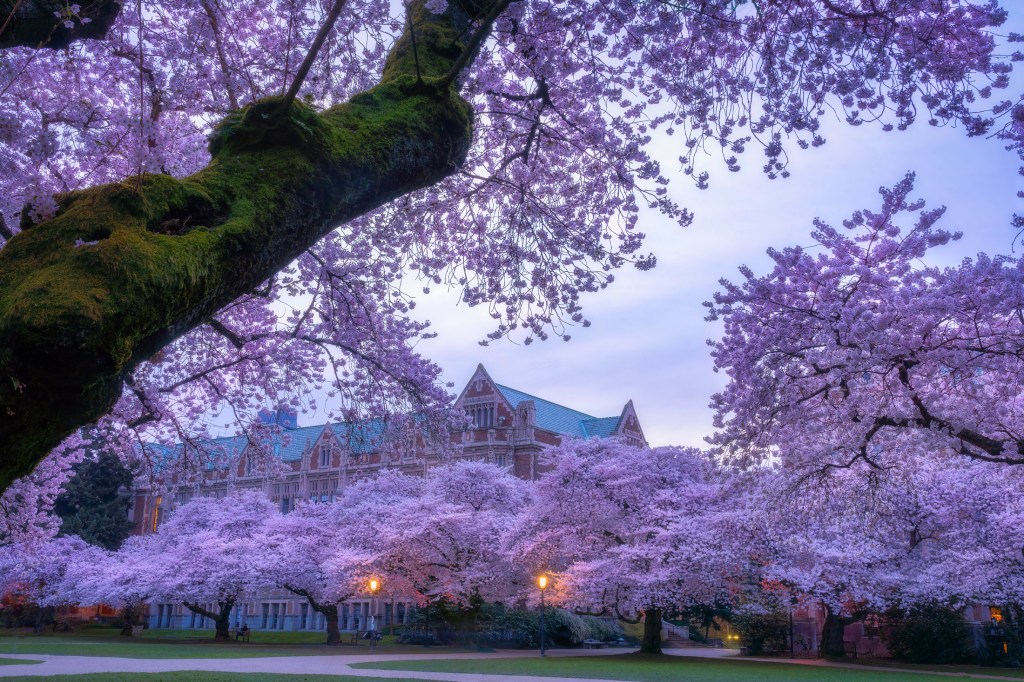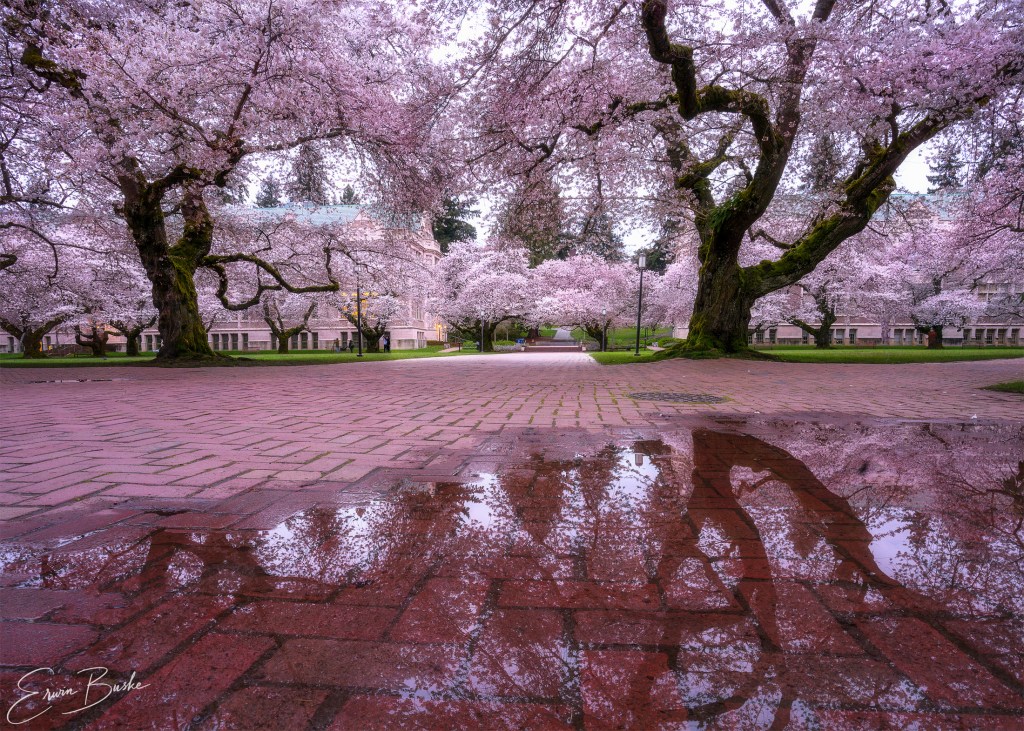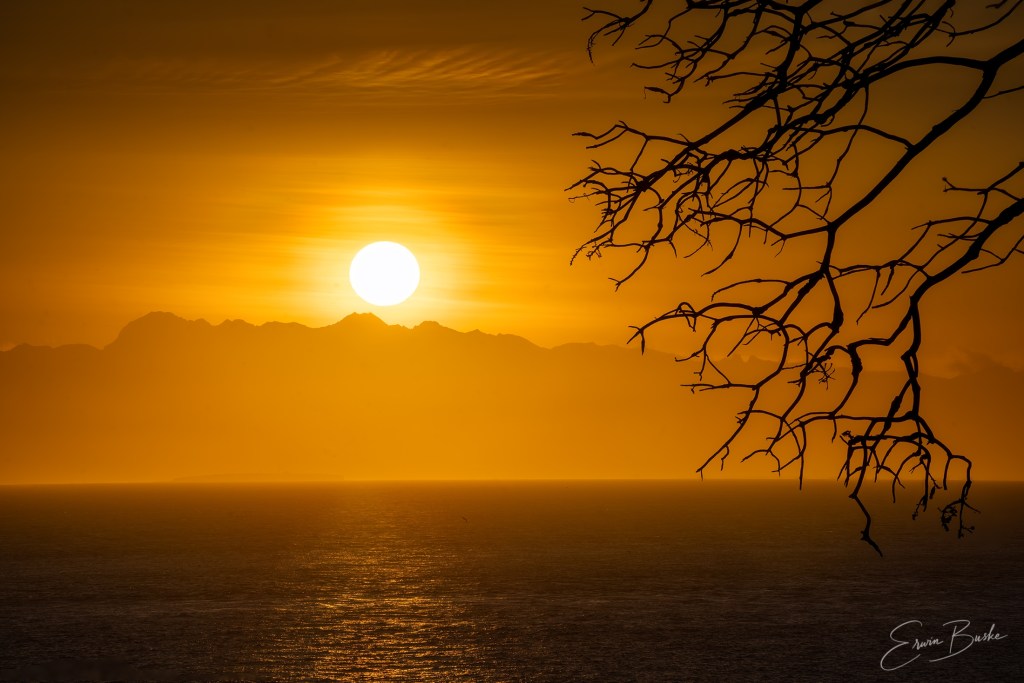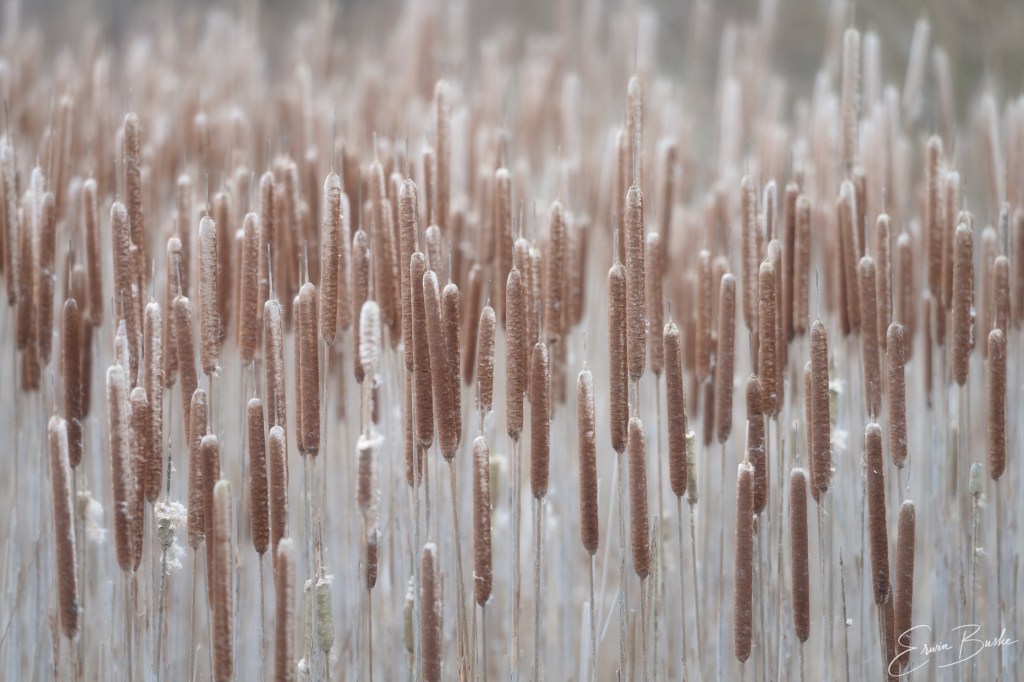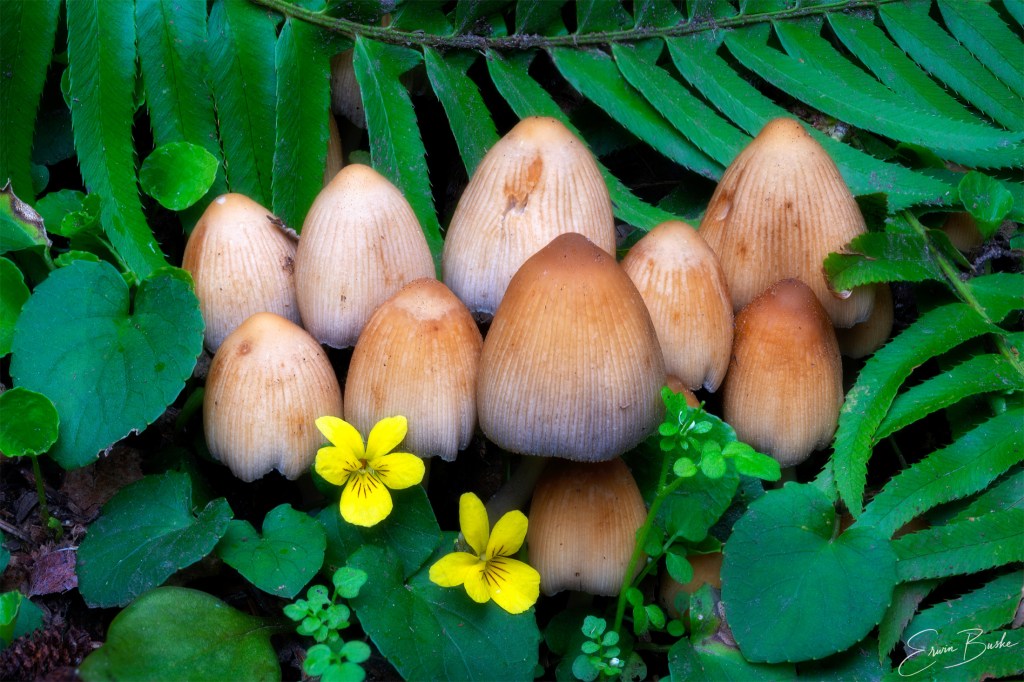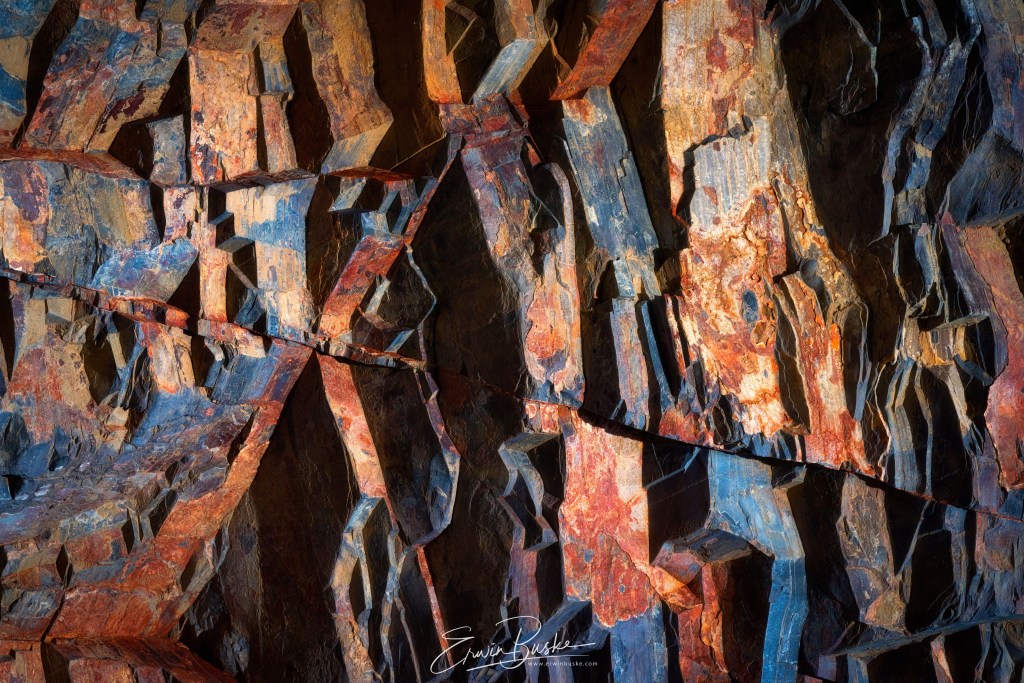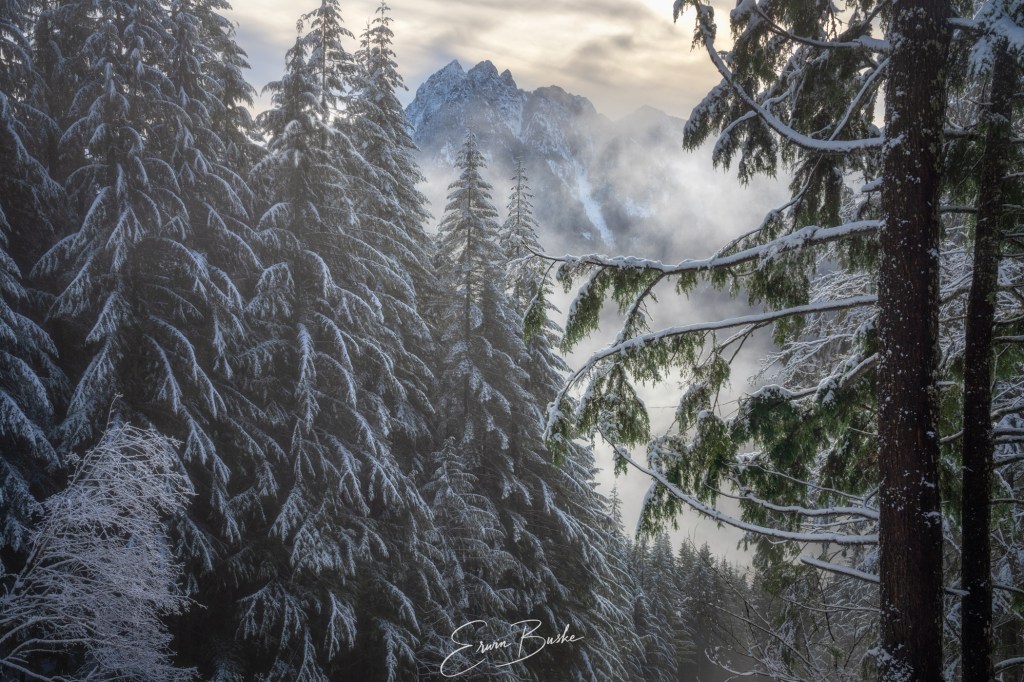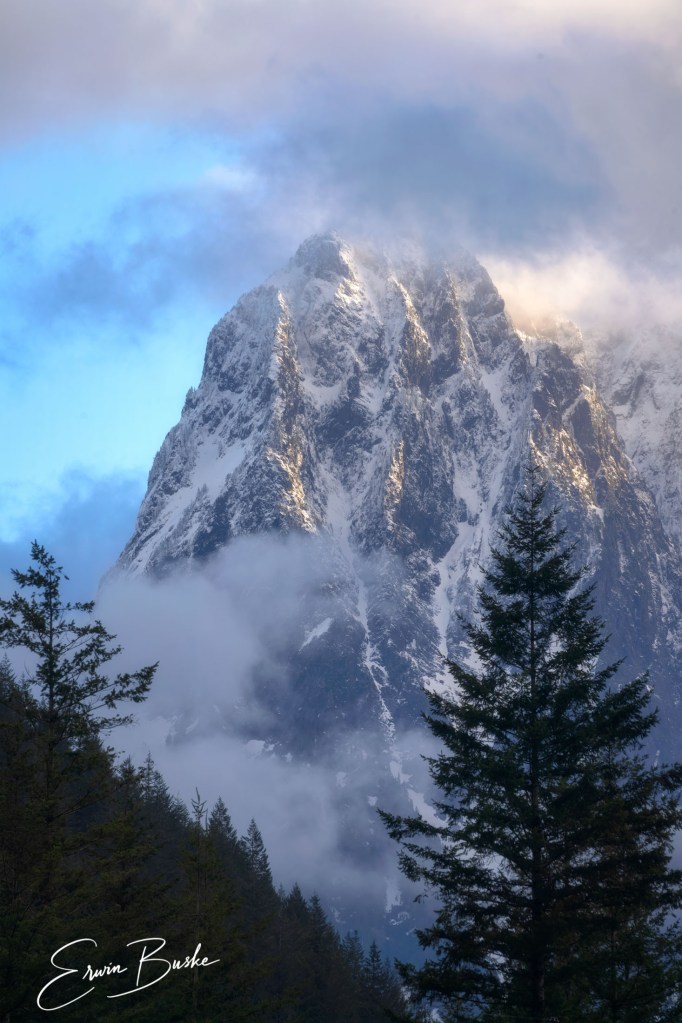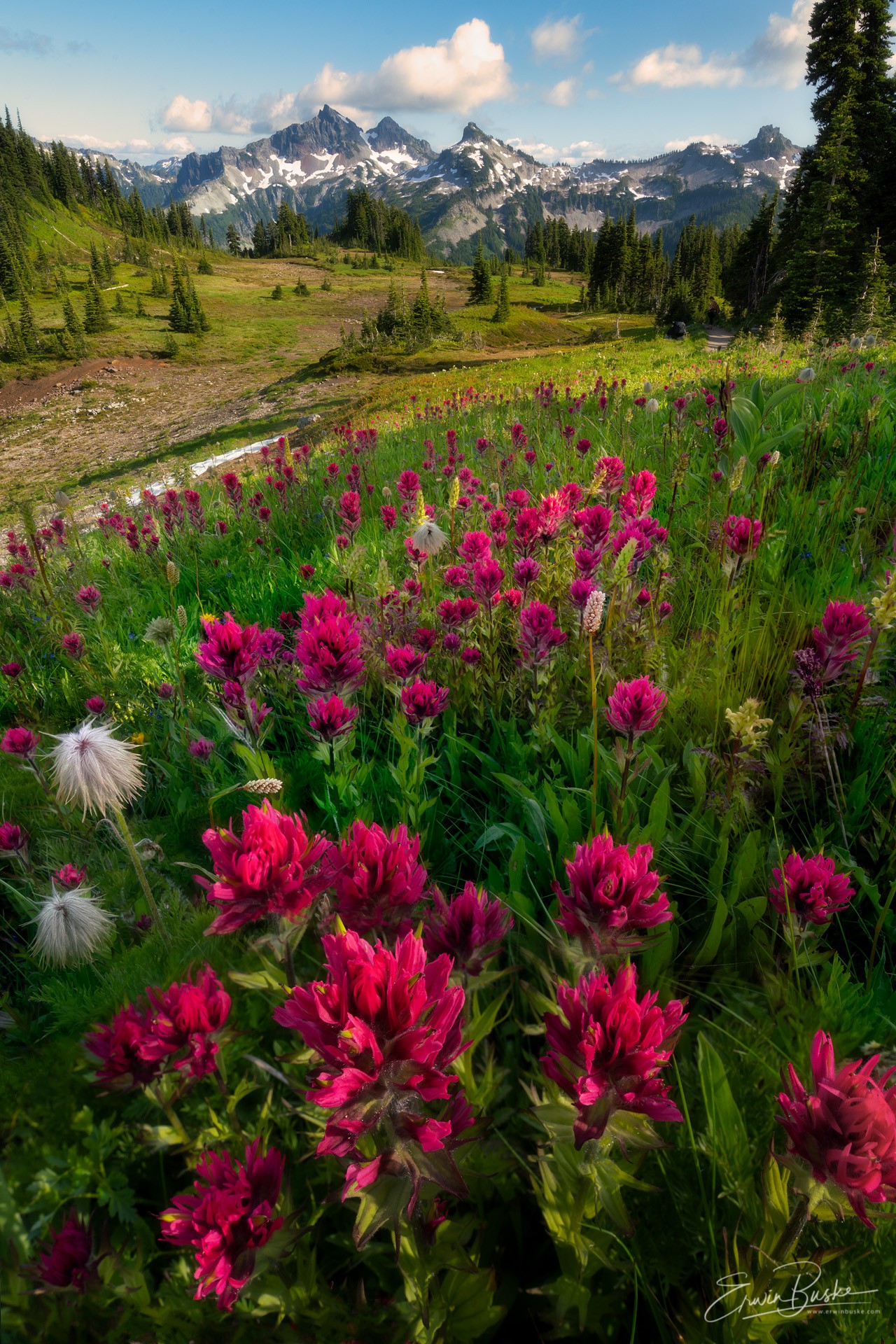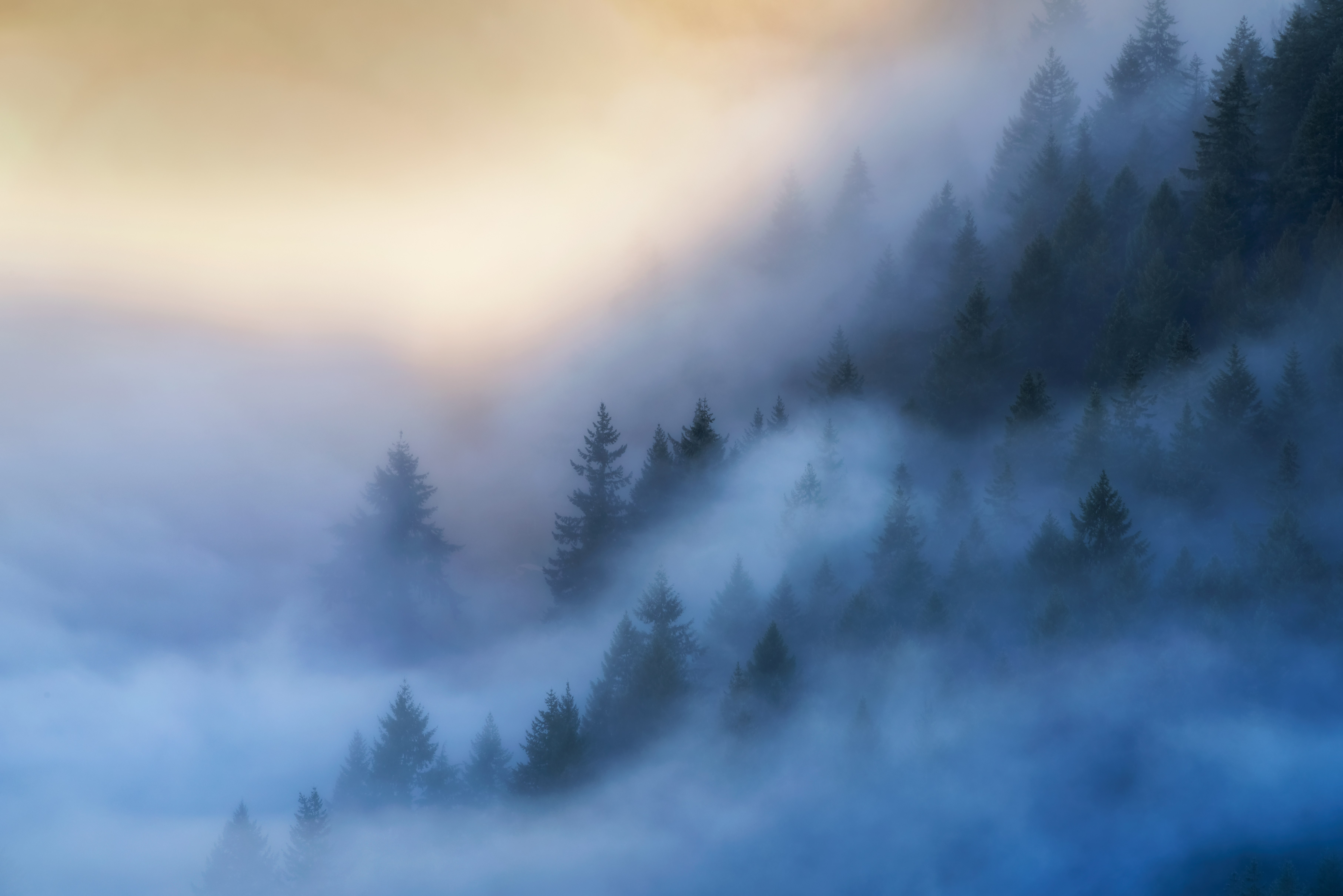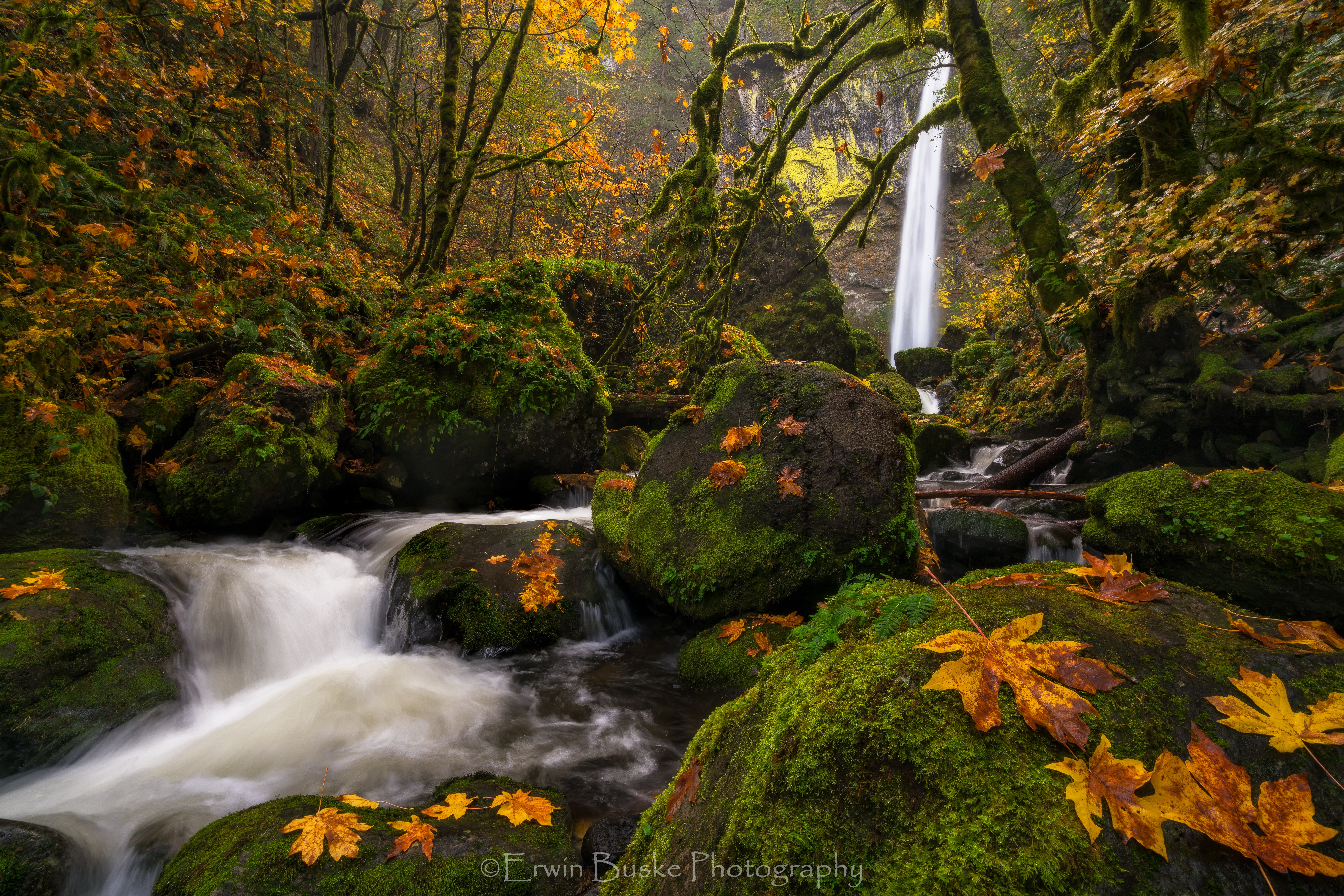
2024 Connecting with Nature and Community

This Blog Post includes fifty of my favorite images that together tell my story of CY 2024 (R1 12.29.24)

2024 for me was a year for renewing connections with nature and the community. In the process of doing this I found fresh visions for my photography and the support friends and followers. It is a mantra echoed throughout the photography community that good photography comes from following one’s own drummer rather than chasing popularity. I think this is true, but good photography also comes from close connections with the community and tapping into consciousness of the public who views our photographs. It is not either or, and to consider our audience when creating photographs is not the same thing as chasing popularity. Can you imagine creators of a successful cinema movie making no consideration of the audience who is ultimately going to view the movie? Of course not. The same thing applies to nature and landscape photography and for that matter any art form. We connect with our viewers through symbols, metaphors, themes and emotions that are also present in the consciousness and zeitgeist of our viewers. In this way we create a shared vision, the highest level of accomplishment for any nature and landscape photographer. Examples of these common themes would include finding solace in nature, coming home to nature, reflecting in nature and many others found in my images.

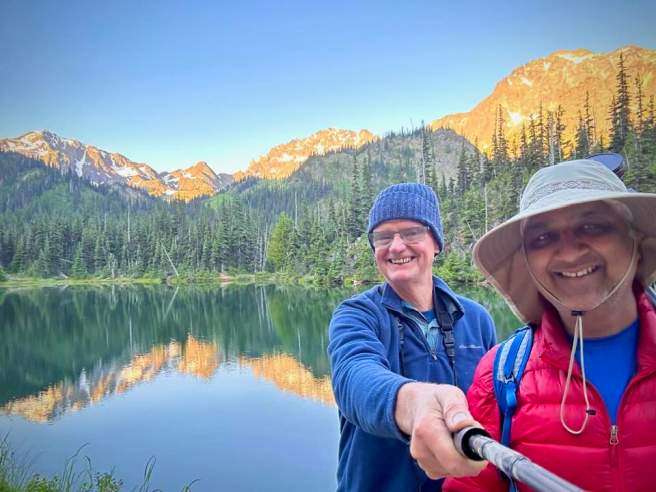
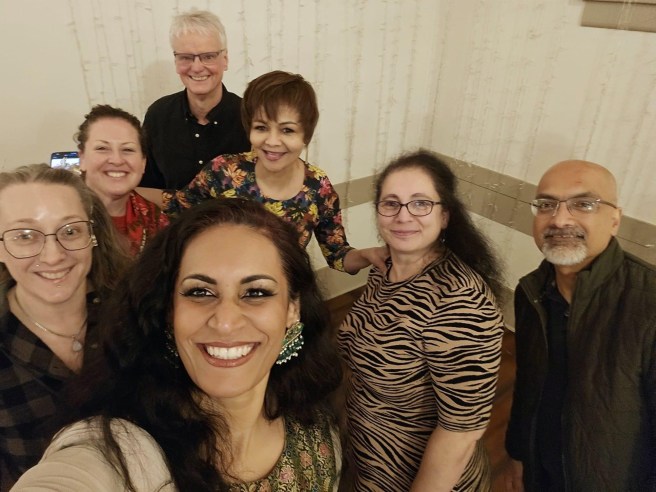
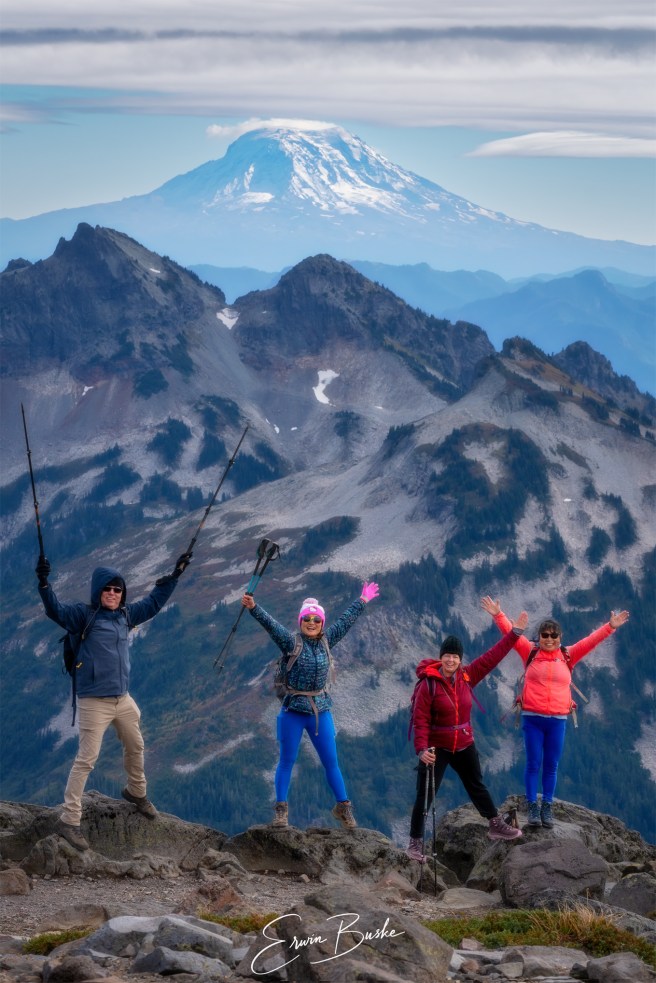
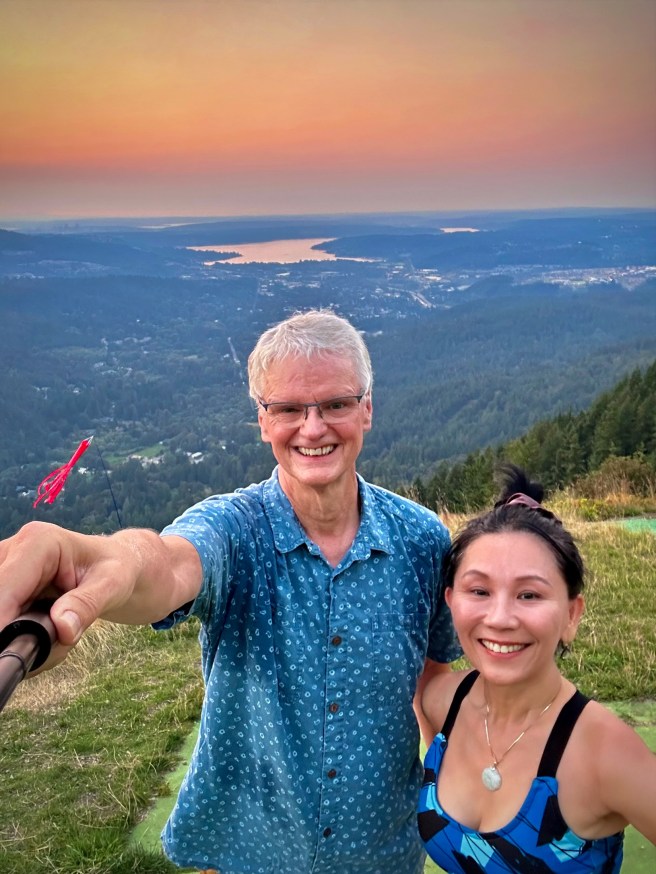
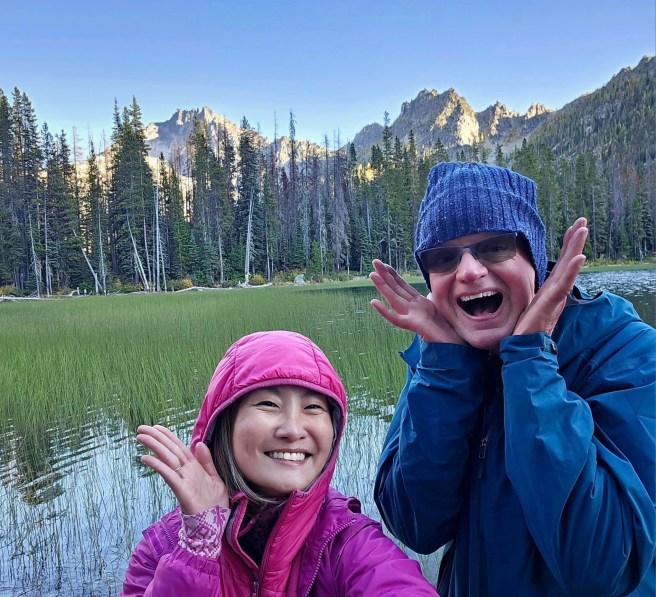
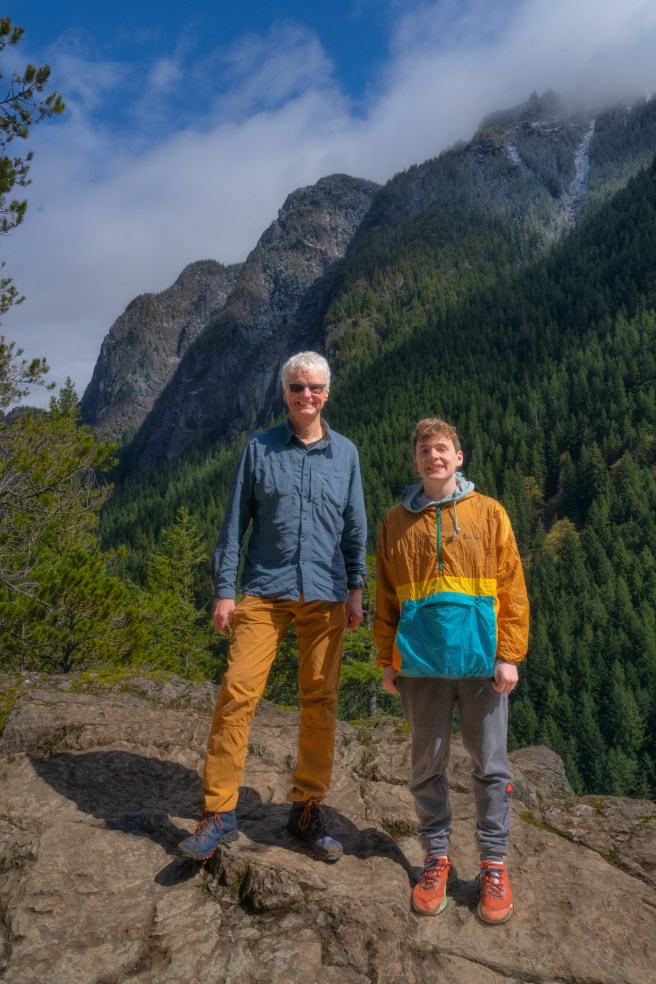
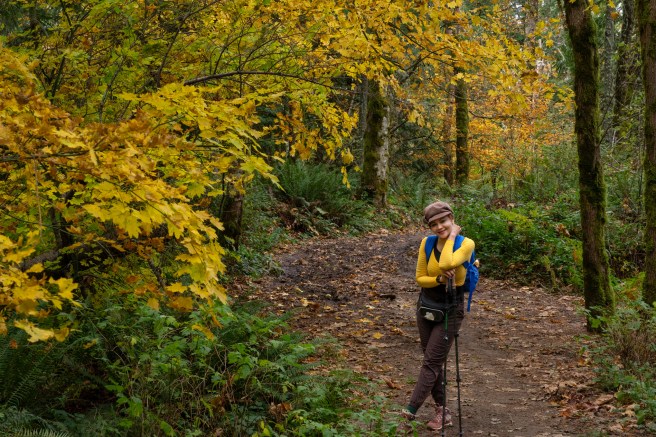
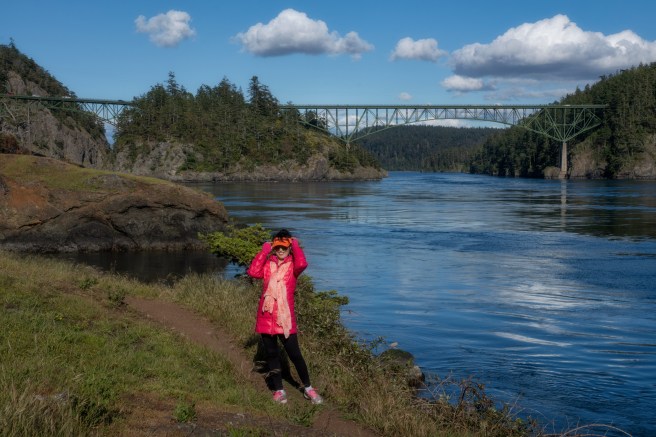
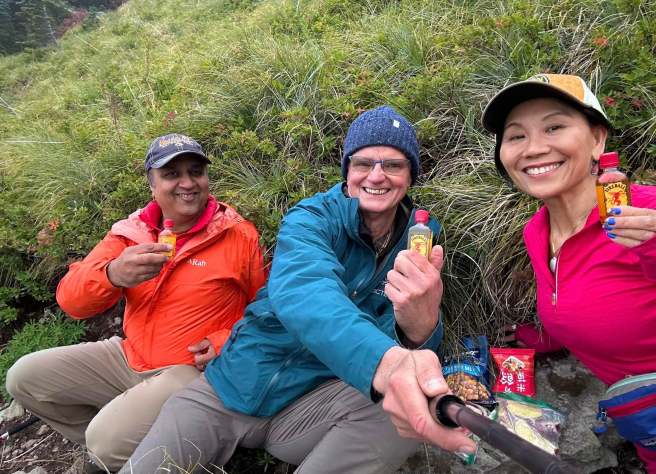
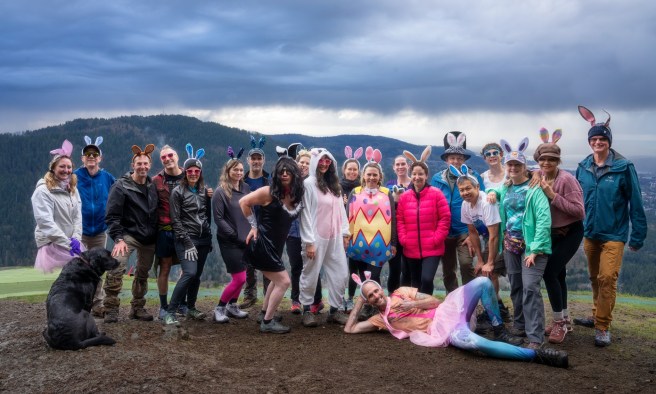
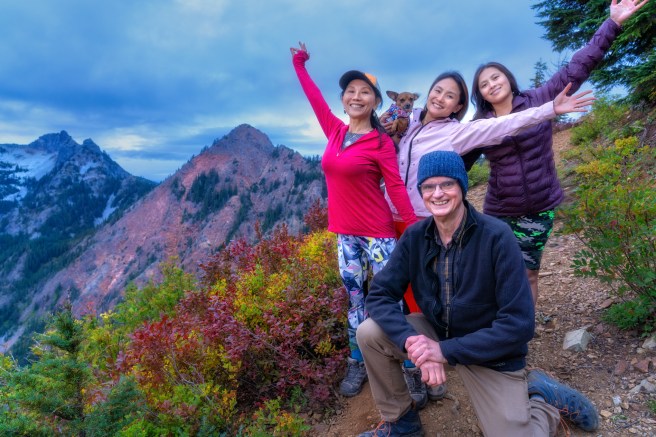
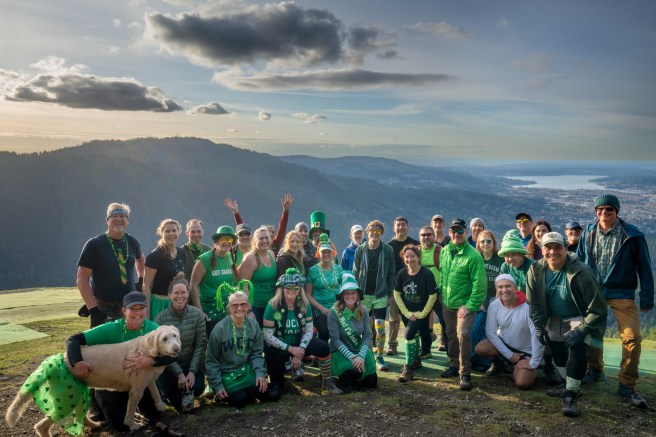
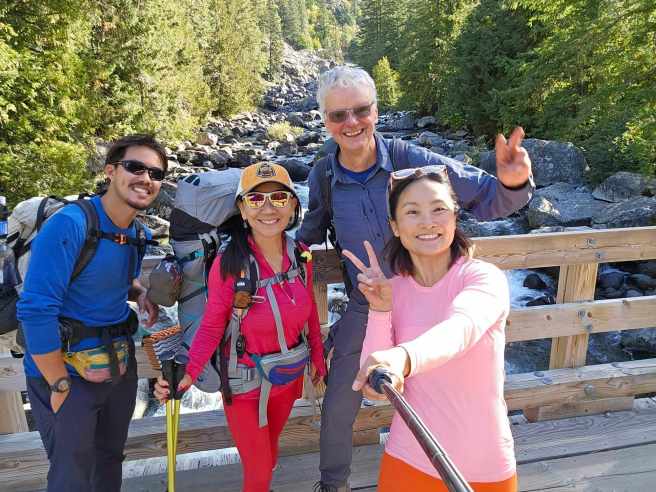
This year I formed some new friendships and solidified some longstanding ones providing me some company on my forays into nature. Some of the best conversations I have ever participated in have been right on the trail usually hiking with just one or two hiking friends. Its also great to experience with others the beauty of Mother Nature’s creation and this deepens and nurtures friendships. I also mentored a 16 year old student this year, transferring knowledge to the next generation of landscape photographers. Here are some snapshots of my friends and hiking and backpacking buddies.
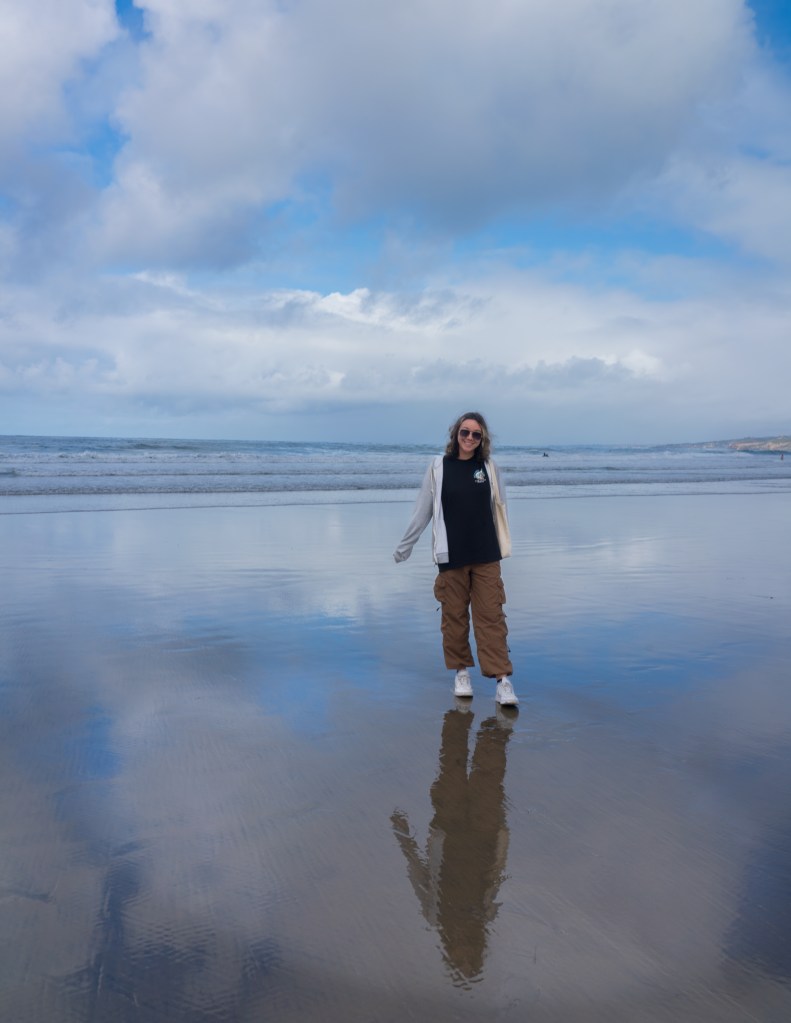
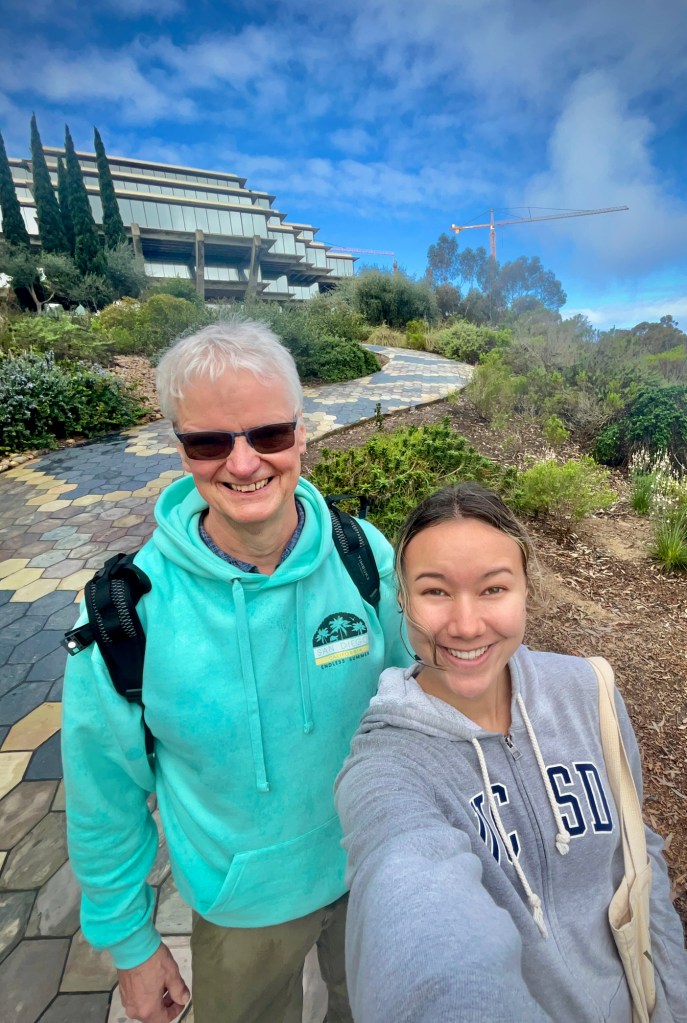
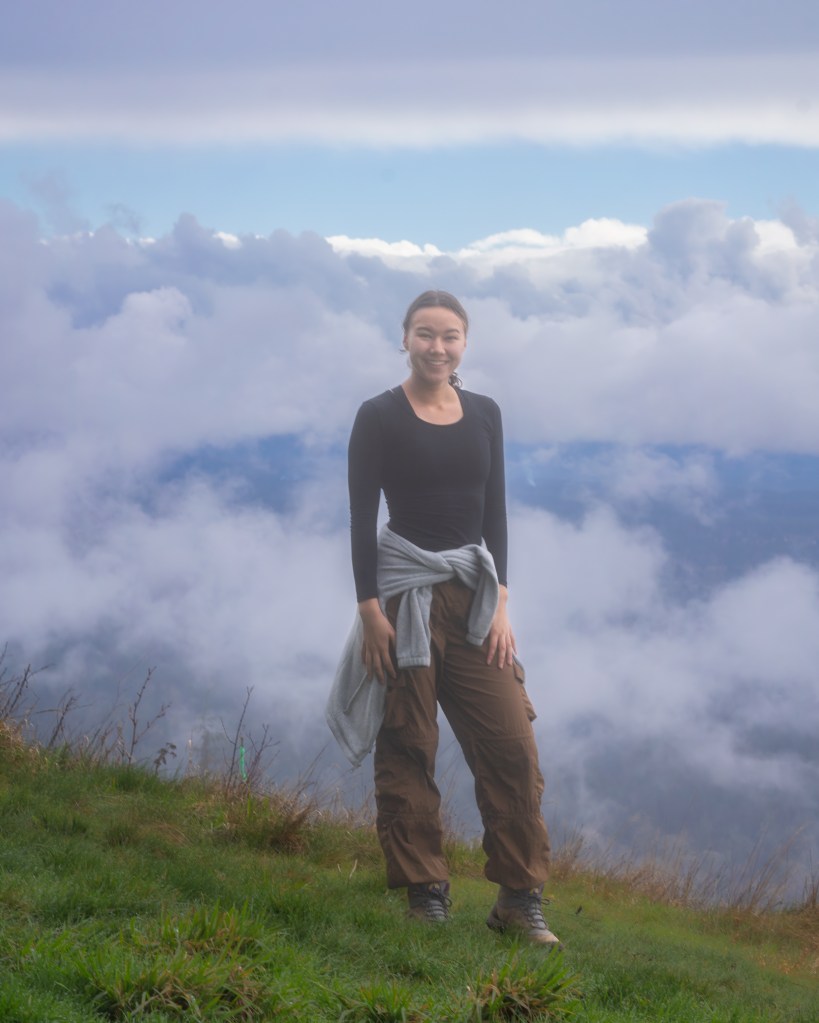
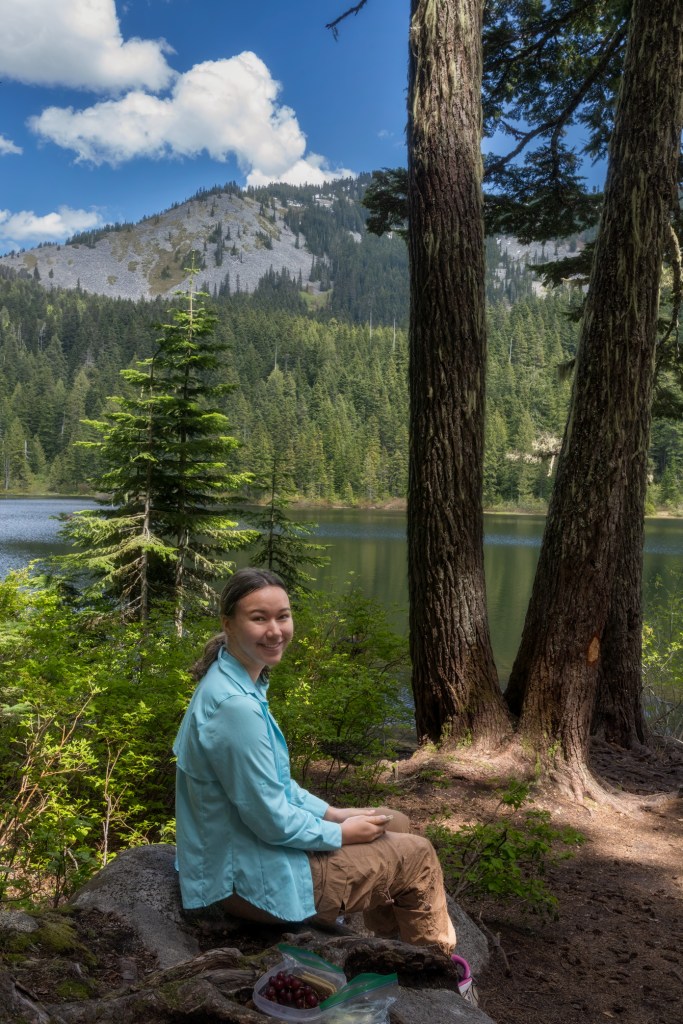
My favorite hiking partner of all is my daughter Caroline. She visits me on her breaks for the University of California San Diego (UCSD). Here are a few images and precious moments from various breaks both here in Washington and in San Diego.
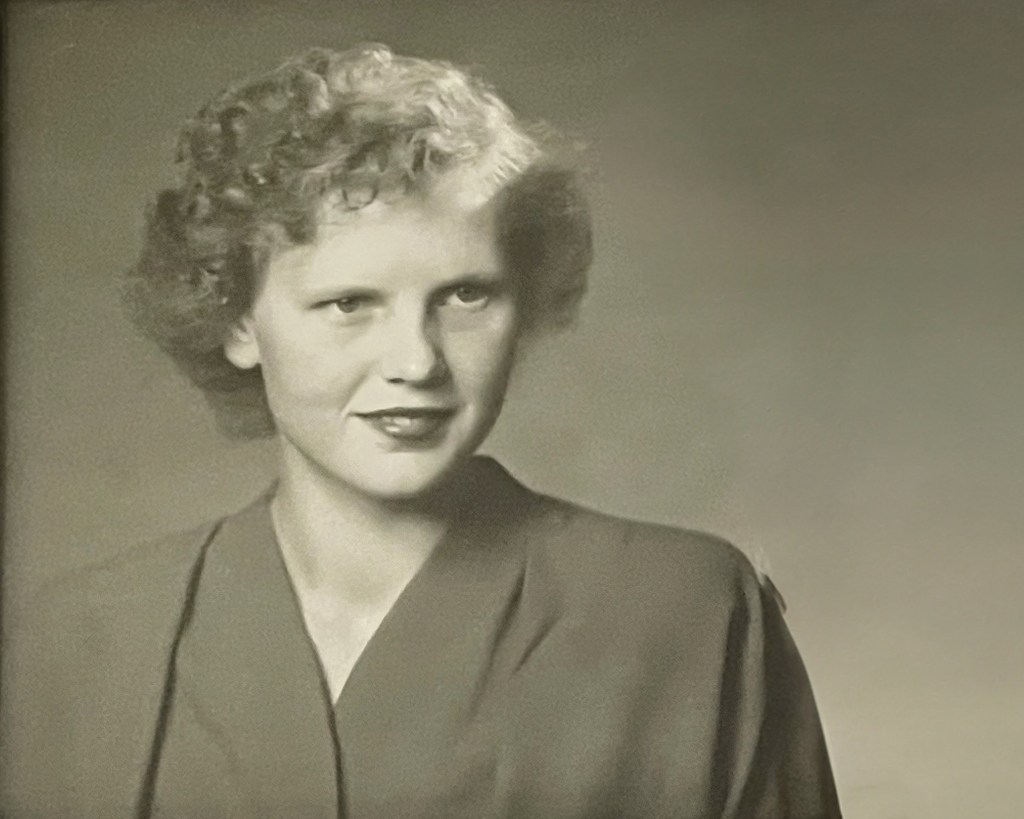
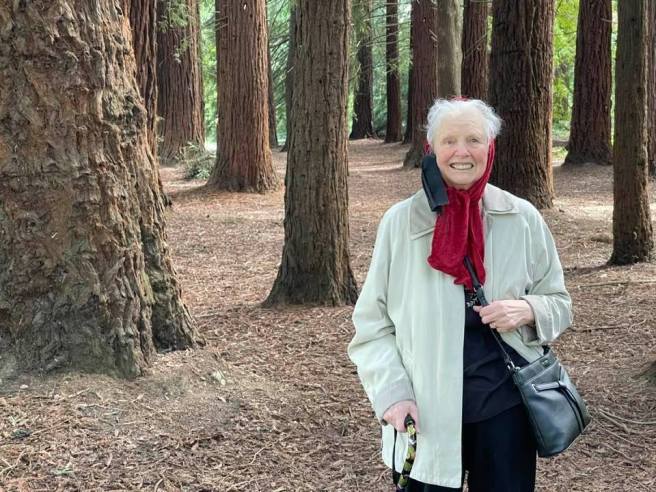
My year slipped into sadness in early October with the passing of my Mom, Agnes Buske who died from complications due to Alzheimer’s. My Mom grew up in a farm village in German where she developed a love for nature and the land. I learned from my Mom this same love for nature along with the value of tolerance. Loosing a parent is never easy, and now both of mine have passed which reminds me of my own mortality and need to live more in the moment as time here on earth is limited. Here is a poem my Mom wrote before she slipped into Alzheimer’s that she instructed us to read only once she passed.

This year I found beauty in both familiar and new places. Images 1 through 6 are from backpacking trips including my first ventures into Royal Basin in Olympic National Park, and to Panorama Point in Garibaldi Provincial Park, British Columbia. I also made a beautiful return to Indian Henry’s Hunting Ground at Mt. Rainier National Park. Images 7 through 18 are from road trips that also involved daily hiking. These trips included Rialto Beach in Olympic National Park, the Columbia Gorge Wildflowers, the Palouse, the Oregon Coast and the Three Sisters, and the North Cascades and Tumwater Canyon. Images 19 though 22 are from new day hiking photography destinations including the Lower Quilcene River in spring, Mt. Pilchuck in Autumn and Granite Lakes in Winter. Images 23 -28 are fresh perspectives from my favorite close in destination that I return to often, the Middle Fork of the Snoqualmie River. I also frequently return to local gardens and images 29-33 provide fresh perspectives of some of the familiar gardens I visit. Images 24-35 are from beauty in the forest across the street from my home. The remaining images are finding fresh visions of beauty on hikes I return to again and again.

1. Spirea Royal
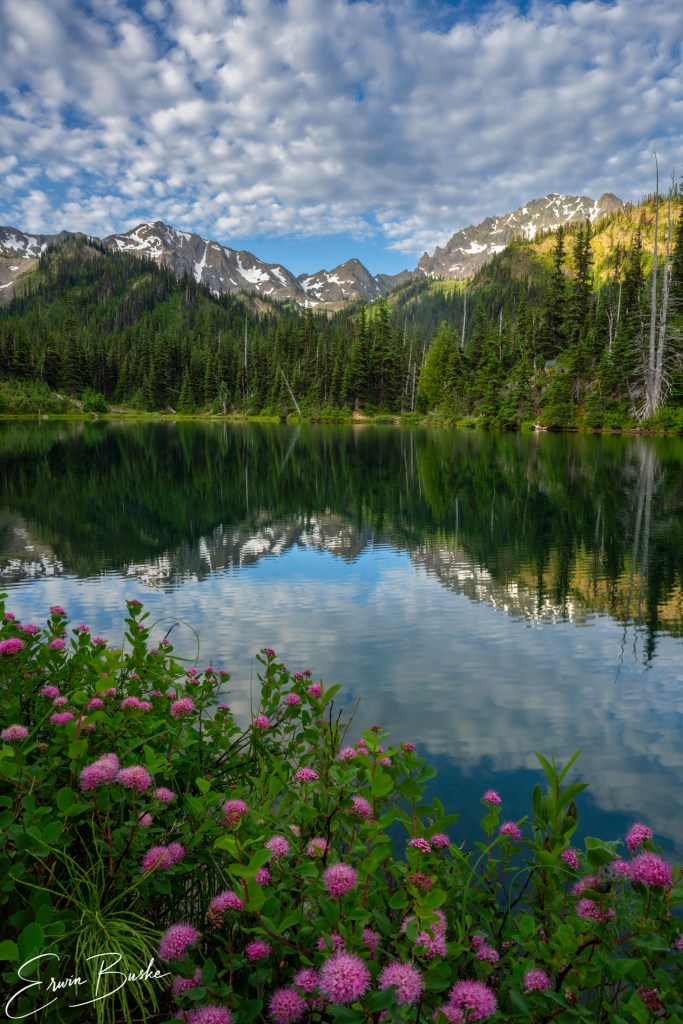
Mid July this year turned out to be an absolutely gorgeous time for wildflowers at Royal Lake and Basin in Olympic National Park. Everywhere we went, from the subalpine to alpine and tundra, most flowers seemed to be in peak bloom. I was in awe and amazement at all of the beauty. These wild flowers were beyond my wildest dreams!

But the good comes with the not so good as my friend and photographer colleague Lalit found out when first arriving at Royal Lake. I had already been there a few minutes and heard some mad yells and thrashing movements in the bushes. I turned around and thought Lalit was going through the beginning stages of an epileptic seizure. His backpack was completely unpacked with everything strewn over the meadow grass. I asked him what he was doing and he said looking for the bug spray which he apparently forgot. One bug went up his nose and that was the trigger for the near seizure. Luckily I had readily available a large bottle of 14 Hour Picaridin Insect Repellent and handed to him. Lalit found some quick relief. In a more calm and his more typical yogic state of mind that is more the foundation of his beautiful nature images, he started reassembling his backpack!

2. Cascading Heather
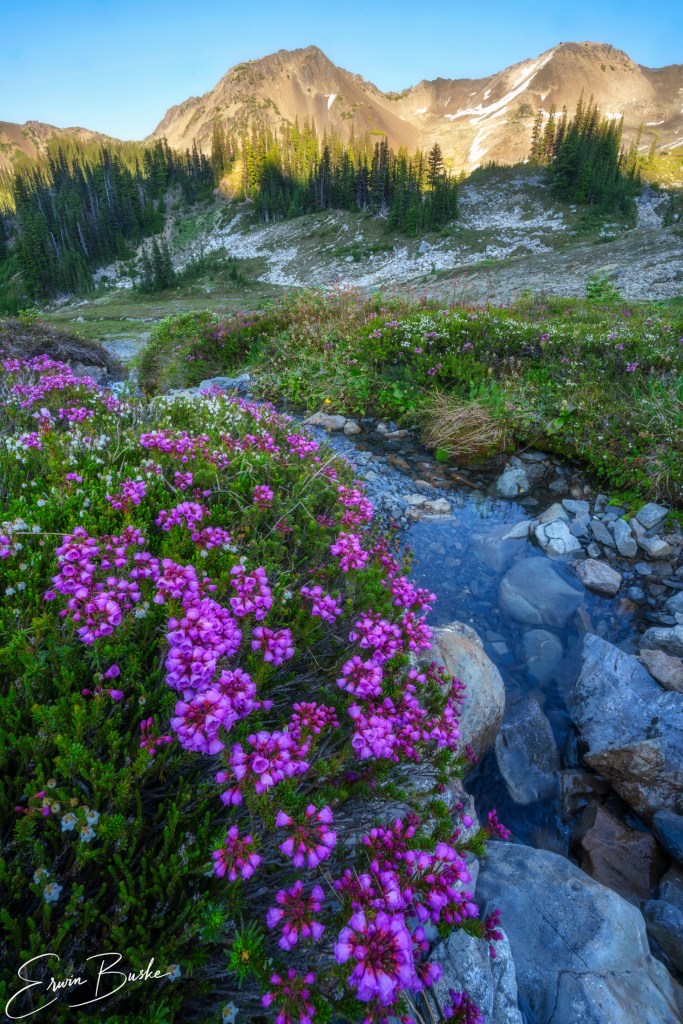
I loved how this heather cascaded down the meadow rock and echoed the shape of the stream, both leading my eyes out to Royal Basin and the distant peaks. This is definitely a place I want to go back for a return trip!

3. Garibaldi Mystical Morning
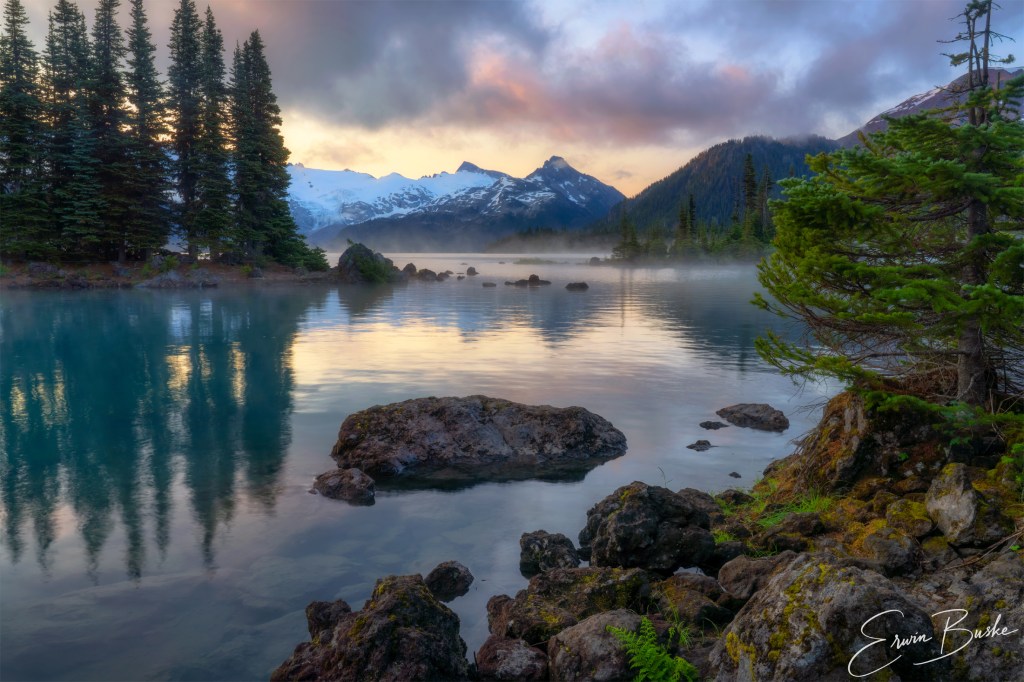
In the early morning I peeped out of my tent and saw nothing but blue skies and was tempted to just sleep in, preserving my energy for the climb to Panorama Peak. But I decided to pull myself out of my bag and I am glad I did. The clouds and mist quickly rolled in creating a constantly changing mystical show. This is a scene from that show.

I encountered a very different Garibaldi Lake this year than last. Last year the water level was way down making it easy to walk around the lake to campsites. This was a high water year with the Rangers sending most people on the high route to get around the lake adding considerable elevation to the hike. I asked them if I could take the low route and they said if you do not mind getting a little wet to go ahead. It was more of a balancing act stepping across partially submerged stones, something I am comfortable with. The high water, though, also changed the appearance of the Islands in the lake, in many ways for the better. My estimate is that the lake water was at least 10 feet higher this year.

4. Trifecta
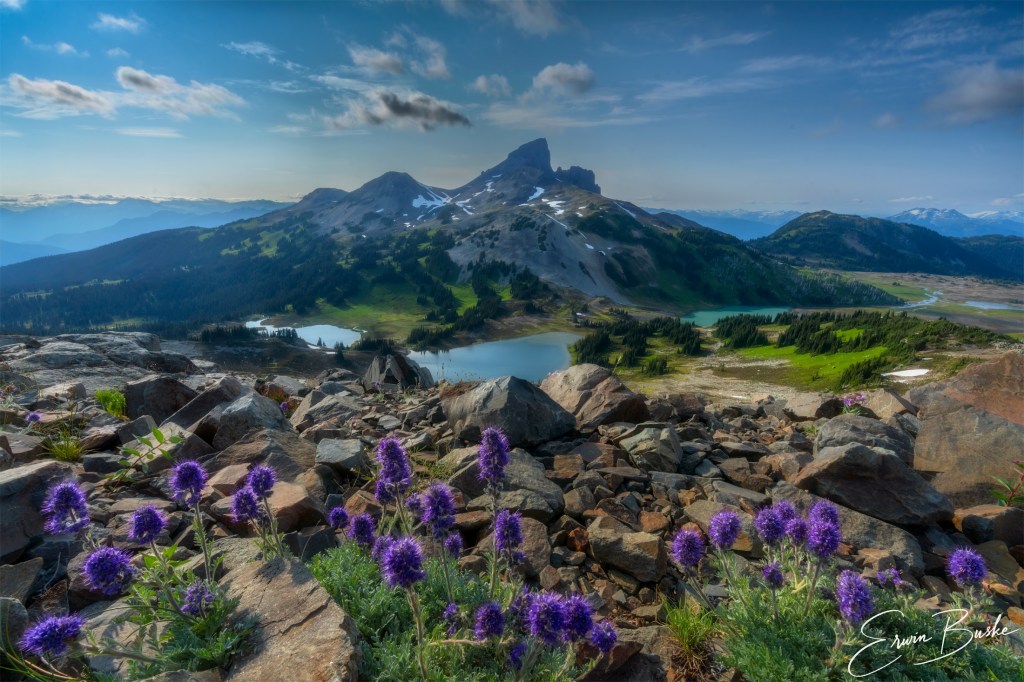
After descending part way from Panorama Ridge, I began looking for some beautiful pin cushion like purple flowers I saw on the way up. I overshot where they were located by quite a bit, and started going back up the mountain to find them. Several people asked me what I was doing going back up again, but once I told them I was looking for the elusive flowers they seemed to understand even though a few shook their heads. I eventually found them and made this the spot for both photography and dinner. To my surprise I left my stove at base camp so prepared a cold Mountain House dinner. Not the best but it was dinner, LOL!

There were three bunches of purple flowers complementing three lakes underneath Black Tusk, hence the name Trifecta. There is also a trail going up Black Tusk for different views, a goal for my next trip to this area.

5. Walking by a Small Pond
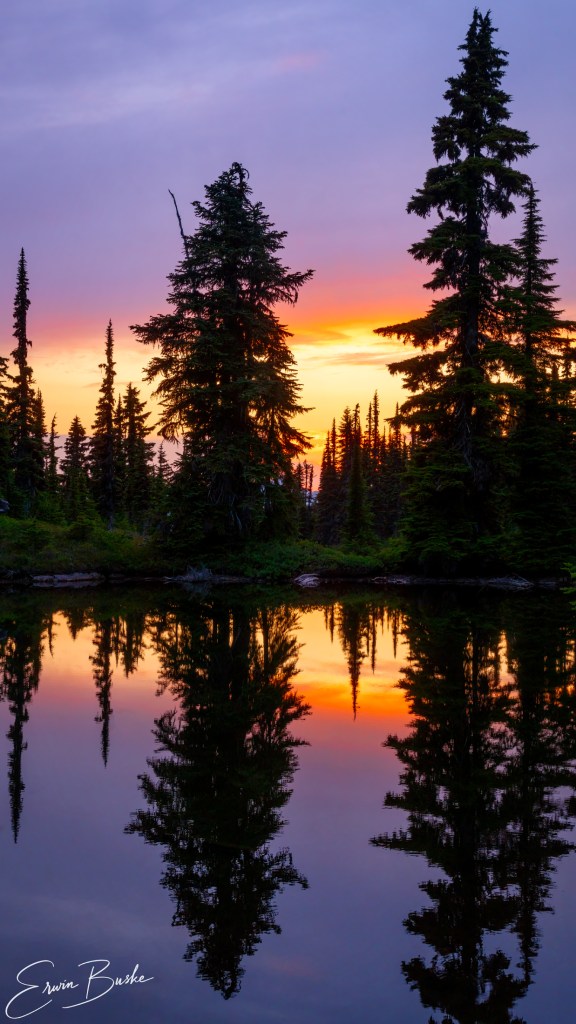
Although I originally intended to stay on top of Panorama Ridge until sunset, I decided that would not be the smartest thing to do as a solo hiker. Hiking back to camp I passed this small pond catching the last rays of light. It was a simple scene of trees and sunset light also reflected in the pond, but it filled me with a sense of joy and happiness

6. Nature is Our Home
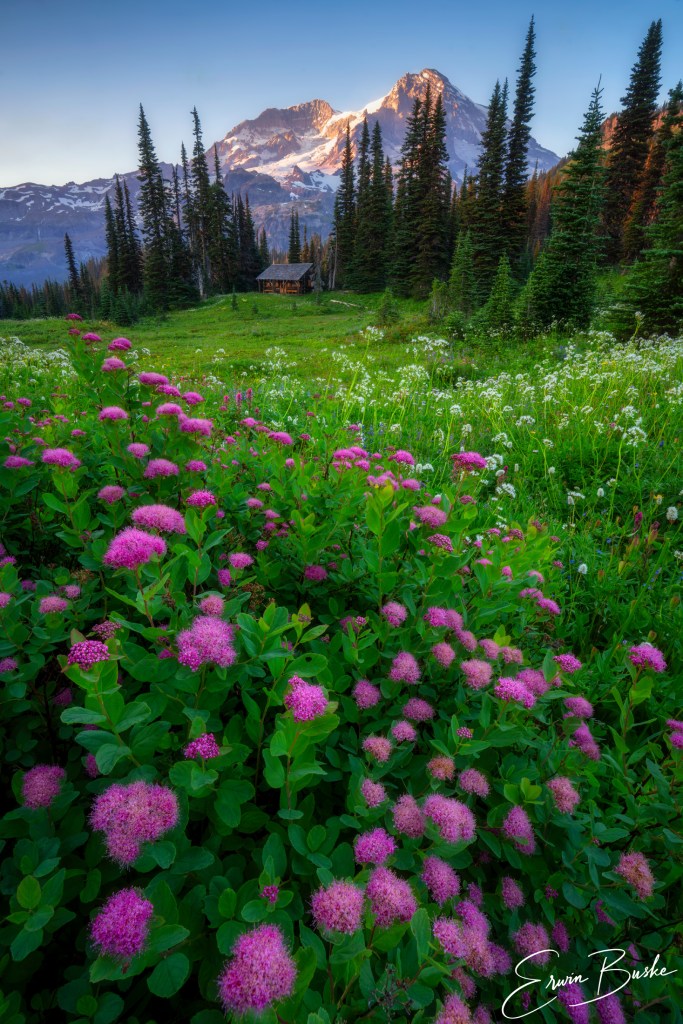
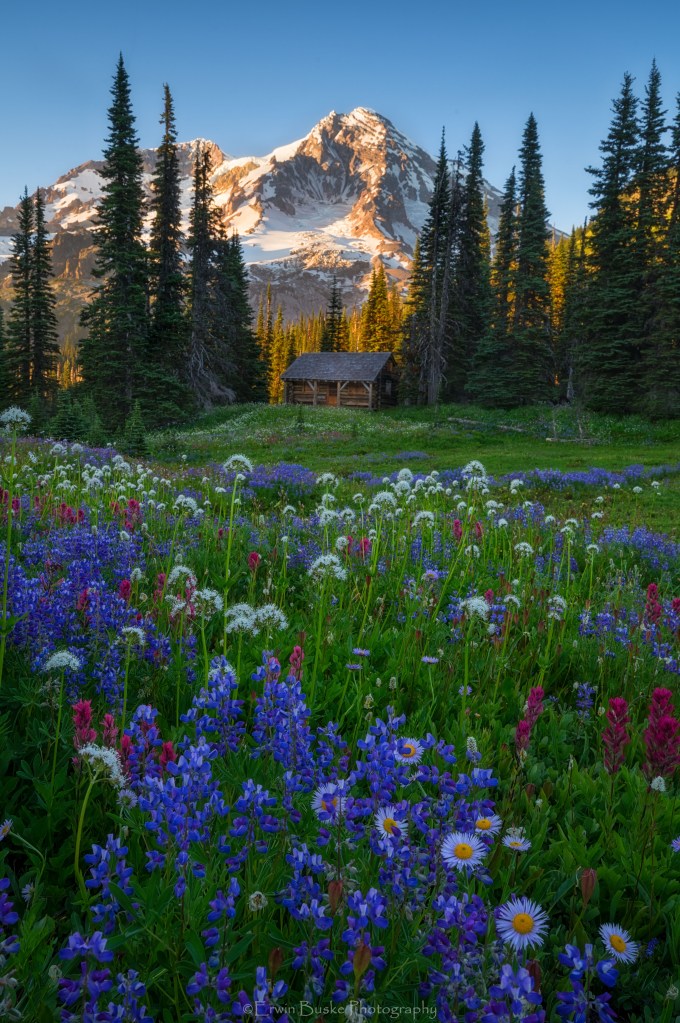
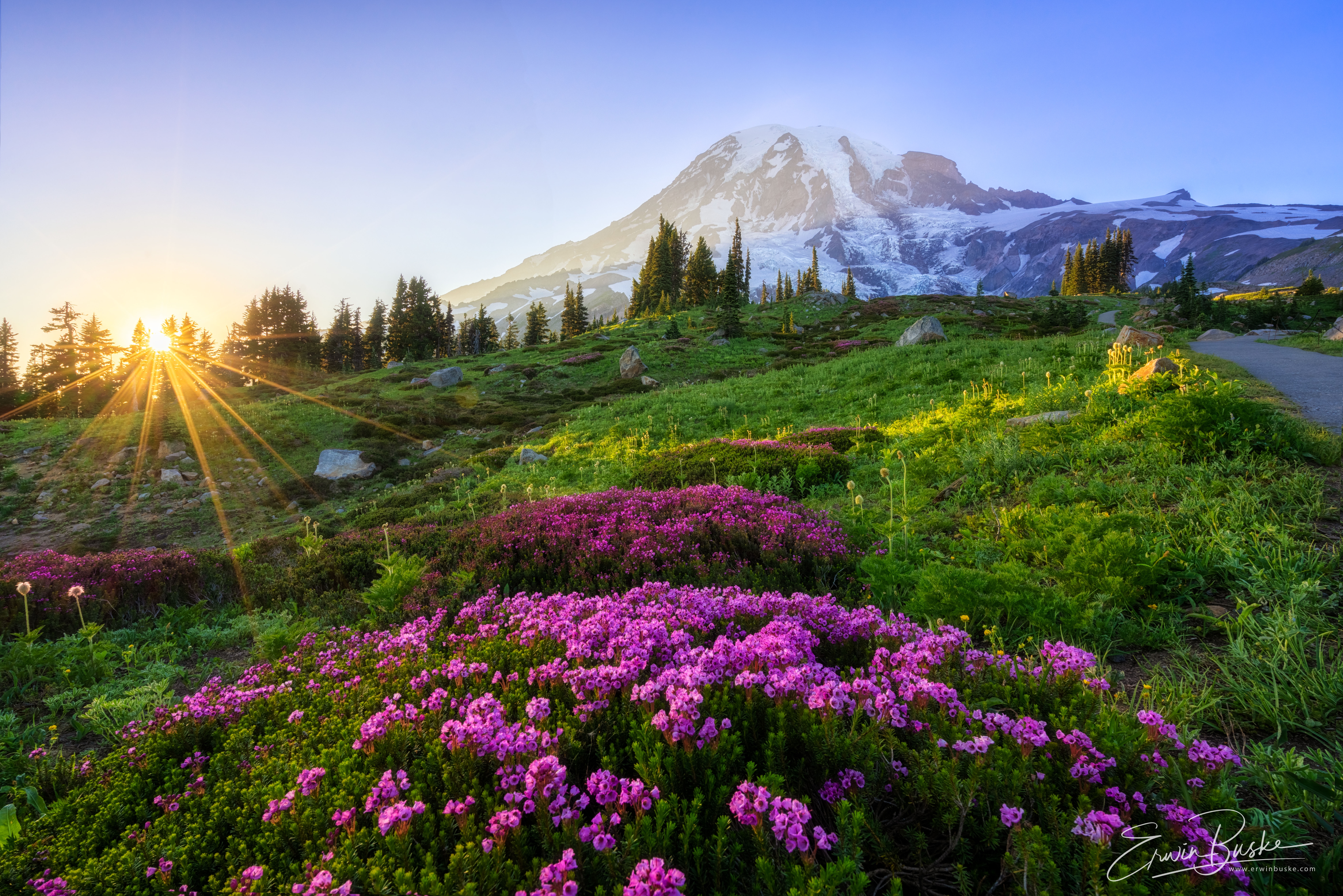
I have returned to these sacred grounds of Indian Henry’s now for three years in a row at about the same time. The cabin to me symbolizes what in our hearts and soul we all long for, a return to nature and our authentic selves. Our lives in a modern and industrialized world and an ever expanding digital age, often move us away from our roots. But Nature is in our DNA, just waiting for us to reconnect and return to who we truly are, Nature in Us, We in Nature, no separation. We long to return to our home. 

7. Quinault Rainforest Waterfall Magic
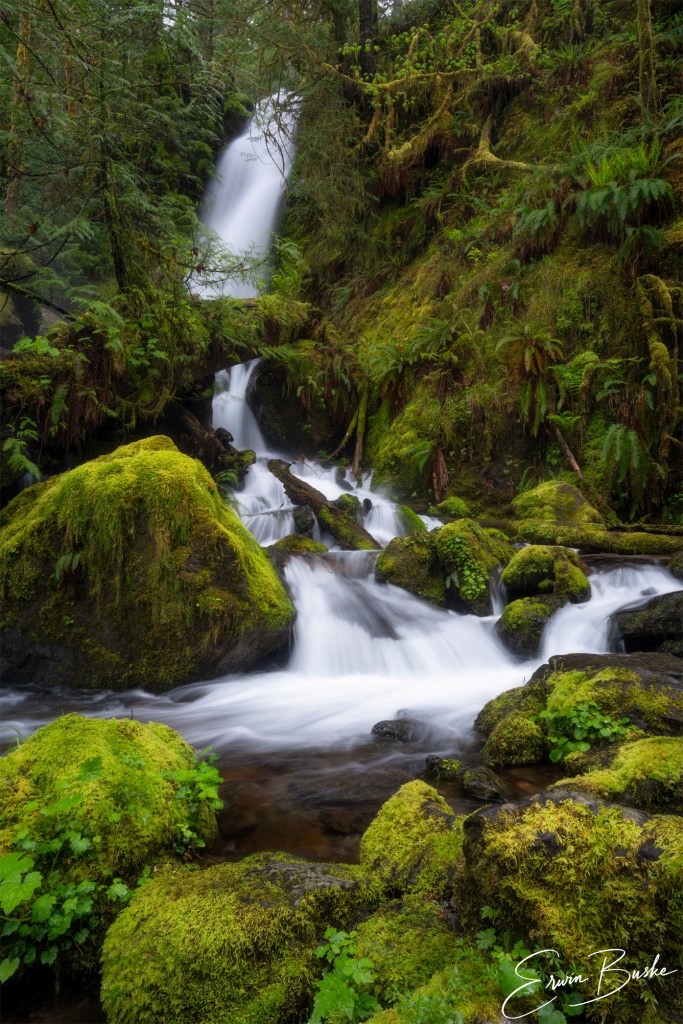
With the recent heavy rains of early Spring, this waterfall is flowing good, as this tributary stream makes its way down through the Rainforest to Quinault Lake and River.

8. Stepping Stones to Radiant Tide and Time
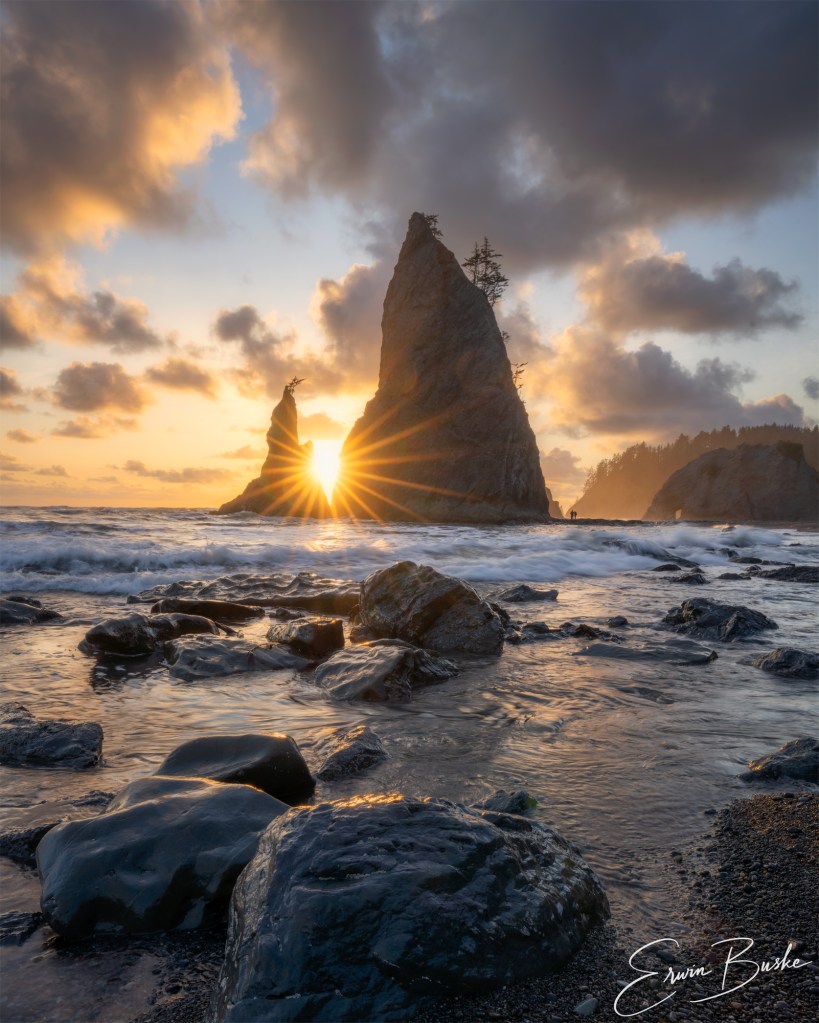
Step out onto the stones into the changing tide, and mark the time with each breath filling your soul with radiant beams of heavenly light. This is a scene from Rialto Beach, part of Olympic National Park.

9. Columbia Gorge Mountain Meadow Bouquet
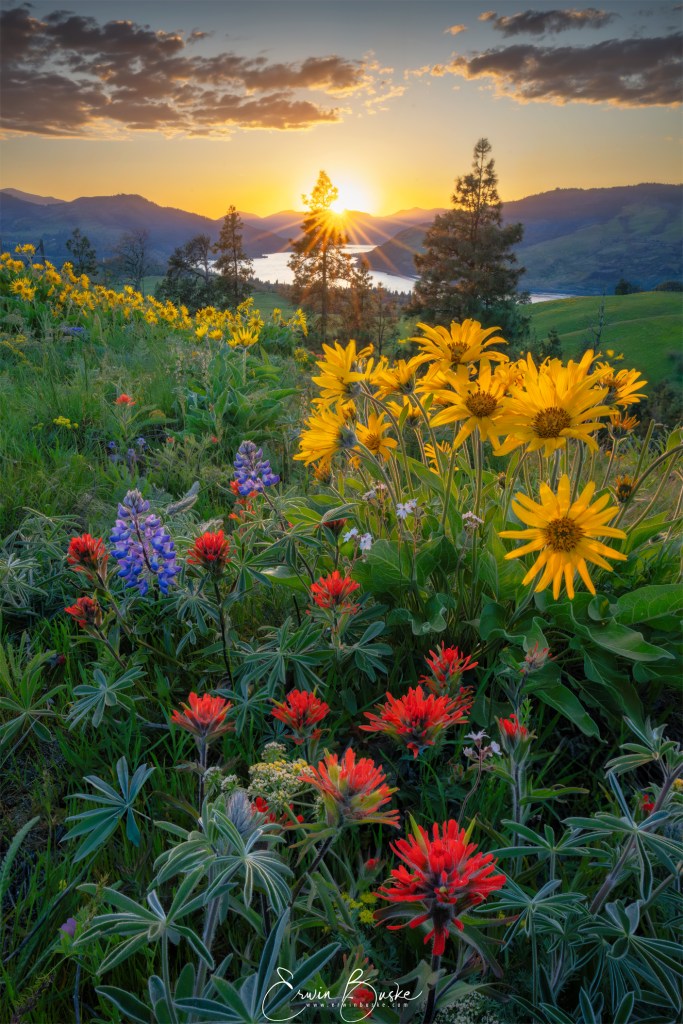
As much as I like a beautifully arranged bouquet from a good florist, there is nothing like the beauty and organic feel of a naturally arranged mountain meadow bouquet. The subtleties of color and texture, the grace of form sculpted by pervasive winds, the placement of the flowers, and even ever-present imperfections—all coalesce to reveal nature’s beauty at its best underneath the light of the setting sun.

10. Palouse Bird in Flight
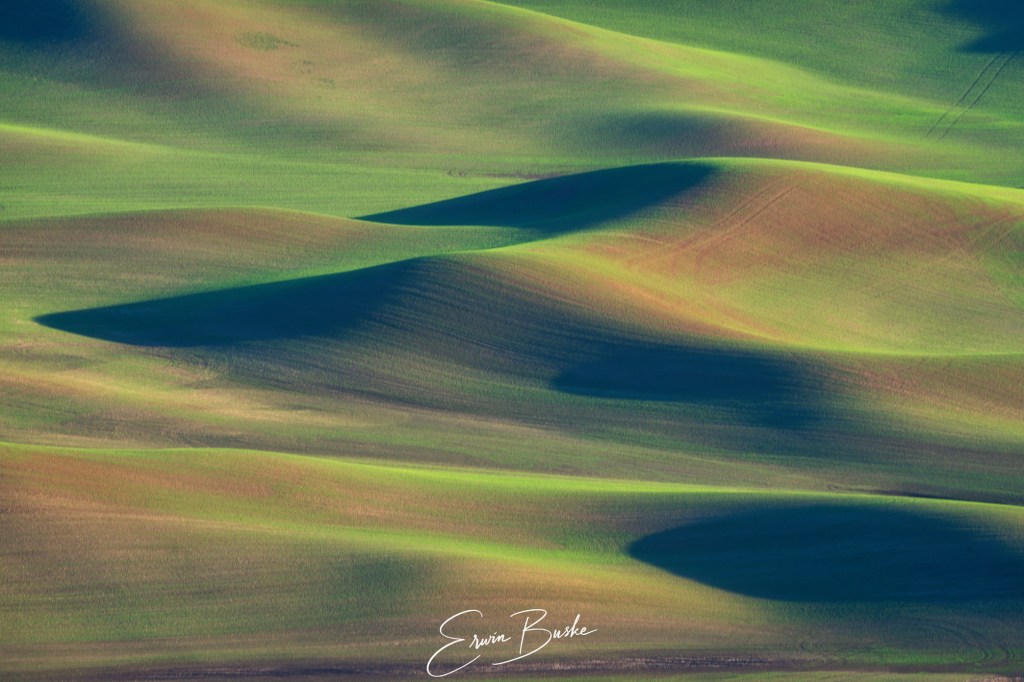
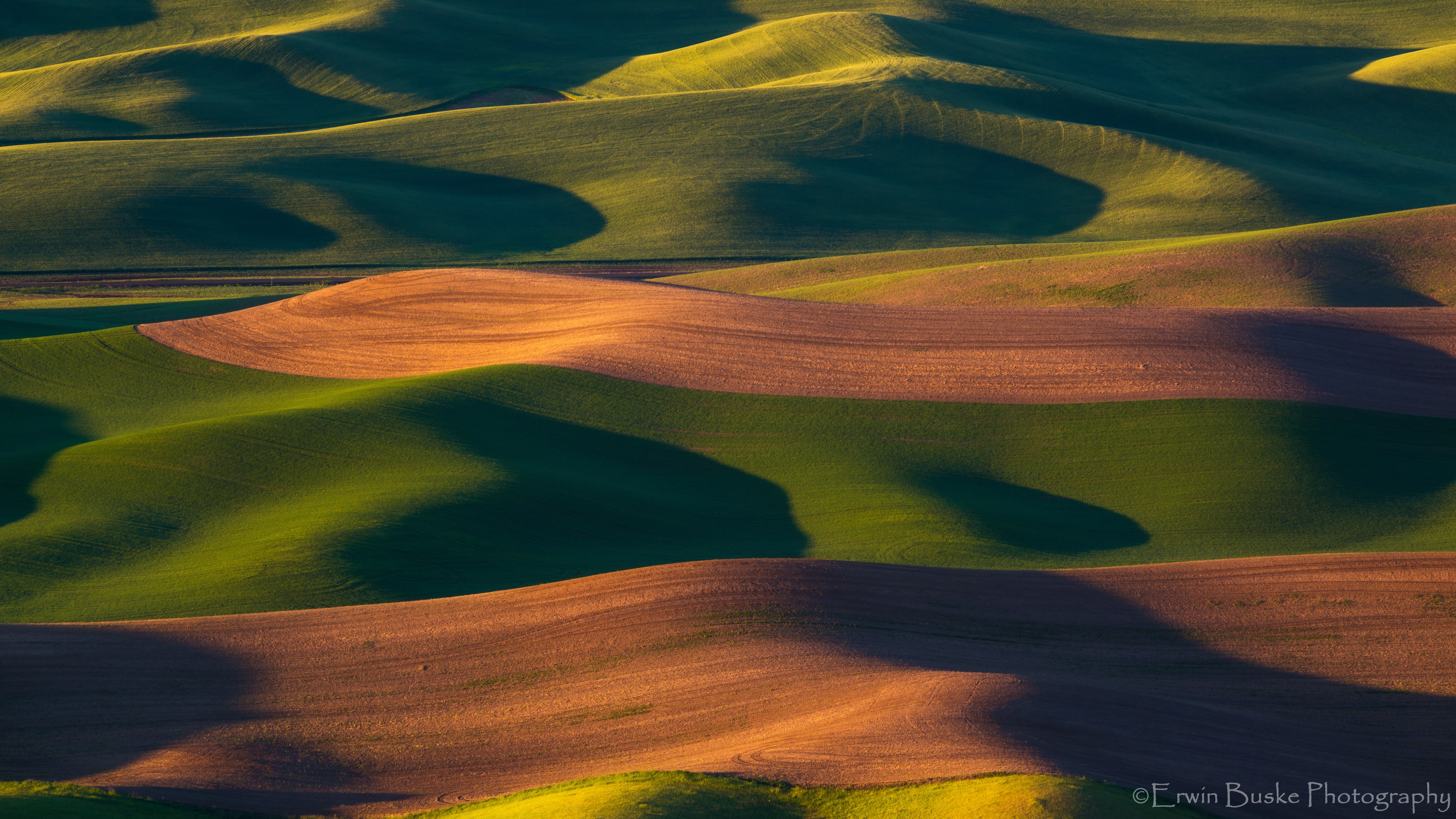
The dark shadows on the wheat fields, cast by evening clouds, reminded me of a large stealthy and jet like bird flying somewhere overhead.

11. Kamiak Butte Happy Trail
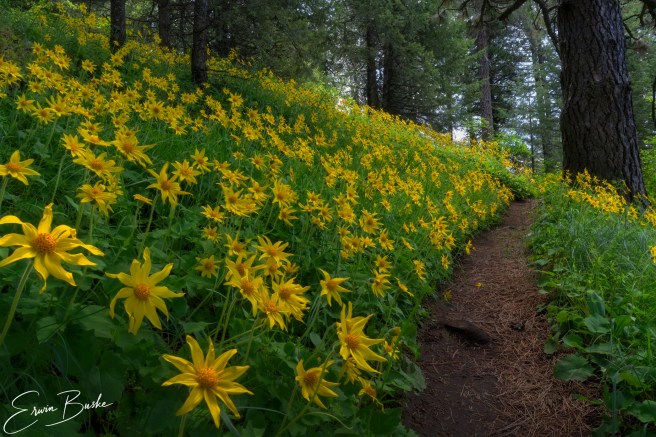
Although Steptoe Butte with its awesome views of wheat fields is a main attraction for many visiting the Palouse, there actually is another nearby Butte, Kamiak Butte. Unlike Steptoe, there is no road going to the top, and one must hike the Pine Ridge trail. There are similar views from the ridge as Steptoe Butte, but what I find even more interesting on this trip is walking through the forest, where I found the large colony of Arnica flowers. Like Balsam Root, these are also in the sunflower family, but they are much smaller than Balsam Root and grow in denser and tighter colonies often forming a carpet. Kamiak Butte provides us with a glimpse of what this area was like before most of it became cultivated for farm crops. It is a wildflower paradise that I visit every year between visits to the Palouse farmland, to exercise my legs with a hike and also enjoy its natural beauty. The park closes at 7PM so sunset photography is not possible with a daytrip, but still worth a visit.

12. Cannon Beach Trinity
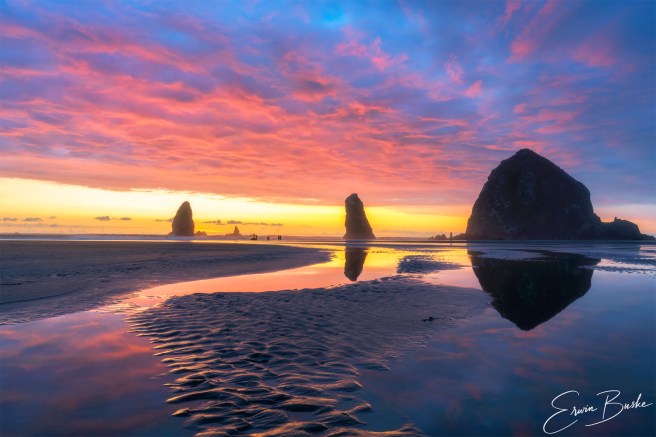
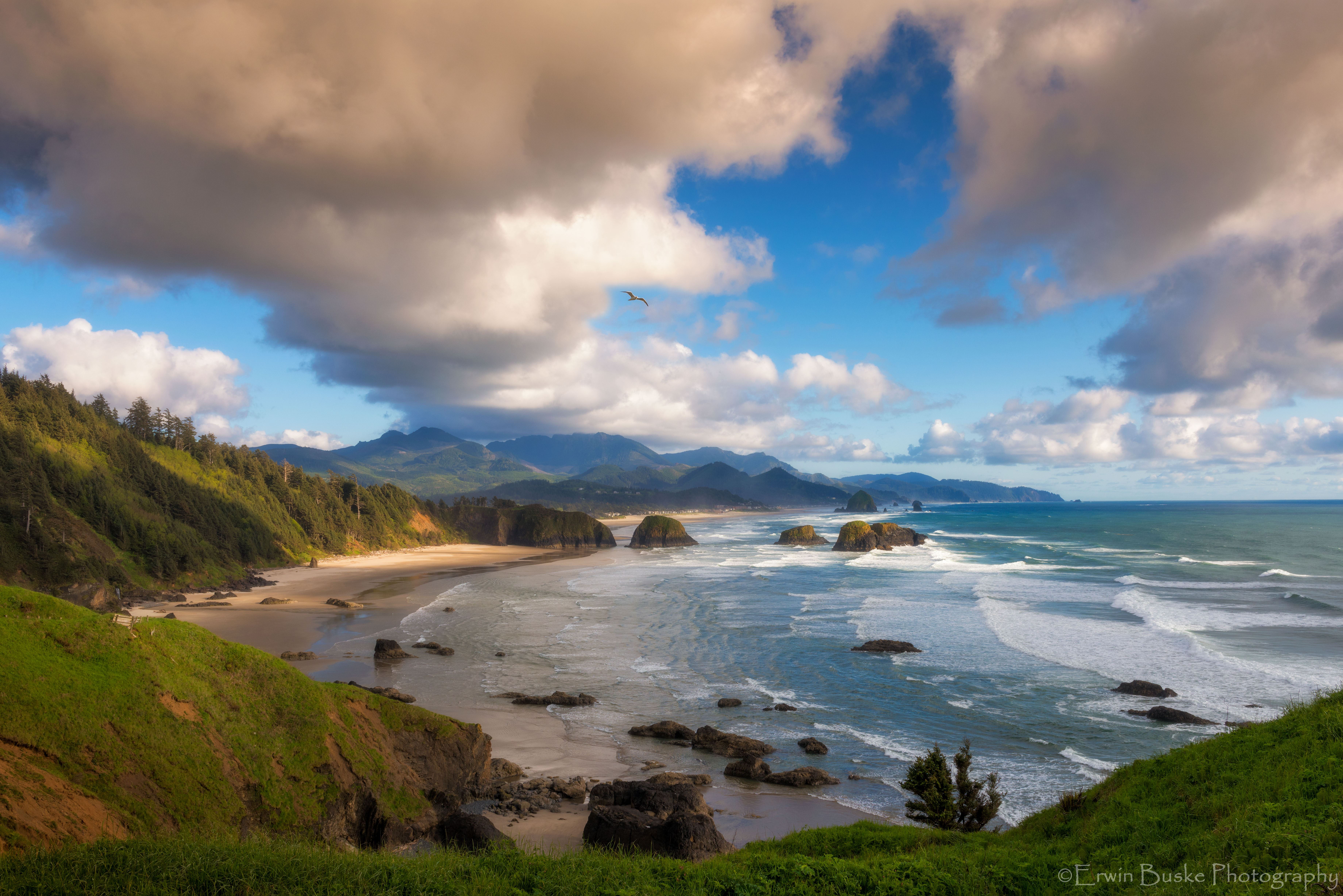
This was perhaps the most memorable sunset I have experienced at Cannon Beach. It was cloudy and rainy most of the day, but these conditions also helped clear the air and when the sun finally broke through there was magic. I usually avoid Cannon Beach due to the crowds, but I am a little more tolerant of people asserting their right to also enjoy the beauty of Mother Nature these days. I zapped several people out of this picture but kept a few toward the center in. They are admiring nature’s beauty also, and were part of the overall atmosphere and mood of this place on the occasion of this gorgeous sunset.

13. Groovin with the Beach Combers
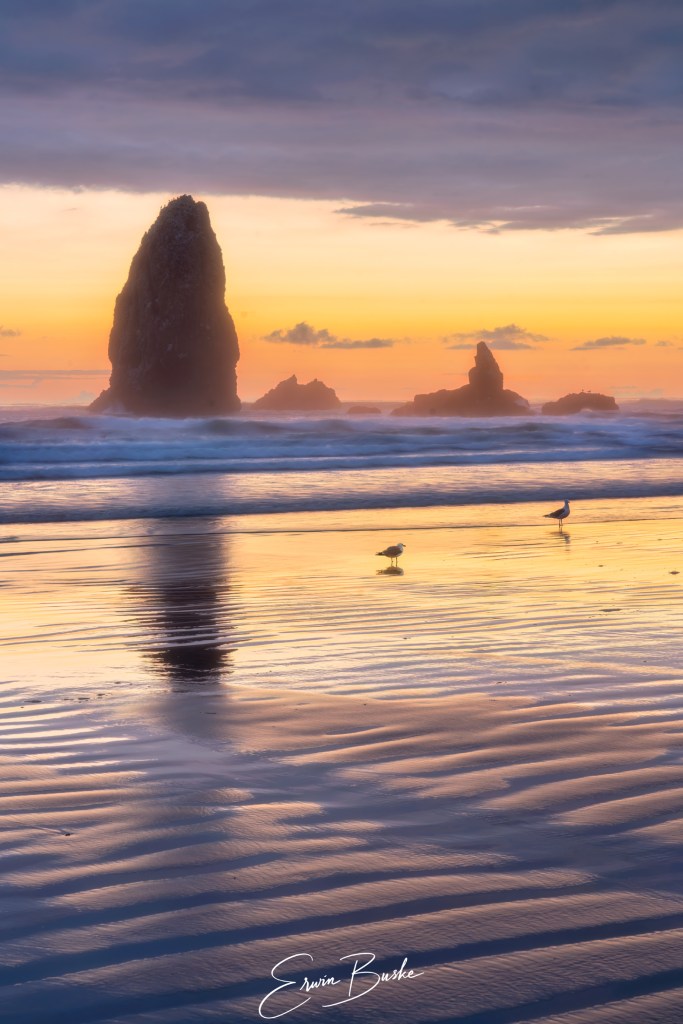
Lines and grooves form in the sand at sunset with the ebb and flow of the tide. A couple of Seagulls comb for their supper between the rolling of waves.

14. Glimpses of Light
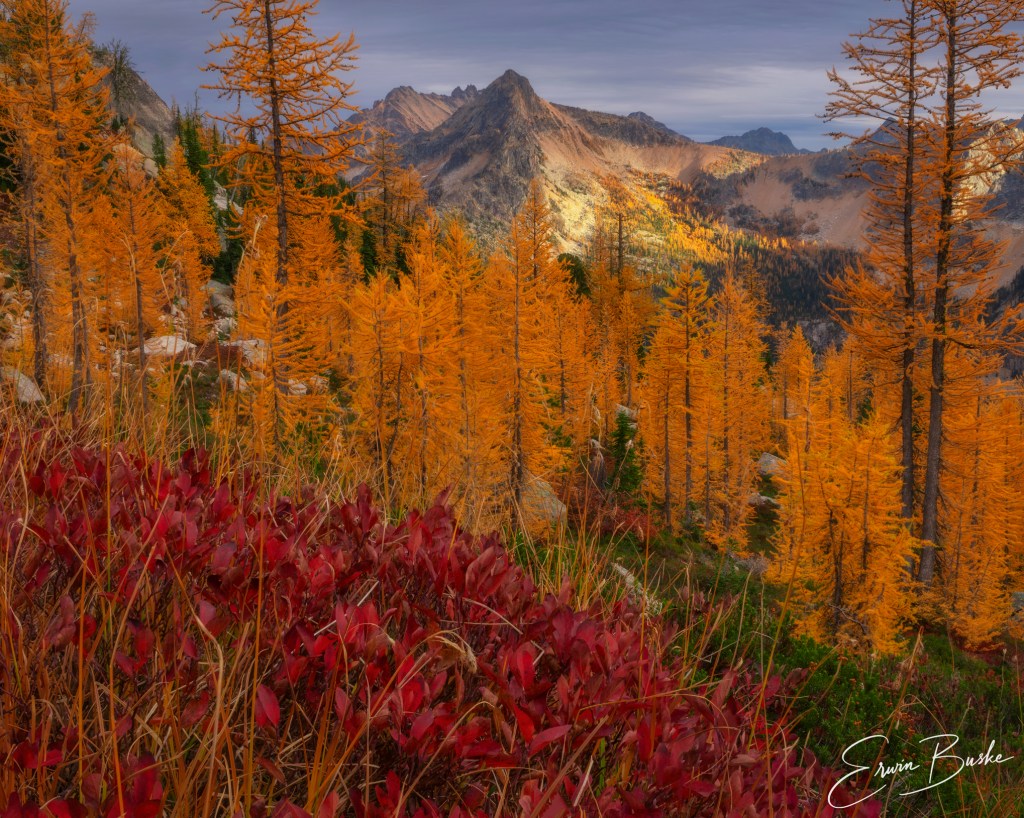
This is from a Mid-October mini road trip heading up to the North Cascades and out through Pateros, Tumwater Canyon and Stevens Pass. I hiked up to Cutthroat Pass from Cutthroat Lake staying until sunset. On the way up there were only a few people on the trail, a major contrast to what must of been a zoo at Heather Maple Pass where I passed a procession of cars about a mile long, LOL! I did not cut any throats up here, but I sure did cut a lot of digital images. I loved the color contrast in this scene and layers of beauty. It was primarily cloudy on this day, but for this shot a opening in the clouds provided some glimmers of light.

15. The Light and the Balance
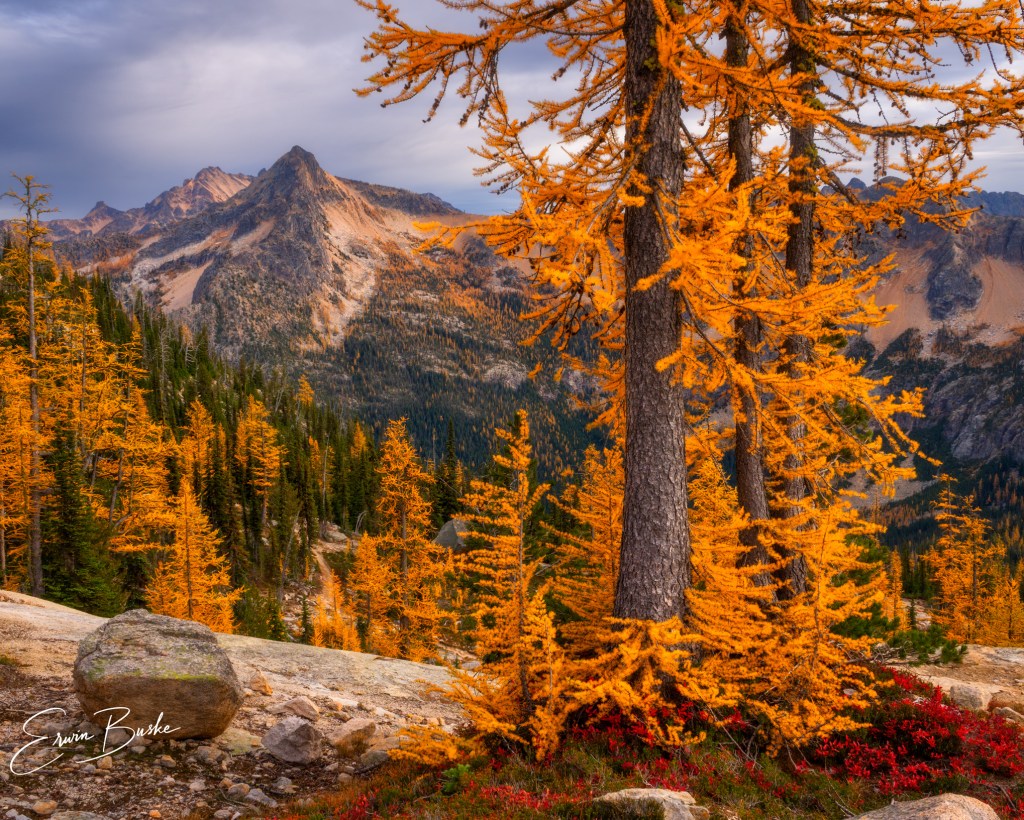
In this scene I loved the balance of the island of tall larches rimed by red huckleberries juxtaposed against a background of distant peaks with one being dominant. The evening light coming in through an opening in the clouds lit up the scene beautifully with the gray clouds acting as kind of a studio soft box to soften any harsh contrast. A few boulders in the foreground to me brought a sense completion to a simple array of elements fitting the essence of the Cutthroat Pass area.

16. Roadside Attraction
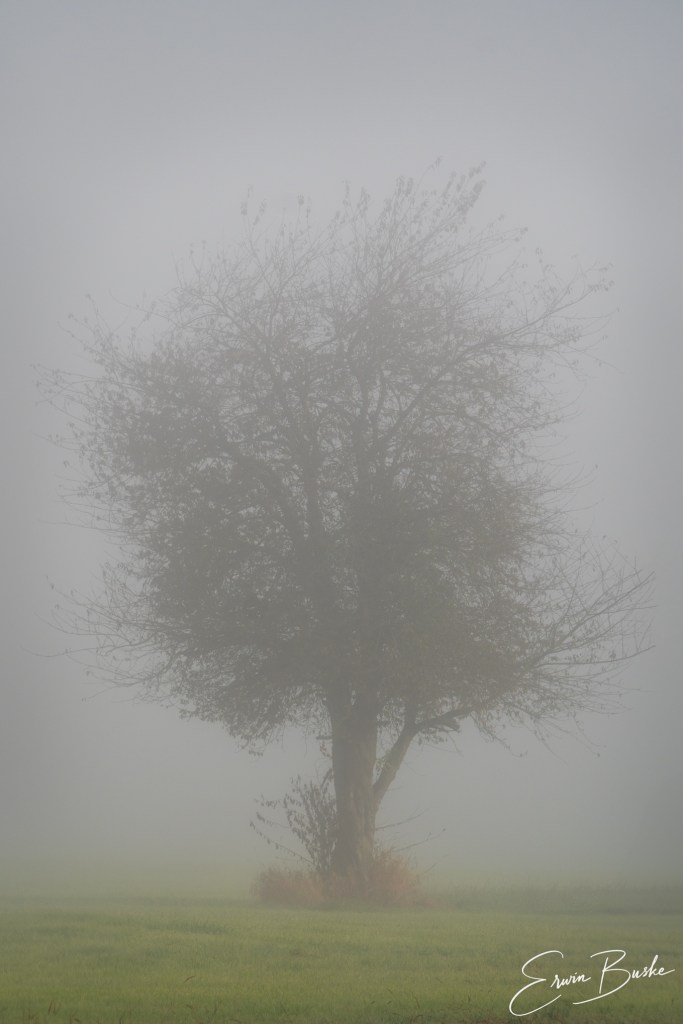
While getting gas on a foggy morning in Arlington I noticed this beautiful lone tree and grabbed my camera while the gas was pumping. Always keep your eyes open for picture opportunities, even in unlikely places.

17. Smooth Sumac
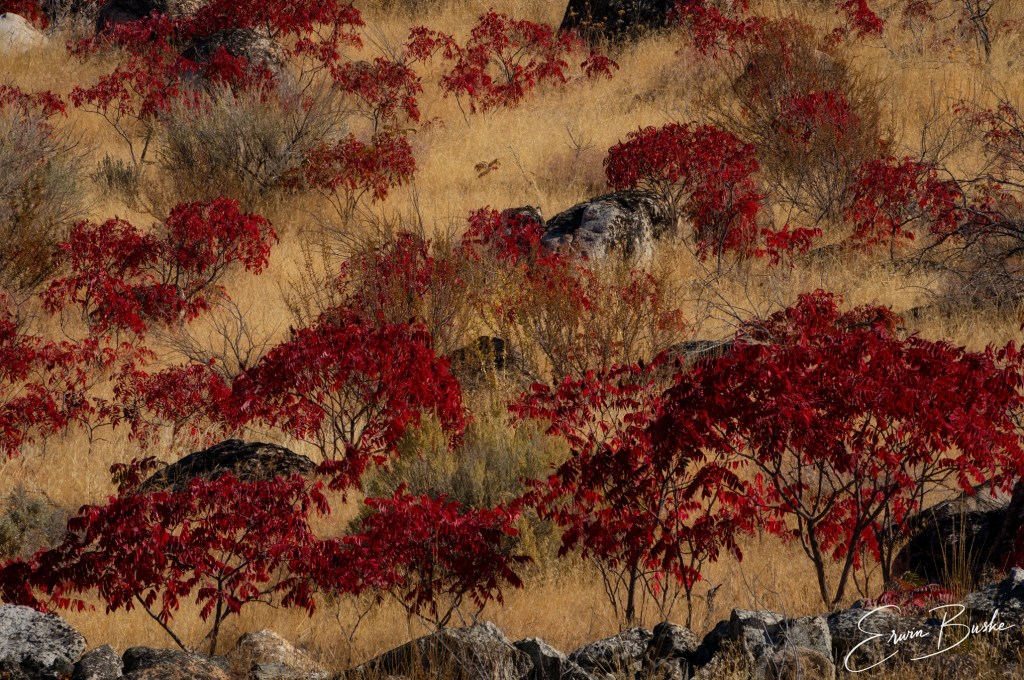
While driving from Twisp to Tumwater I passed through the sleepy town of Peteros along the Columba River. The last time I was here was years ago when we camped at my Brother’s then property close to town. I never noticed then these beautiful smooth sumac bushes that are apparently native to Eastern Washington. I used a telephoto perspective to create this pattern shot of the autumn sumacs now dressed in red dotting the grasslands just outside of Peteros.

18. Sun Setting through an Aspen Grove
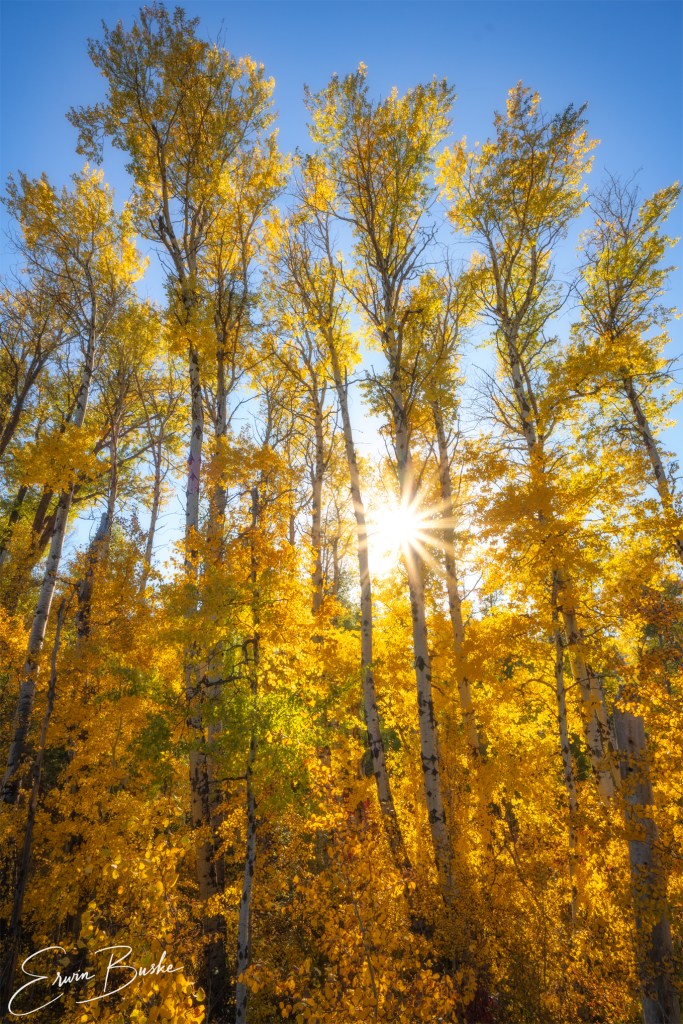
On my Mid-October two-day road trip I also visited the Tumwater Canyon close to Leavenworth, pulling over at a few lesser known spots where there were no cars, also looking for lesser known views. This Aspen Grove caught my eye as the sun was setting, and I quickly abandoned my initial idea for a composition in favor of this beautiful moment in time. Good photography is mainly about showing people our world, both the iconic and the lesser known, in ways they have not seen before.

19. Ribbons of Red Huckleberry Bushes
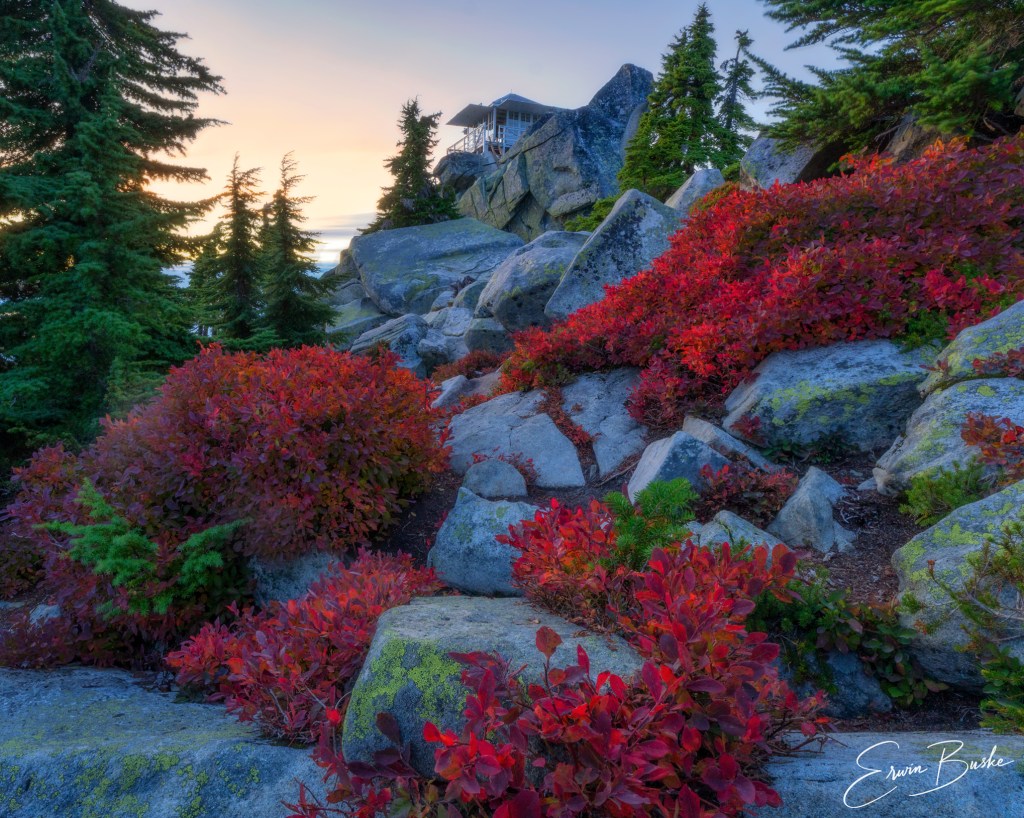
In late September, I took a wonderful exploratory sunset hike with friend Sun to Pilchuck, arriving at the top about a half hour before sunset. Having left from Bellevue about 2:45 PM this was the best we could do with the traffic and of course mandatory stops to take pictures! Neither of us are go straight to the top without stopping kind of hikers LOL! I do not fully comprehend why I have never been here before, but I definitely having been missing out on a mesmerizingly beautiful place that warrants many future visits! The Fall Color toward the top was especially beautiful, which we stumbled upon through taking a wrong boulder path. Wrong turns can sometimes deliver the best results! Its called Pilchuck, but a better name might have been Boulder Mountain, as this mountain is pretty much made of boulders including those that are synonymous with the trail!

20. Mossy Rhododendron of the Olympic Forest
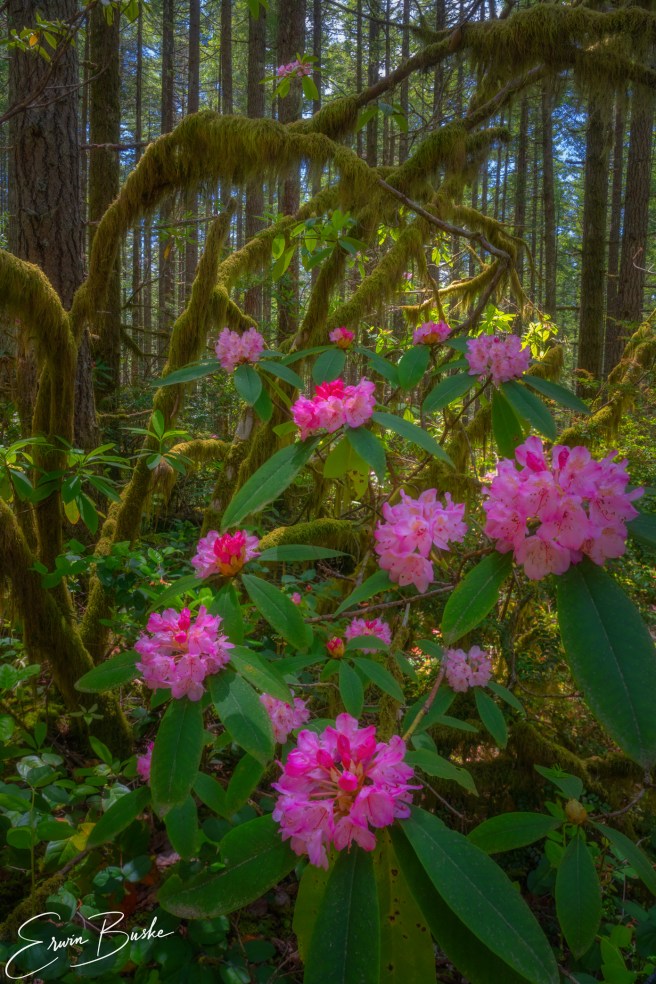
In June, I did some exploration in some new to me areas around Belfair on the Olympic Peninsula. The wild Rhododendrons in the foothills of this region were at this time close to full bloom. After visiting the Redwood and Oregon Rhododendrons, I have come to the conclusion that there are actually more and wider spread wild Rhododendrons here in Washington than either of those two states. The biggest difference is that many of the Rhododendron regions in Washington are in areas of second growth timber, but the trees are getting bigger with each passing year! The fog is less frequent in the Washington areas also. Nevertheless, I found this particular Rhododendron very beautiful in the dappled sunlight filtering through the forest, also casting light on the flowers and moss.

21. Lone Bunchberry Among the Oak Ferns

In June I explored for my first time the Lower Quilcene River on the Olympic Peninsula close to the Hood Canal. This is not a area for finding grand landscapes (sans Mt. Walker), but there is a lot of hidden and uncommon beauty for those who are willing to to take the time to slow down and explore. Rhododendrons can be found here and there along the river, but on this day this was my most interesting discovery, a Lone Bunchberry Among the Oak Ferns.
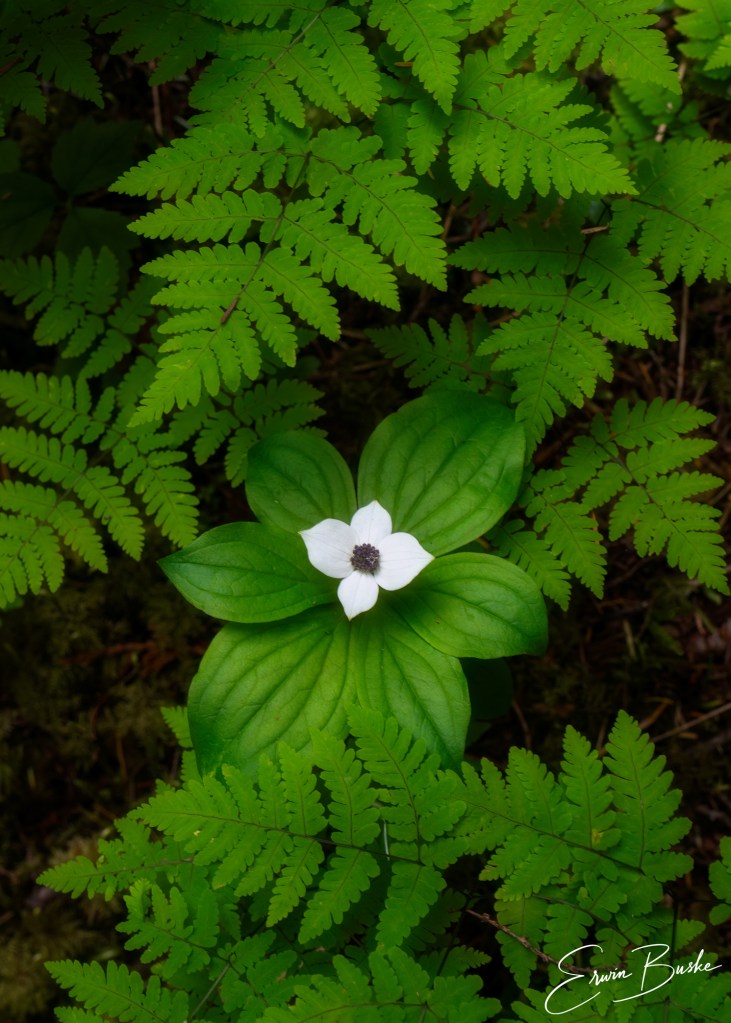
Need to say something

22. Granite Lakes Welcoming Winter
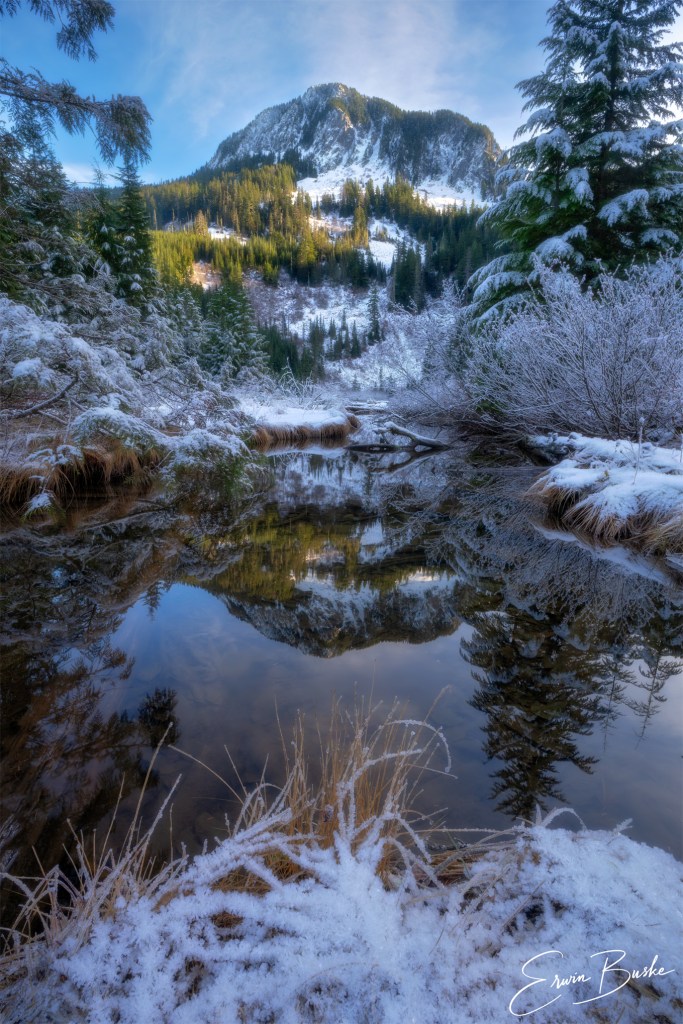
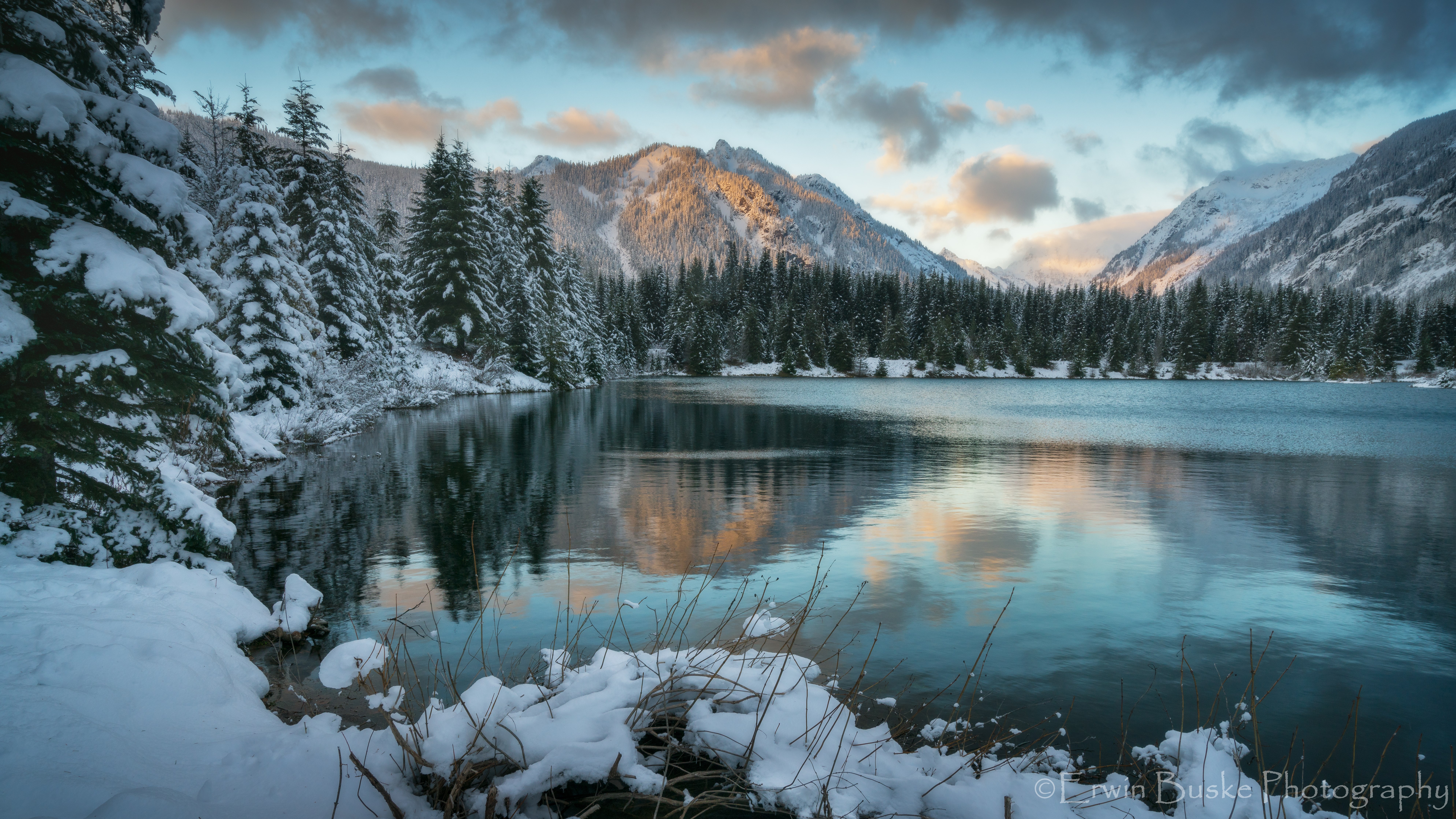
In early December, I took a wonderful hike to Granite Lakes welcoming the arrival of Winter. It was still Early Winter with beautiful reflections at the outlet of the lake. I enjoyed the peaceful calm feeling of this Winter setting. The lake itself was already frozen over. It was cold at the lake but with all this beauty I did not notice it until about an hour later when I found it difficult to operate the camera any longer and hiked out.

23. Calm Before the Cyclone
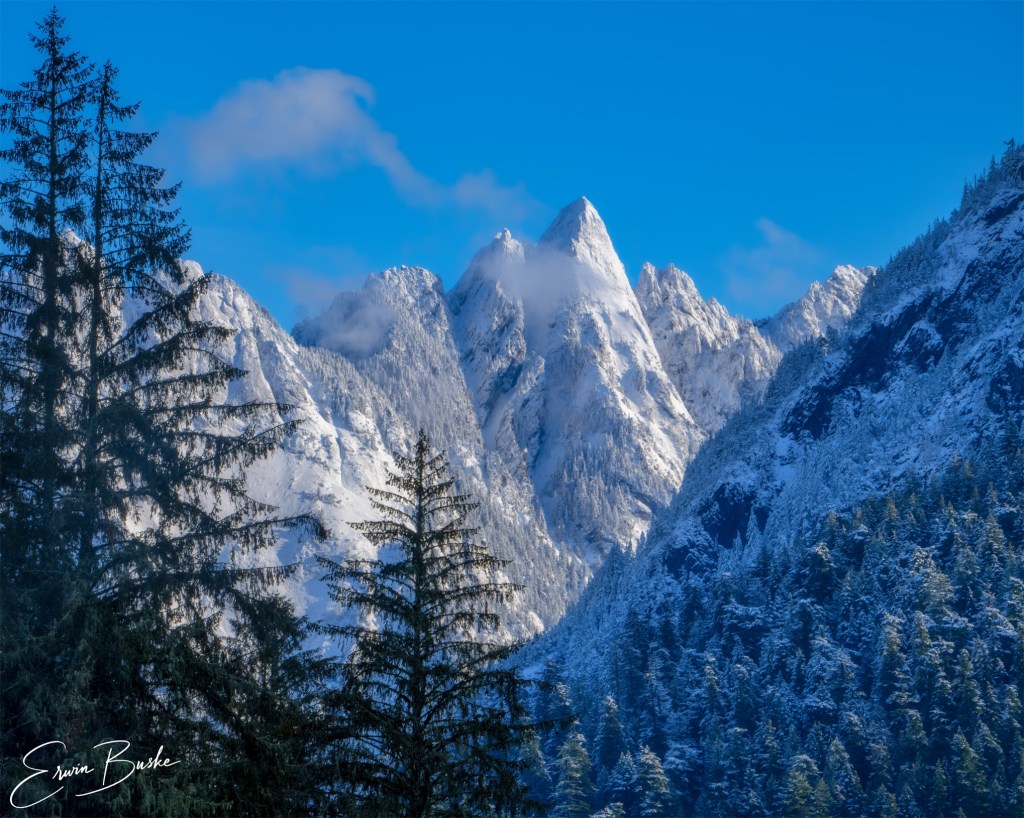
Heavy winds were in the forecast for this area later on this today, some describing it as an approaching “bomb cyclone”. But standing at this spot this morning at the Middle Fork looking out to Mt. Garfield, all seemed quiet and peaceful with only the freshly fallen snow signaling Winter’s approach.

24. Finding Riverside Peace
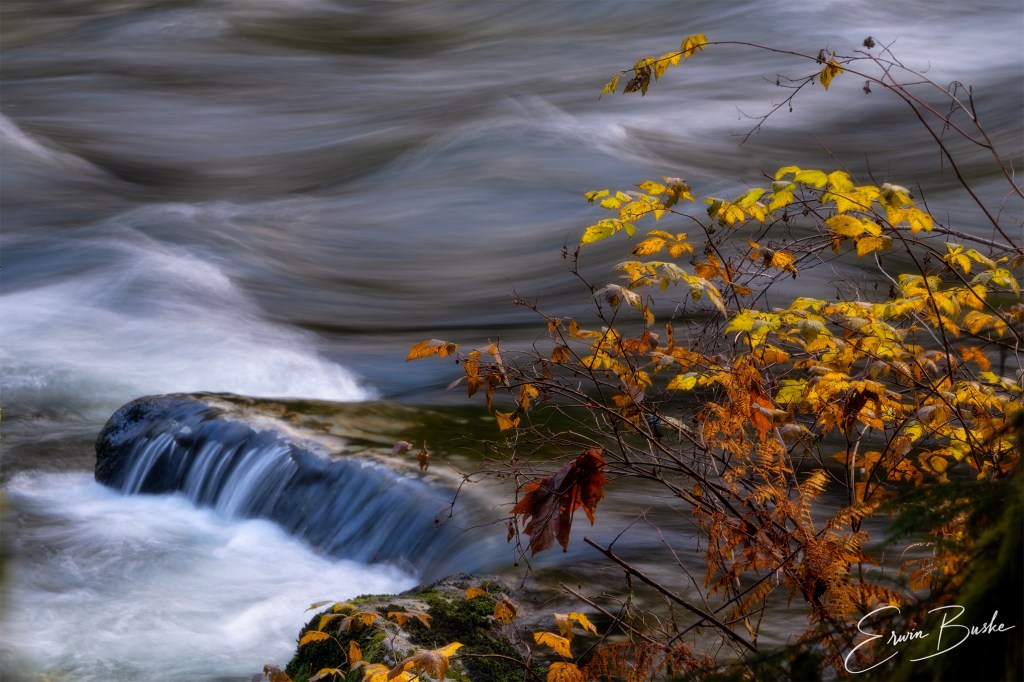
This is a glimpse, a snippet, of the beauty I found hiking up the Middle Fork of the Snoqualmie River on a Mid-November day. On this day I just used one lens, my Sony 70-350 telephoto mounted to my ultralight Sony APS A6700 camera, this results in a lens that is about a 105-525mm Full Frame Equivalent. Using just one lens is an excellent way to tap into inspiration to see the world differently, focusing more on small area scenes. This also plays well with the Middle Fork trail where grand landscapes are far and few between, as most of the time we are looking at smaller sections of the forest and river.

25. Middle Fork Mystical Morning
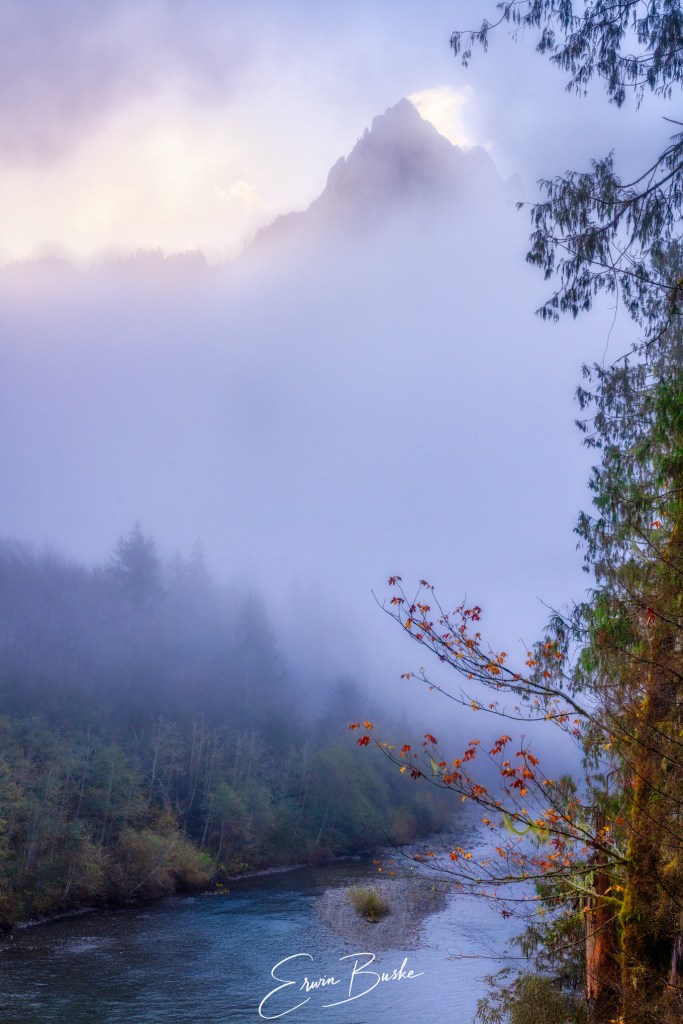
Here is an impression, and a flash of perception while heading up and down the Middle Fork of the Snoqualmie River in Mid-October. The day started out with beautiful fog gradually rising. The allowed the sun to come in and light up some of the autumn hues.

26. Comfortably Lost in the Middle Fork Forest
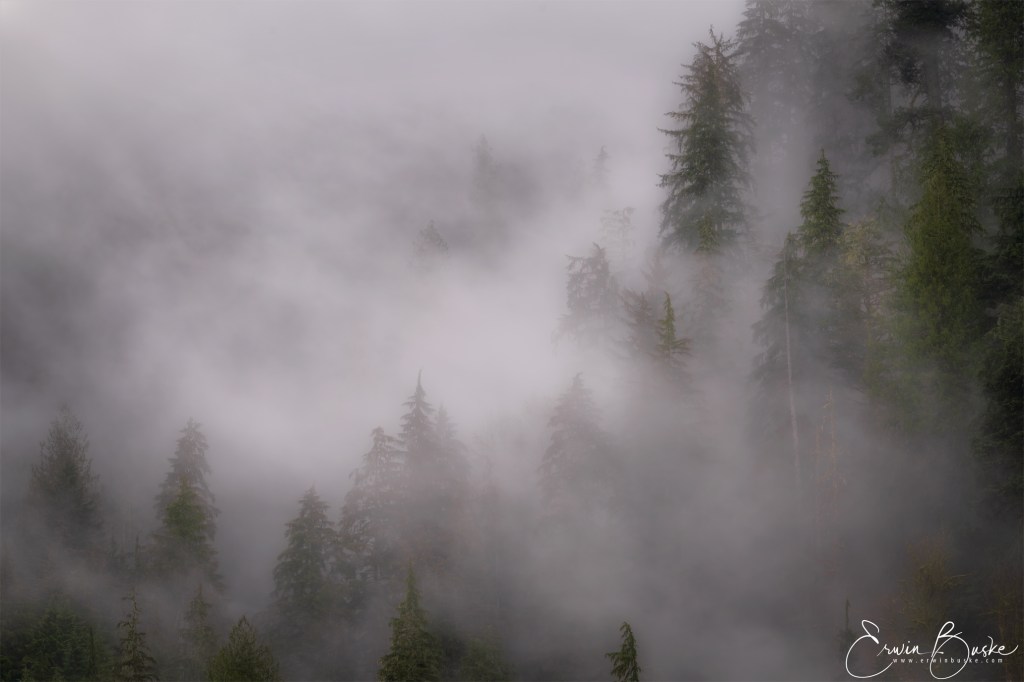
The Middle Fork of the Snoqualmie River is beautiful area not far from Seattle that includes a wild river surrounded by rain forest and steep partially forested peaks with craggy outcrops and granite cliffs. Moss, fog, mist, and mystical moods are abundant in this area especially in Winter.

27. Forest Pond Mossy Stones
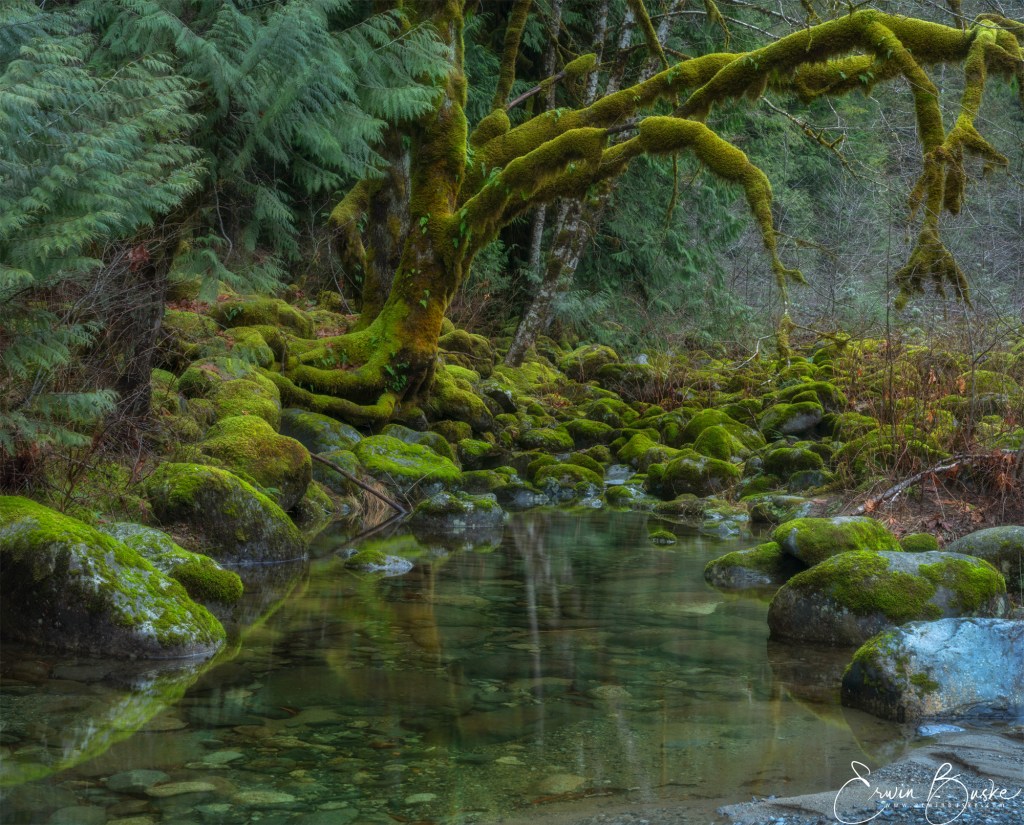
While hiking through the Middle Fork forest I came upon this small pond surround by lush mossy stones. To me, although not grandiose in its beauty, it was such beautiful sight to behold on a mid Winter day.

28. Middle Fork Touch of Autumn
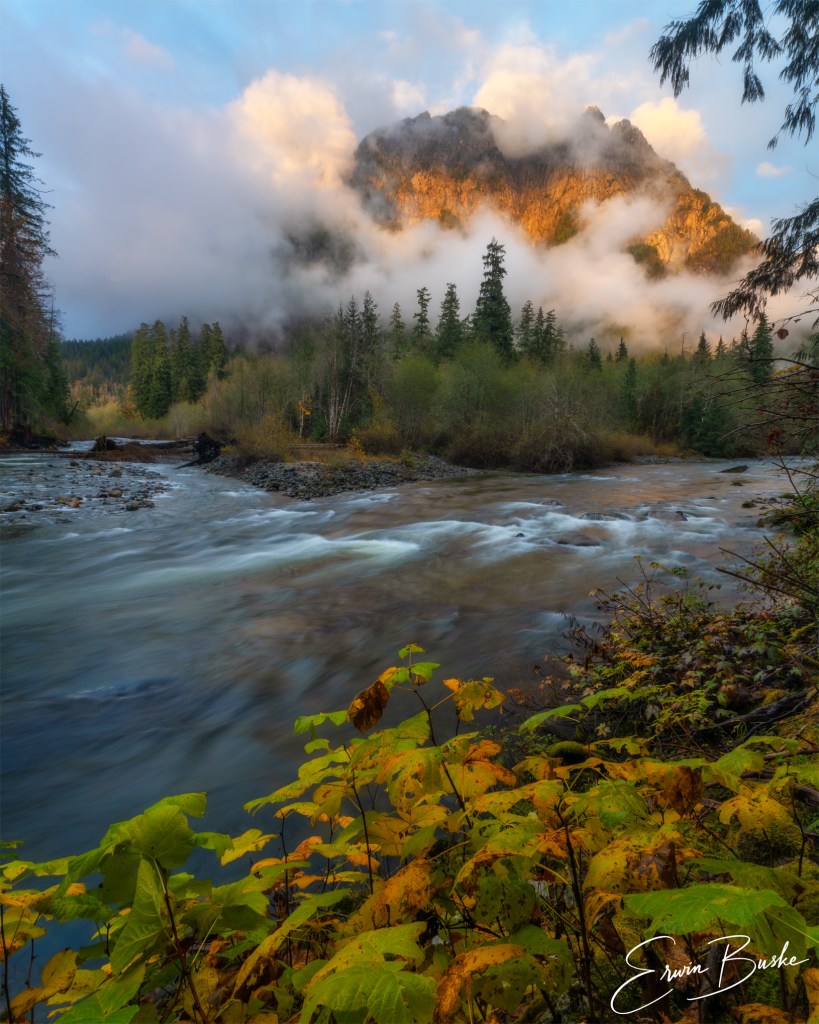
Yesterday after her work, hiking buddy Kim and I headed down the Middle Fork passing touches of Fall Color, glimpses of bare trees signaling Winter’s approach and plenty of mushrooms. We ended up back at the confluence of the Taylor and Middle Fork of the Snoqualmie Rivers (and the car) close to sunset where this shot was taken. Garfield Mountain, the largest in the area, rises above the confluence at this point and had some beautiful mood and atmosphere mixed with the golden light of the setting sun.

29. Cherry Blossom Lane
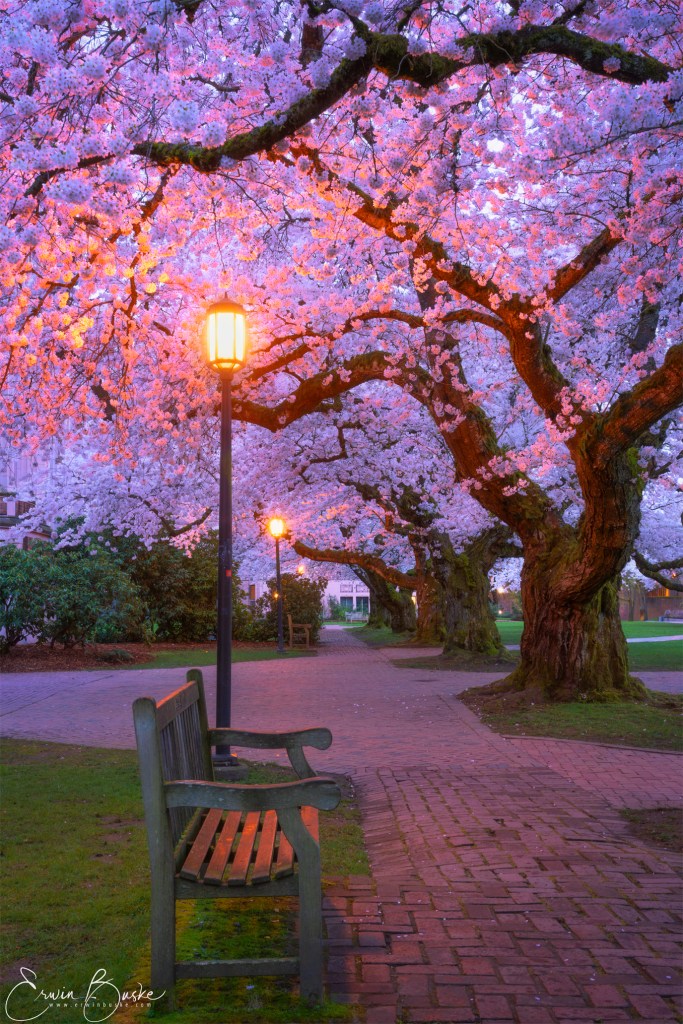
It was a peaceful morning at the UW quad today, that is until—-
Some dude started walking in zig zags with sporting his new undersized T-Rex outfit (do people really want to see this LOL!), and the garden crew pulled in with multiple trucks and vehicles to do lawn maintenance (I forgive them!), and also the fairy princess started waiving her magic wand and sprinkling fairy dust! Oh well at least I got a few shots in and returned the next day to a much quieter place.

30. Harvest Time
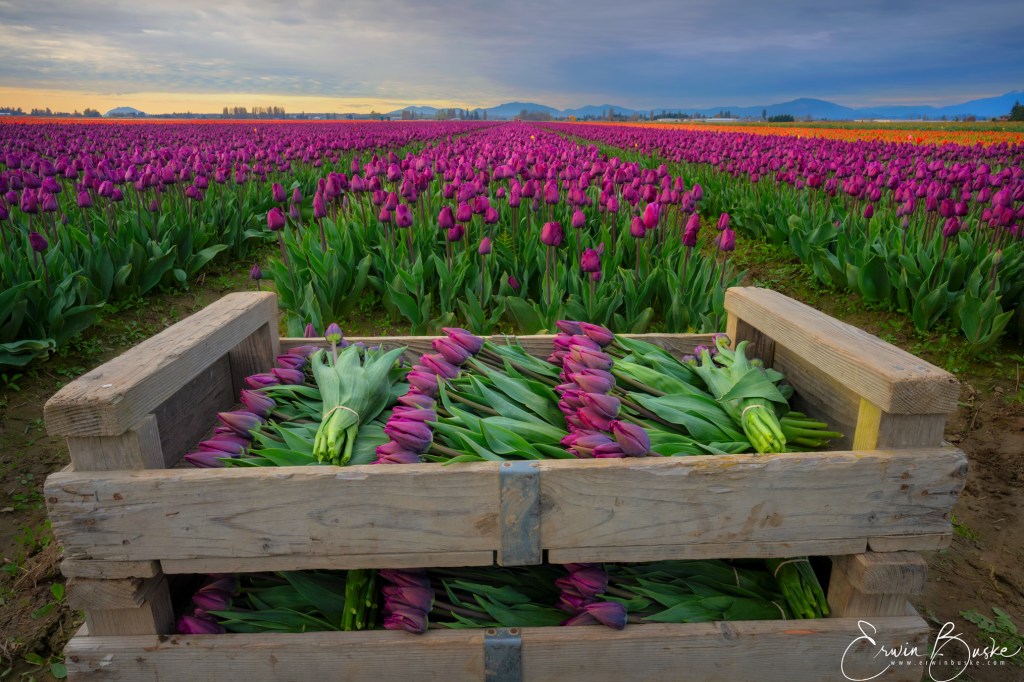
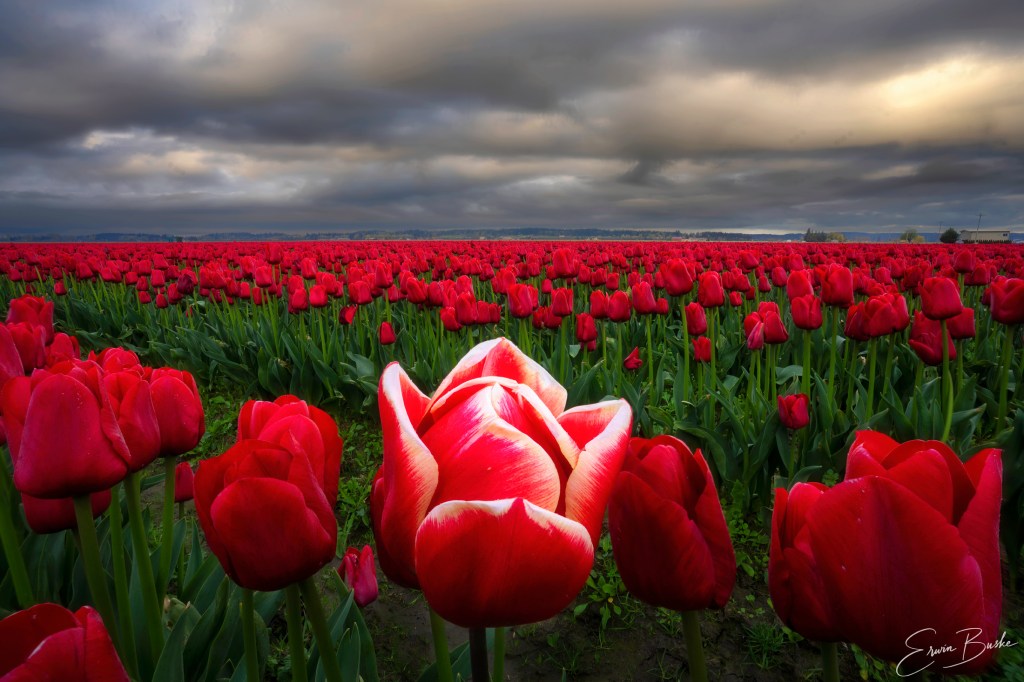

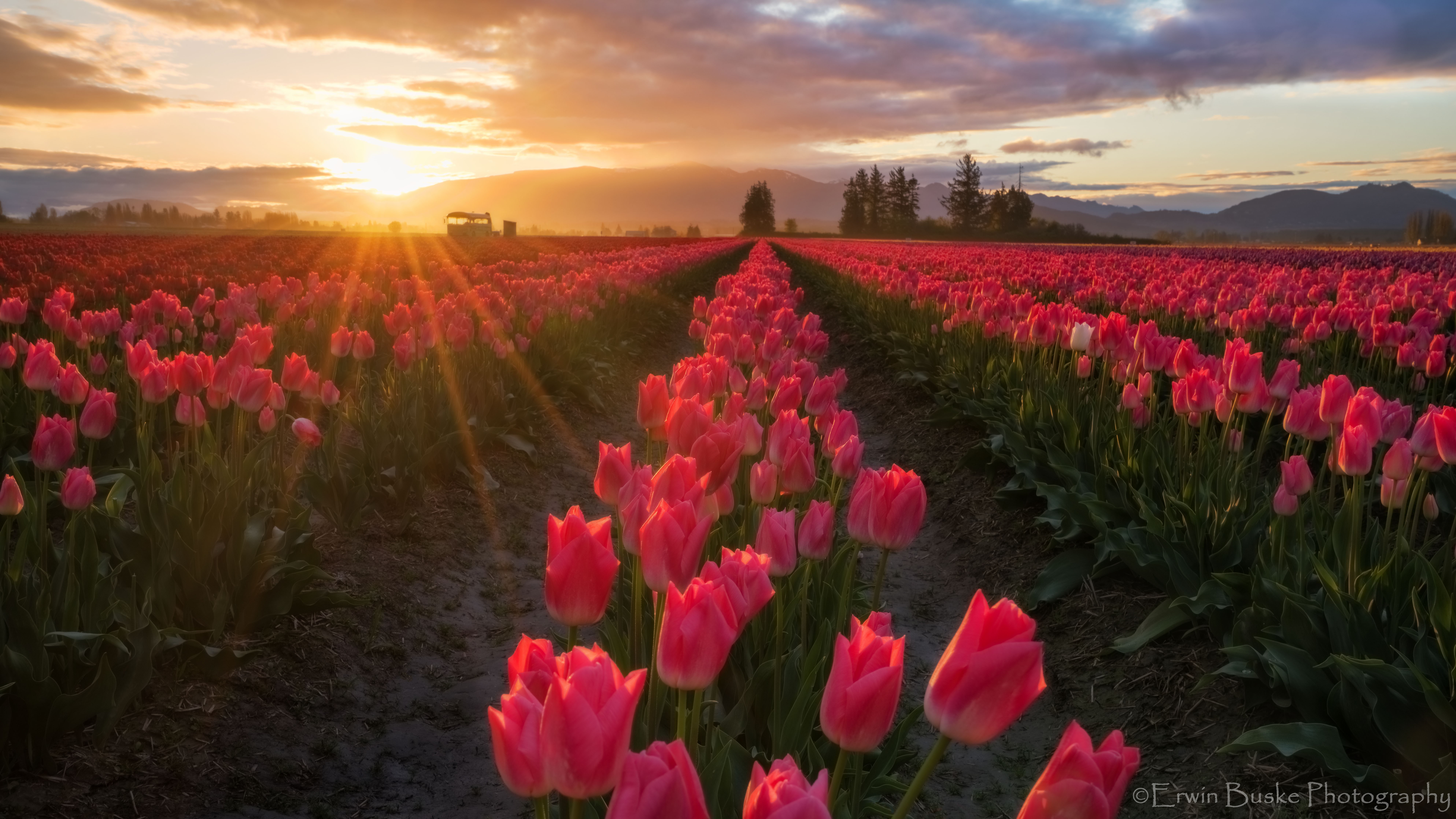
These Skagit Valley Tulip Fields are not just here for our enjoyment, they are functional farms. Here tulips are cut and collected in flats eventually to make their way into markets where people can purchase to bring some beauty into their homes.

31. Rainy Day Walk in the Garden
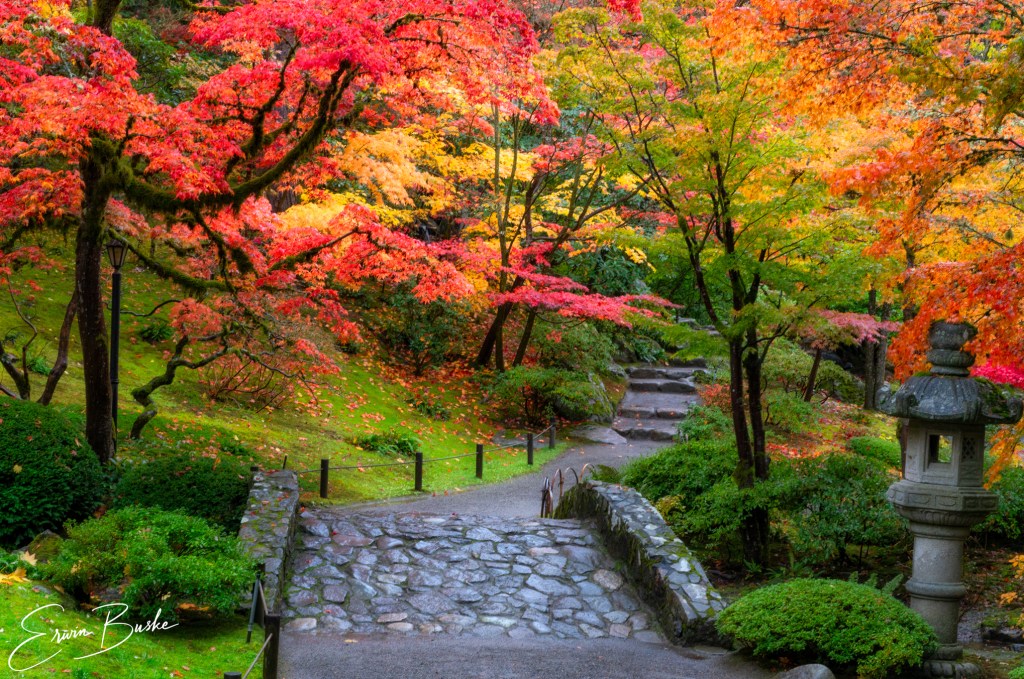
On a rainy day in early November I took this image of this iconic foot bridge at Seattle’s Japanese Garden. Since it was raining there were few people at this normally crowed garden. This makes it easier to appreciate the often silent beauty except for the pitter patter of the rain drops, falling water, and a few birds chirping.

32. Heart Bridge to Autumn at Kubota Garden
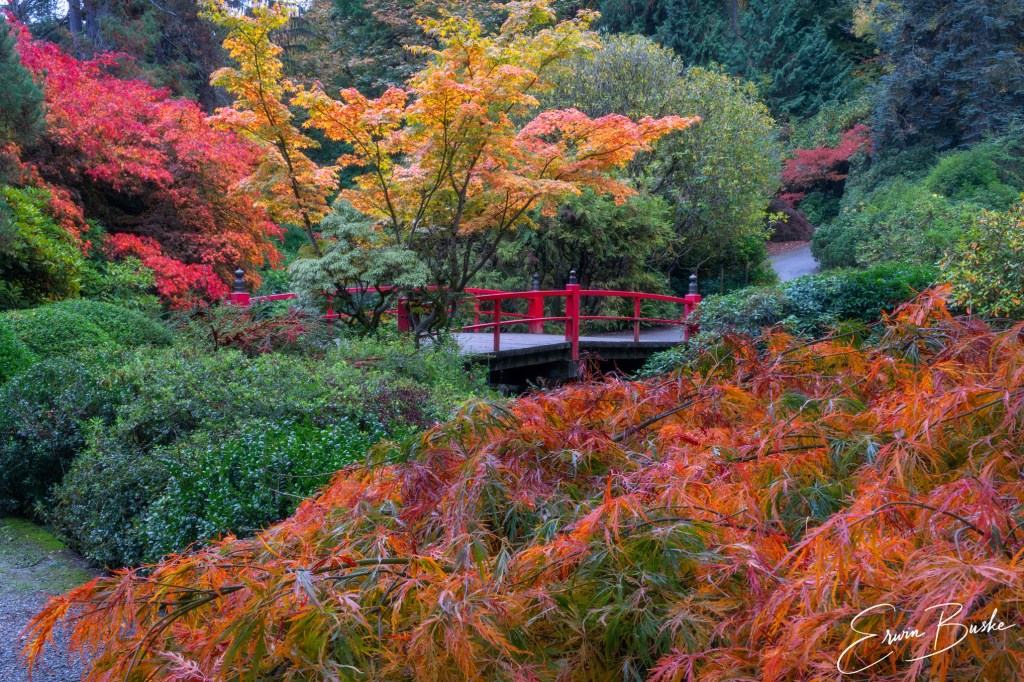
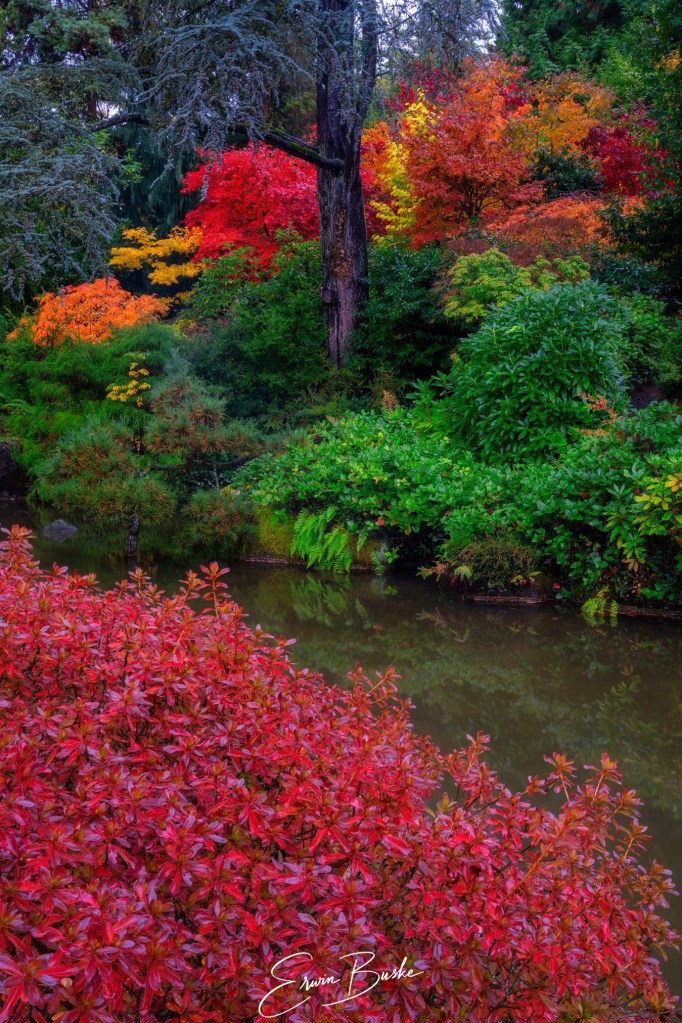
Kubota’s heart bridge crosses the Necklace of Ponds passing through splashes of beautiful autumn hues and textures.

33. Blue and Gold
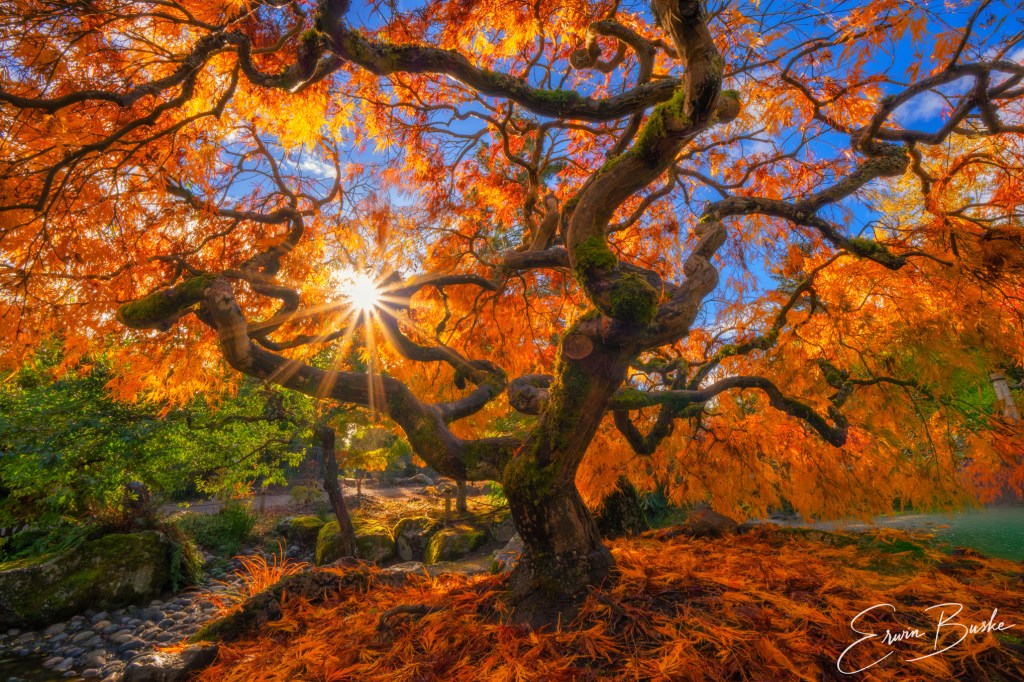
I went out to check out some of my favorite Japanese Maples on this morning. I was not sure they would hold out much longer with the overnight winds and rain, but this one seemed to be at the sweet spot between lace leaves on the tree and on the ground. Life is so sweet and beautiful underneath a Japanese Maple in the Morning!

34. Mushroom Promenade
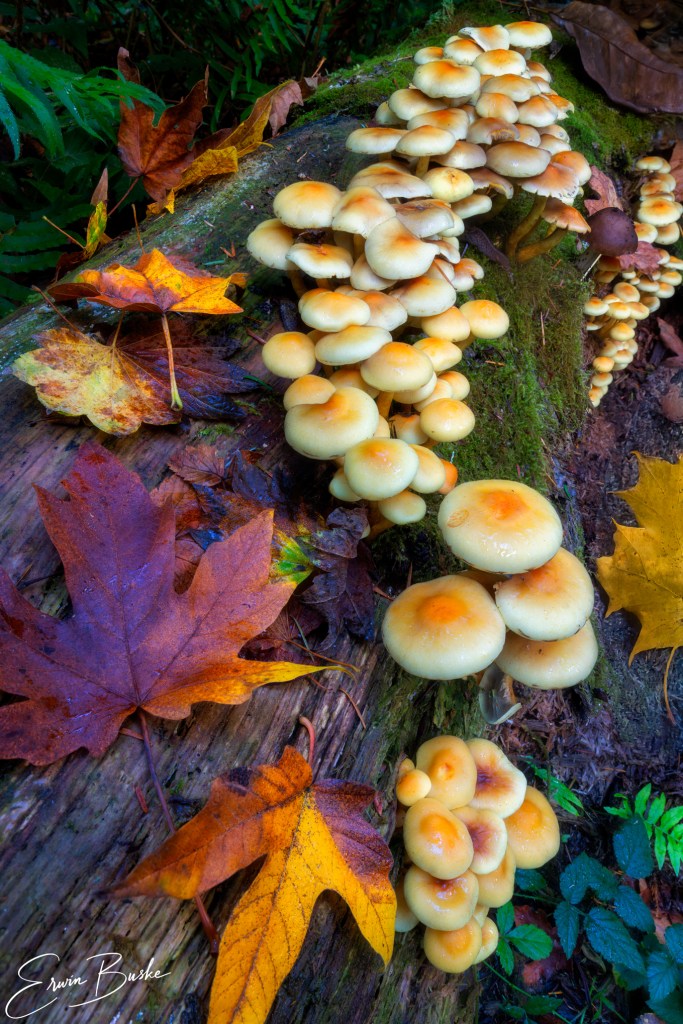
A procession of Sulphur Tuft mushrooms lines an old fallen log in the forest on a cool Autumn Day. Thanks cousin Sylvia for pointing out these mushrooms on our walk in the forest close to my home.

35. Sunburst in a Foggy Forest
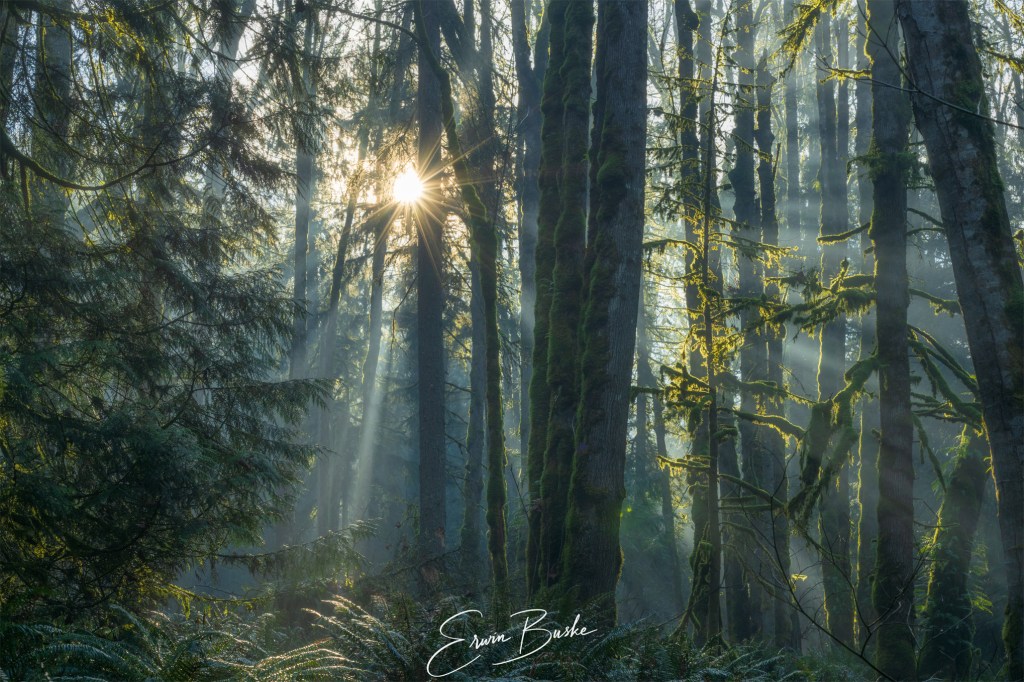
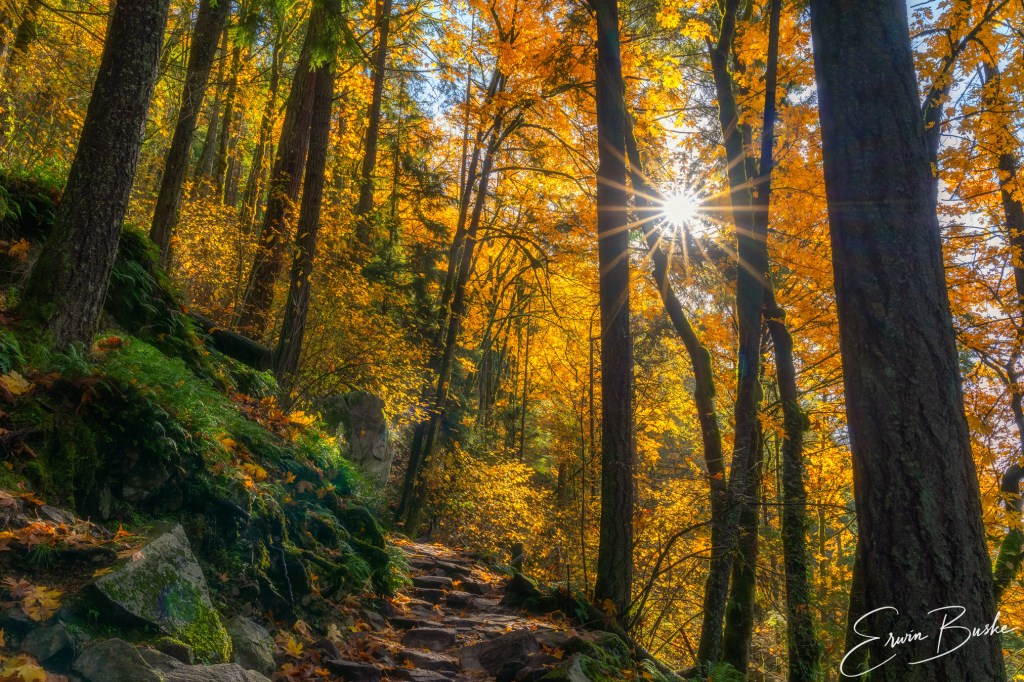
Often I get asked by people how they can improve their photography. One of the things I tell them is to find a place close to their home and go there often finding beauty in a place often thought of as ordinary and mundane. One can learn more in this way than going to places where the shot is in your face and has already been defined as good by those who came before you. Yesterday I practiced what I preach, and headed out my front door on a foggy day to find some beauty in the woods close to my home. The forest was very humid with water droplets dripping from the trees as the sun gradually penetrated the fog-perfect conditions!

36. Wildblumen-Bergwiese
(German for Wildflower Mountain Meadow)
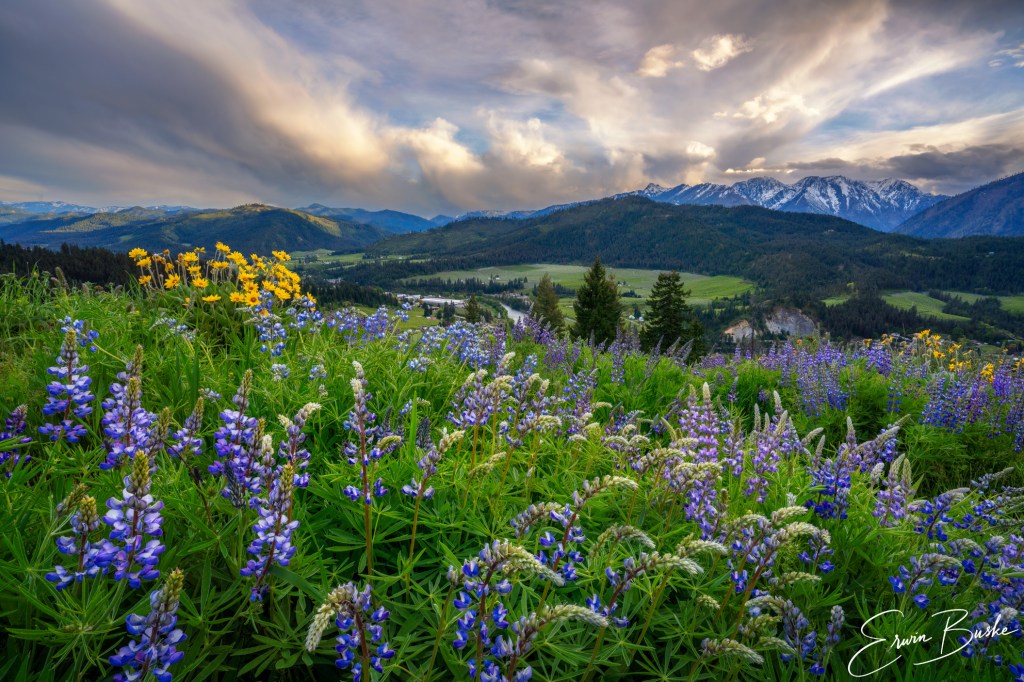
During an exploratory trip to the area surrounding the German theme town of Leavenworth, I stumbled across this beautiful Lupine Meadow and decided to just stay here until sunset. It was a great place to lie down for awhile (not on the flowers!) and watch the clouds go by. One does not need to travel far and wide for Wildflowers, they are right here in our beautiful state of Washington!

37. Daisies Meet Foxglove
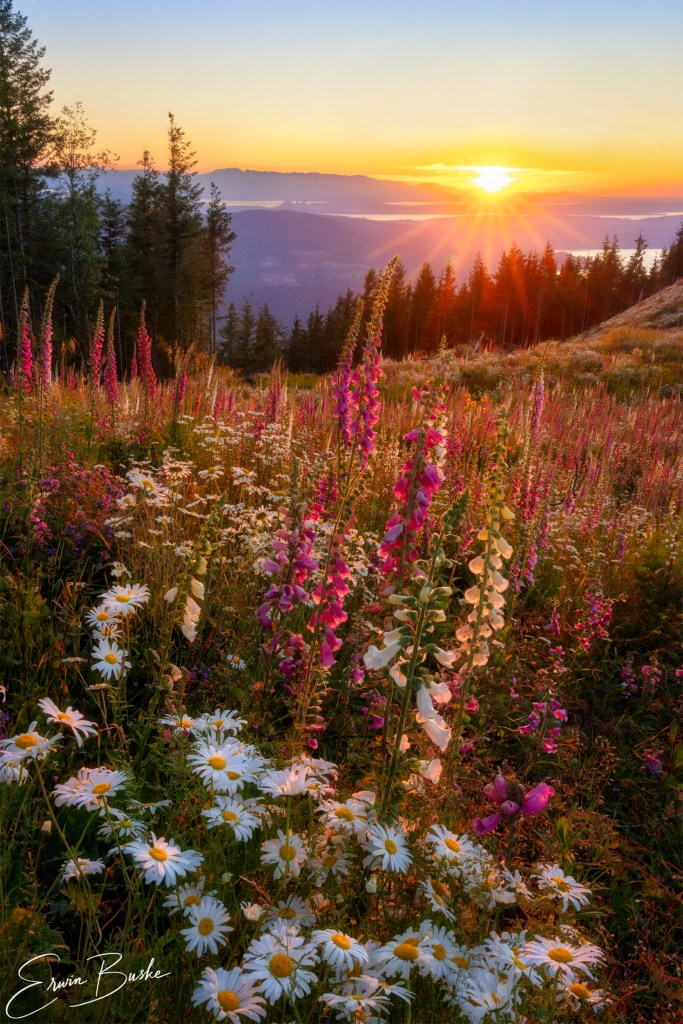
Its date night for the Daisies and Foxglove up at Tiger Mountain! In June, I left home at about 6PM and headed to the West Tiger 3 Cable Line Trail. I made my way up a little slower than usual, heeding the advice of medical experts not to overexert in the heat wave and also stay hydrated. The hot temps moved the pink Fox Glove into a hyper bloom cycle as I was feeling the heat and beauty at sunset between West Tiger 2 and 3.

38. Mt. Si Haystack Rock Revisited
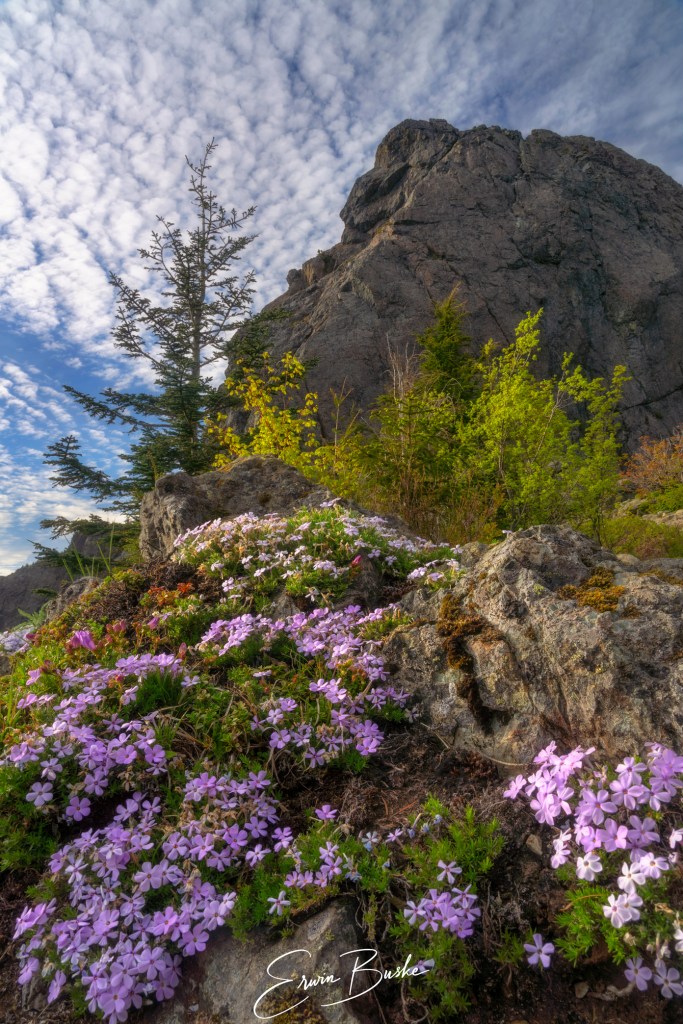
Here is what I think for many of you will be a fresh perspective on Mt. Si’s Haystack Rock. It sure took on a different look for me, as I was lying down on the ground with my camera lens only a few inches away from a carpet of phlox flowers that were making a toehold on the jagged rocks, and looking up toward the iconic Haystack.

39. Summer Paintbrush Meets Autumn Gentian
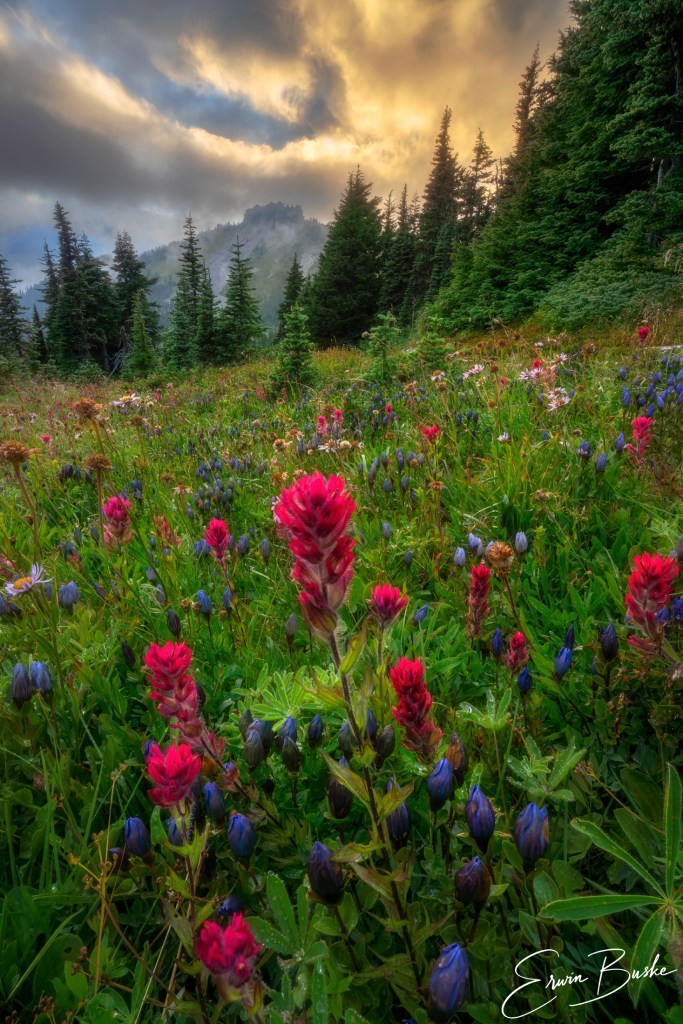
I love seasons in transition, including the feeling of passing from Summer to Autumn. In this meadow the Summer Indian Paintbrush flowers are still at peak, but the Lupine have already gone to seed, to be replaced by Autumn blooming blue Gentian flowers. Gentian reminds me a little of blue flame candles. Seasons in transition remind me of the Japanese Zen aesthetic concept of Wabi Sabi: nothing lasts, nothing is perfect, and nothing is finished. But it is in the experience of Wabi Sabi that one finds beauty.

This image was taken on a middle of August evening at Spray Park. A misty Hessong Rock is in the background. Although Rainier was never visible it did not matter to me. All I needed were these beautiful flowers and light.

40. Kiss the Sun
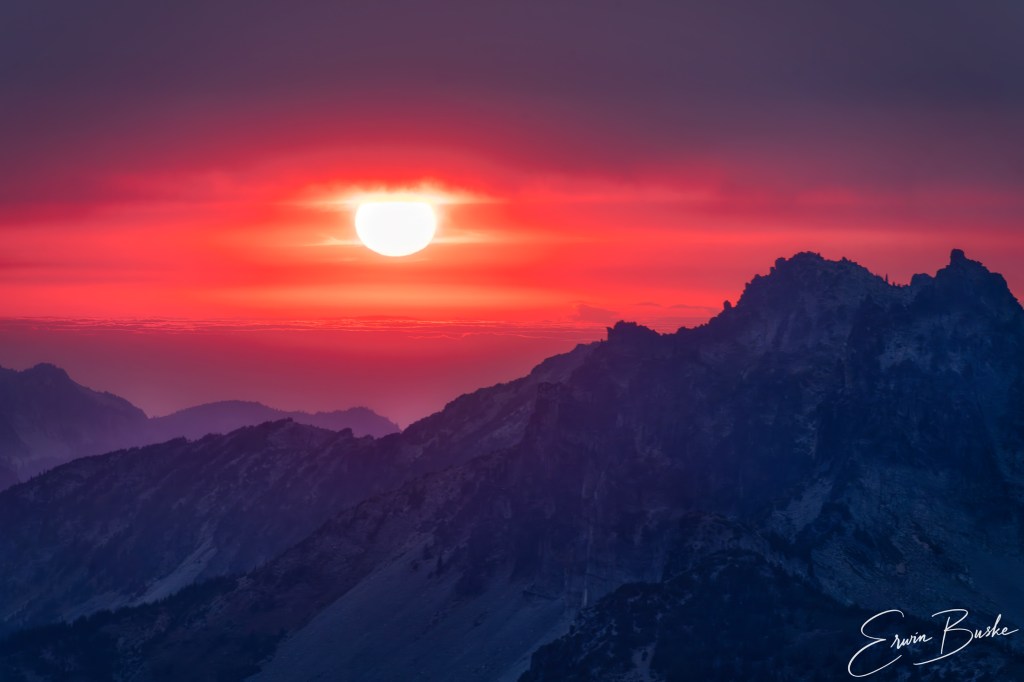
On an early September evening, hiking buddy Hua and I were about to leave what at first appeared to be a non-eventful sunset at Mt. Fremont. Then we noticed the Sun gradually reappearing between layers of clouds. The color was very localized in this small area captured using a 300mm telephoto perspective. It appeared to me as though the reds clouds were lips kissing the bright Sun slowly falling from the sky.

41. Grazing with New Coats
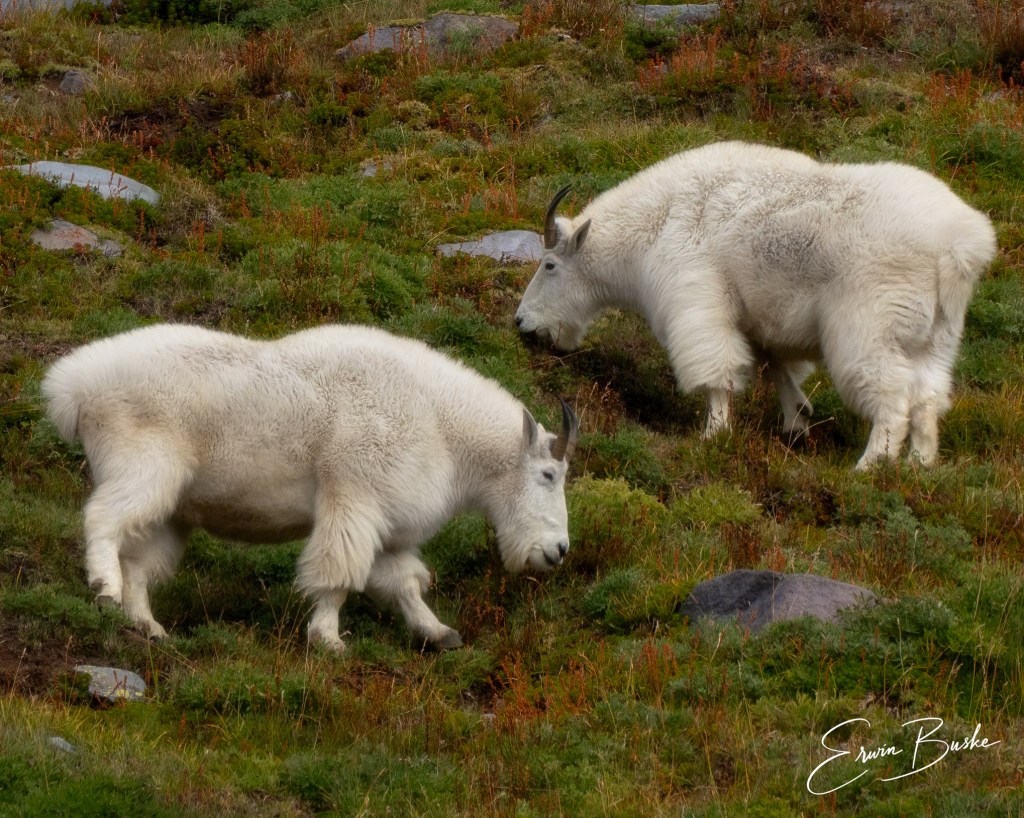
In September we did a wonderful clockwise loop of the Panorama Point hike passing Goats, Bears and Marmots and plenty of beautiful Fall color. These two goats were in the meadow above us, and I was able to feature them grazing with new coats of beautiful fir using a long telephoto perspective cropped in. The goats shed their summer coats to be replaced by thicker and warmer winter coats.

42. Visions from the Other Side
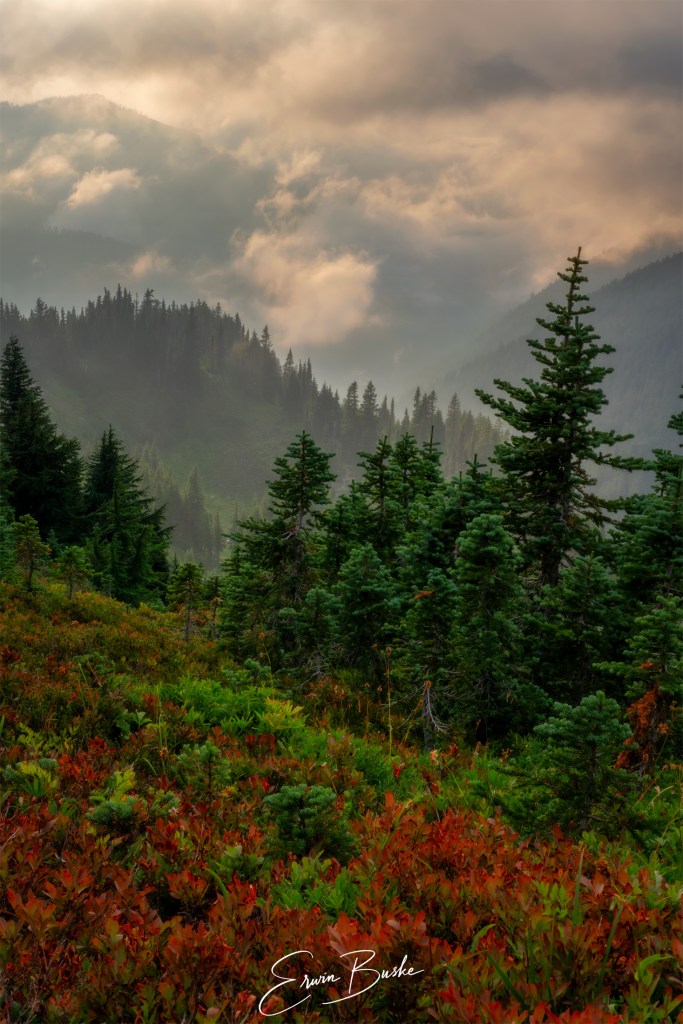
On a Mid-September evening Mt. Rainier and Eunice Lake were barely visible from Tolmie Peak, but hiking buddy Hua and I found some spell binding mystical beauty on the other side of the peak. A system of fast moving clouds and fog merged with the lingering smoke ultimately pushing the smoke out of the way. The sun pierced through the sky with golden light also illuminating the huckleberries well on their way to peak Fall color. This was a reaffirmation of what I practice almost every time I go hiking: embrace the moment and what Mother Nature offers. There is always some beauty to be found!

43. Autumn is in the Air
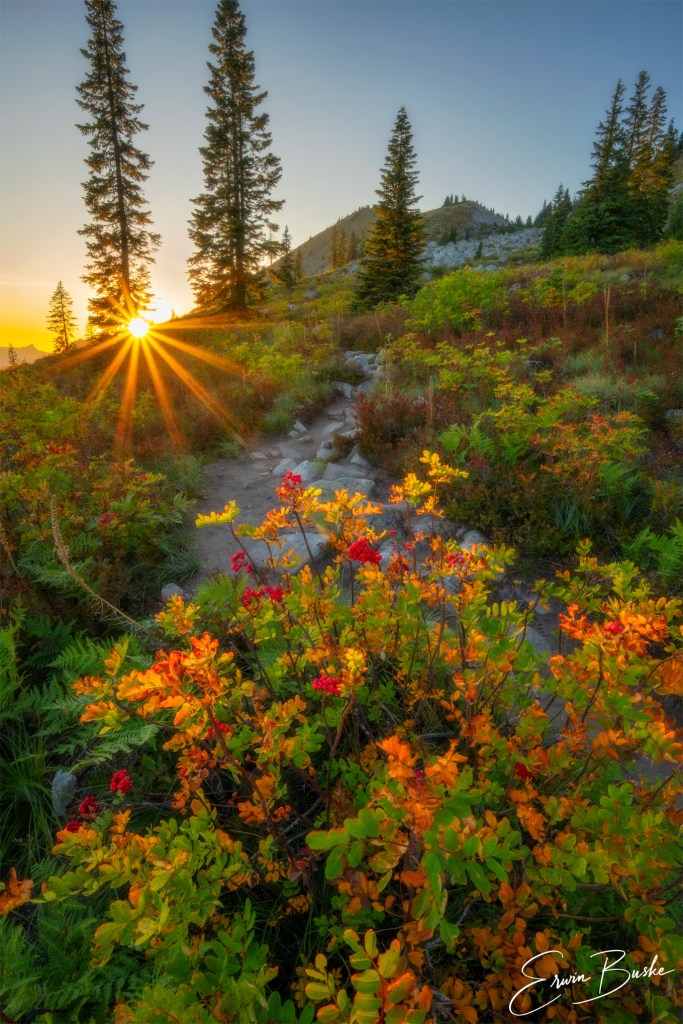
This was my parting shot at sunset heading down the Granite Mountain Trail. Although it was not Autumn yet, the colors were well on their way to the Golden Season. Personally, I love colors in transition even more than peak Fall color. There is something about moving from one season to another that is very alluring.

44. Autumn Cotton Wood Reflections
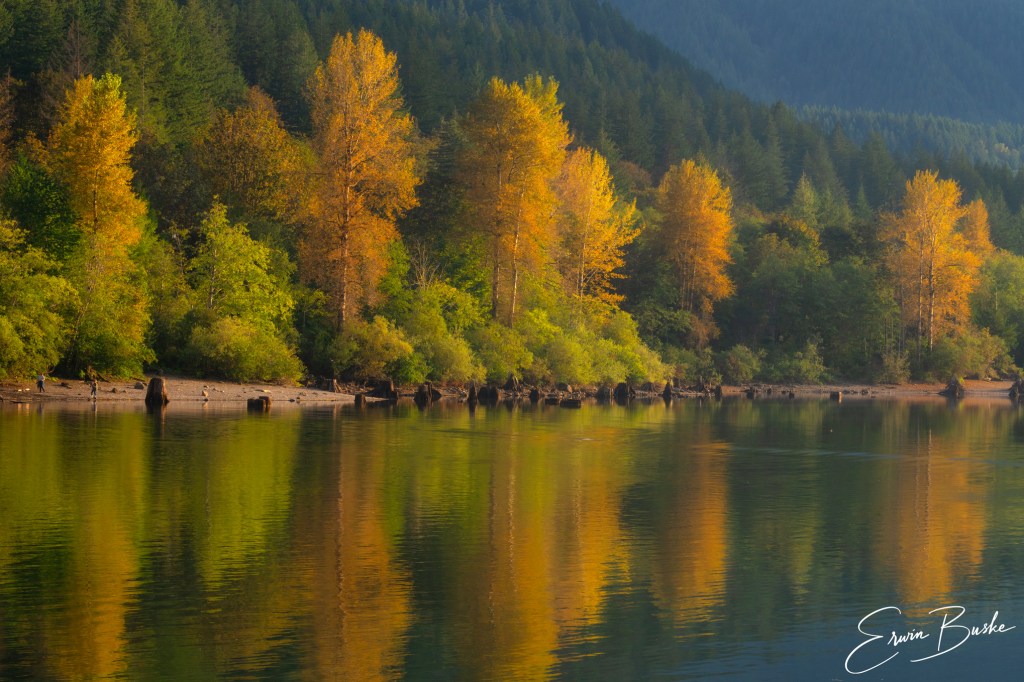
On this day I found some unexpected beauty upon returning from my hike to Rattlesnake Ledge. I did not go in search of pictures, but I found some uncommon beauty. I am always prepared to take images, even when I have no expectations of finding them! Its important to develop a mindset that is always open to possibilities.

45. Understory of Vine Maples
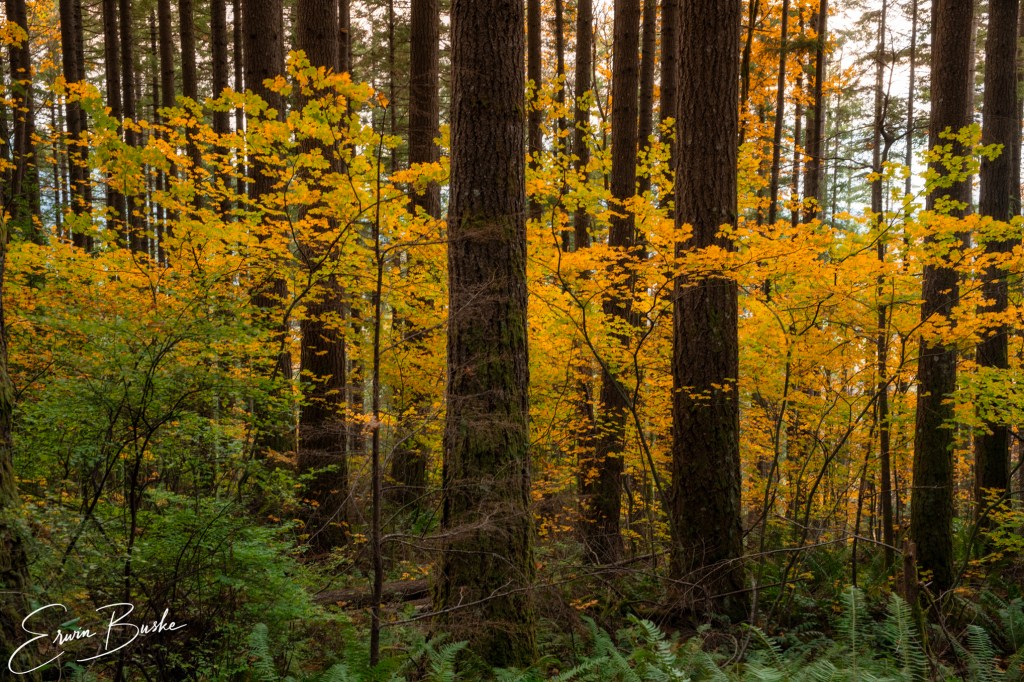
There is Big Si, and there is Little Si, and in some ways I actually like Big Si’s little sister better! There is certainly more variety to the trail, passing through a fern grotto and tall cliffs that are a favorite of climbers using pitons, and some beautiful view point rock outcrops on top where we could wave hi to Big Si. Hiking buddy Sun and I left Bellevue about 2:45 PM and we arrived at the top at 5PM, leaving plenty of time to enjoy the golden hour, partake of our hiker’s feast including Smoked Salmon Bagels, and a few fire balls. On the way up we saw some wonderful understory color of golden vine maples under the tall evergreen trees. There is beauty everywhere waiting for us to step out and discover.

46. An Unexpected Visitor
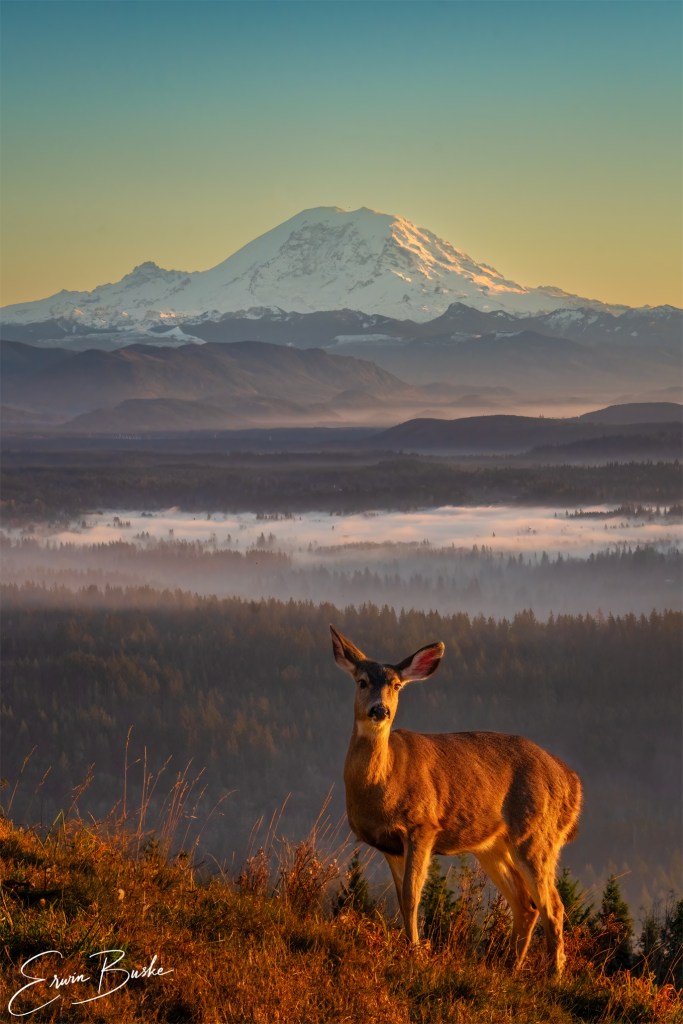
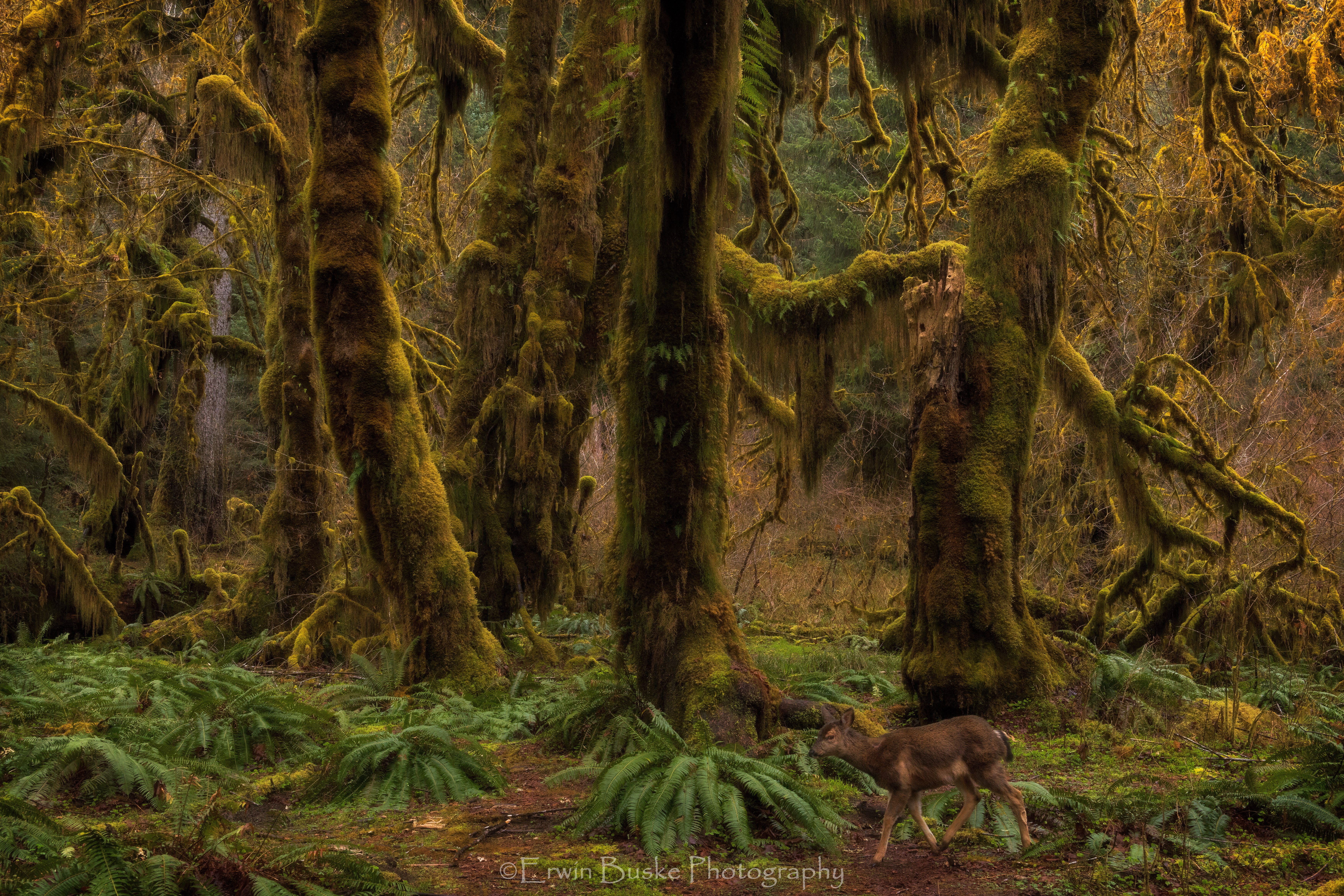
I never thought of myself as a Deer Whisperer but now I am beginning to think I am. This deer was posing perfectly on this day on Tiger Mountain, and seemed very comfortable with my presence for a long period of time

47. Kayaking Into Sunrise
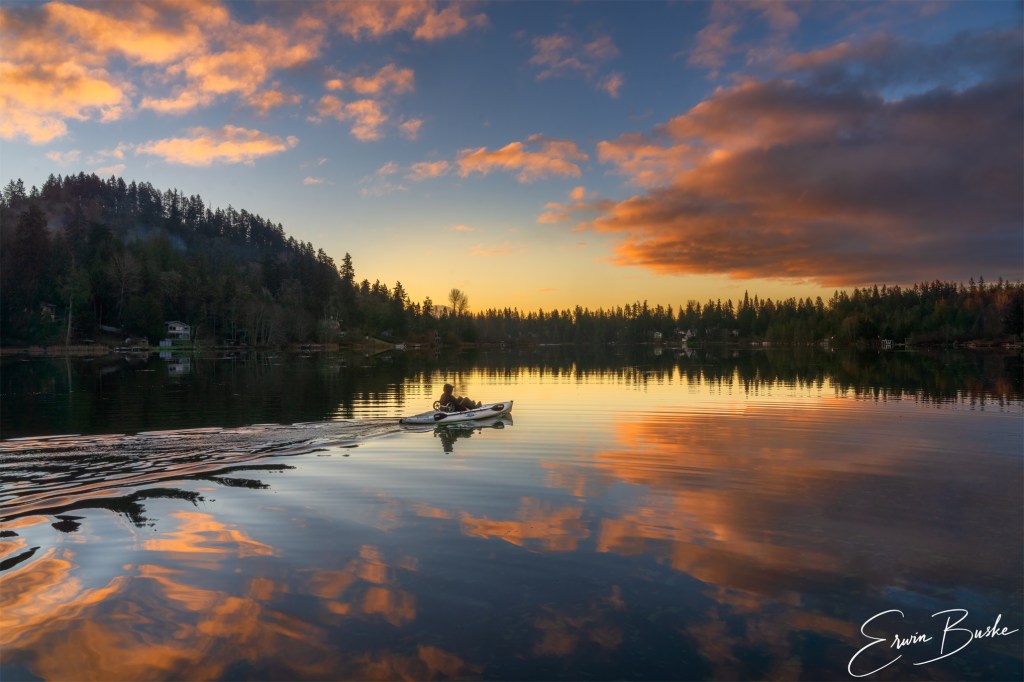
Every time I go down to close to my home Lake Desire for Sunrise, I see this guy launching his Kayak. He has it on wheels so he can just roll it from his nearby house to the boat launch. This morning I captured him heading out into a glorious sunrise. The Kayak appears custom built and has both a paddle and petals and he was using the latter today to propel the Kayak forward.

48. Mountains, Clouds and Mist
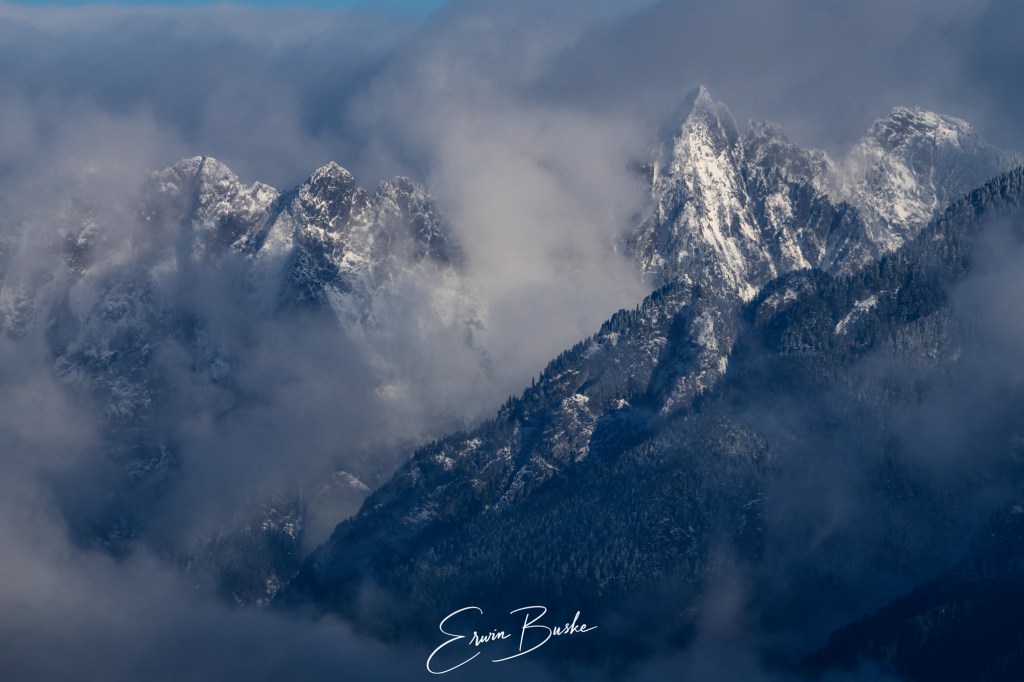
On this December day I did some long telephoto work up on Rattlesnake Ledges. Working in this way I can bring to life distant peaks and portray them in ways that are not obvious to our naked eyes. Telephotos isolate and compress layers in the scene which opens up new composition avenues for creative expression. The lens I used on my ultralight Sony A6700 is the Sony 70-350 which is equivalent to a 105-525 Full Frame lens. The lens and camera together only weigh about two pounds, making it a great choice for hiking and backpacking.

49. Delicate
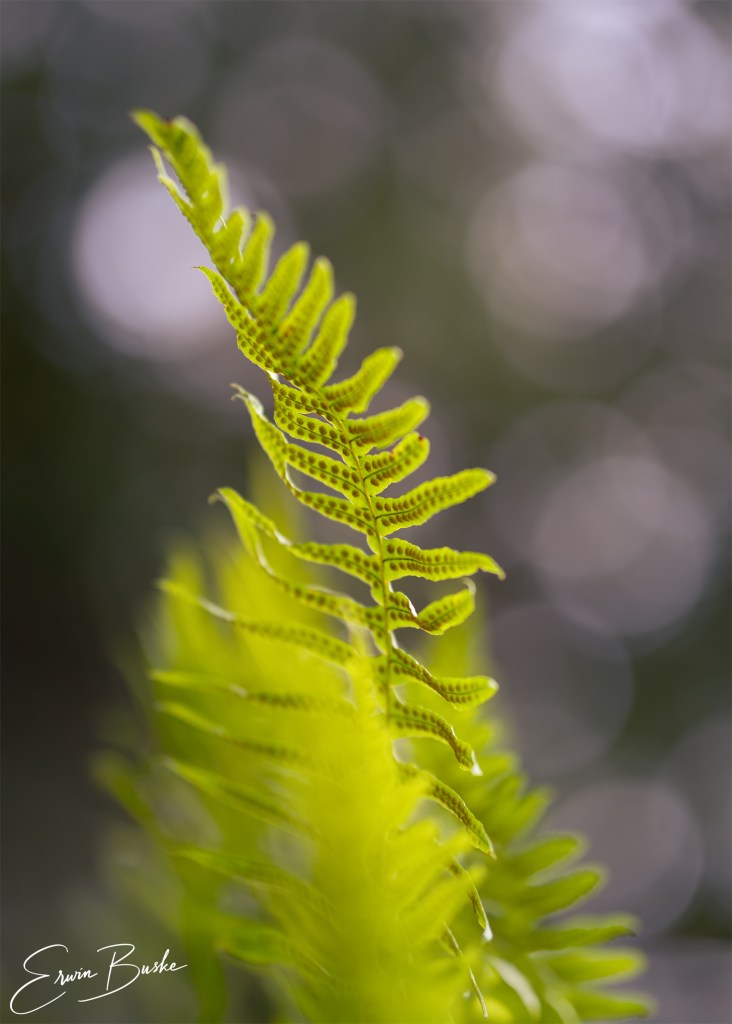
A licorice fern frond growing on a tree limb reaches up into the cool forest for small streams of airy light filtering through the forest canopy. This is like the Tree of Life except a fern, with its spores ready to spread bountiful life and nature’s love throughout the forest.
Getting Lost, Getting Found, in a Single Moment: 2023 Best Images

I am hiking along a long and winding trail at Mt. Rainier National Park in dense fog. The visual ques I am used to seeing are all gone: Mt. Rainier rising from the meadow, Dewey Lakes in the valley below. The fog moves me into a more internal state of consciousness, and deep into my own heart and soul. Now I can see what is visible of this beautiful Autumn meadow in new and fresh ways. Fog not only creates mood and interest and softens the sharp edges of a landscape, it also changes our habitual way of viewing the world. Fog makes us more attentive to our internal state of consciousness. Habits are formed over long periods of time, but in the present moment the factors that formed those habits may no longer be relevant. All the cells of our body change with each passing year, and who we are as a person also changes. Fog helps us be more aware of this fact. We can get lost, and we can get found all in a single moment. 

Here is a collection of my best and favorite images from 2023, along with the backstory for many of them, my thoughts, impressions and a few photography tips. They are not in any particular order, some were very popular some not so much so, but all are meaningful to me. Thanks for looking!

1. Lost in a Huckleberry Meadow

Doesn’t it feel good to get lost once in a while! 

2. Peace in the Valley

“I look deep within my heart and soul and what do I see but nature and the external world. I then look out to the external world and nature and what do I see but my own heart and soul.” Erwin

It seems like this Autumn I was running out to meet new adventures before fully coming to peace with the adventures I had already completed. There are many images with great potential just resting deep in my hard drive, kind of like these beautiful clouds in the valley waiting to show a little of themselves to the world. This image is an image I rescued from hard drive oblivion. When I come back to images after several weeks, I often view them with more objective eyes.  This image was taken while doing a sunset hike along the PCT close to the Catwalk. It turned out to be both my most popular and what I also consider my best image of the trip.  There was a beautiful inversion layer in the valley that enveloped the entire landscape by the time I got back to my car.

There is also a lesson that comes with this trip, when hiking out solo at night, always carry two functioning headlamps and a cell phone flashlight with a backup battery for triple protection! On my way back my aging BioLite red headlamp failed. Never mind, I carry two. Lo and behold, my second blue BioLite also failed. Never mind I said, I will just use my iPhone flashlight. Lo and behold I am at 20% power. Luckily, I made it back to the car with a few percentage points to spare! Needless to say, the next day I went down to REI and bought two more headlamps using different technologies and different brands to minimize the likelihood of failure. And BTW, I will also start carrying backup power for my iPhone!

3. Falling Into a Beautiful Dream

Sometimes I hike out into familiar area and the world looks different to me. With this hike at the Columbia Gorge, it might be because the flower bloom was extraordinary this year. The conditions were evidently just perfect to bring out the full beauty of these flowers. The cool, then hot weather caused these flowers to burst upon the scene all of a sudden with the Balsam Root and Lupine blooming in synch which is so rare. But I do not think a near super bloom at the Gorge explains it all. With each passing year I change and perceive the world differently. This year the change was particularity noticeable because this was my first year as a single man and father after twenty years of marriage.  Yes, I am still the same old Erwin that many of you know, but I have wandered into new paths of awareness. These paths do not necessarily take-on a physical dimension. But nevertheless, they are paths I can follow.  The new paths shed some of yesterday’s way viewing the world and allow me more open to experiencing the world with fresh eyes. Sometimes I wonder, if we could but shed all of our habits that shape how we perceive world, might nature itself take on different forms, lines, patterns, shapes and colors?  Would we walk into a new dimension?

4. Self Realization

I am always amazed at how nature has the power to change people’s lives. A person who has not spent much time in nature, goes to a place like this and their life gets utterly turned around and transformed. What seemed important just the other day, especially attachment to material things, now seem much less important. Nature often comes as a still soft voice wanting us to experience more and more of her graces. The path of my life has been to heed her call as often as I can. Being in nature is the ultimate selfie, when we realize we too are part of nature, part of the beauty that is before us. Every day is a celebration and living the dream when one connects closely with nature.

I took this image on the second half of the Panorama Point Loop Trail going counterclockwise in Mid-August, at Mt. Rainier National Park. The glaciated peak in the distance is Mt. Adams. The white chartreuse flowers that to me resemble a forest of tiny flowers are called Lousewort.

5. Yin and Yang

We love to split the world into opposites–light and dark, blue skies and cloudy skies, joy and sadness, hope and disappointment. But for all of these opposites, we cannot know one without the other and they are all part of the same whole that is nature. This is just one of my many rambling musings while also rambling on a ridgetop on a late September afternoon extending into the evening!  Isn’t it a wonderful world we live in?

6. In the Beginning

Although I have done my share of epic hikes including the Wonderland trail, the Three Sisters loop, the Four Pass loop in Colorado, a 120-mile loop trip in the Pasayten, and countless others along with scaling many peaks-this is not usually what fuels my passion for nature and photography. What sparks my passion is finding meaningful connections with nature. Call me weird and I probably am or at least there is something wrong with me! These days, I just do not get that much excitement taking one more epic hike or crossing off one more peak on my bucket list. Do not get me wrong. I know these challenges mean a lot to many people and I respect that. It’s just not me. I do get excited at places like this which just happened to be at the beginning of this hike to the ridge above Snow Lake. It could have just as well been twenty miles in, the location and the difficulty getting there is not what matters. What matters is my connection to nature. I feel my best when I am fully present with nature and sense a strong connection to my surroundings-as I did here. Although I headed up to the ridge above Snow Lake and trekked cross-country along ways toward Preacher Mountain in the rain and mist–this was the highlight of my day, and it was “In the Beginning”! 

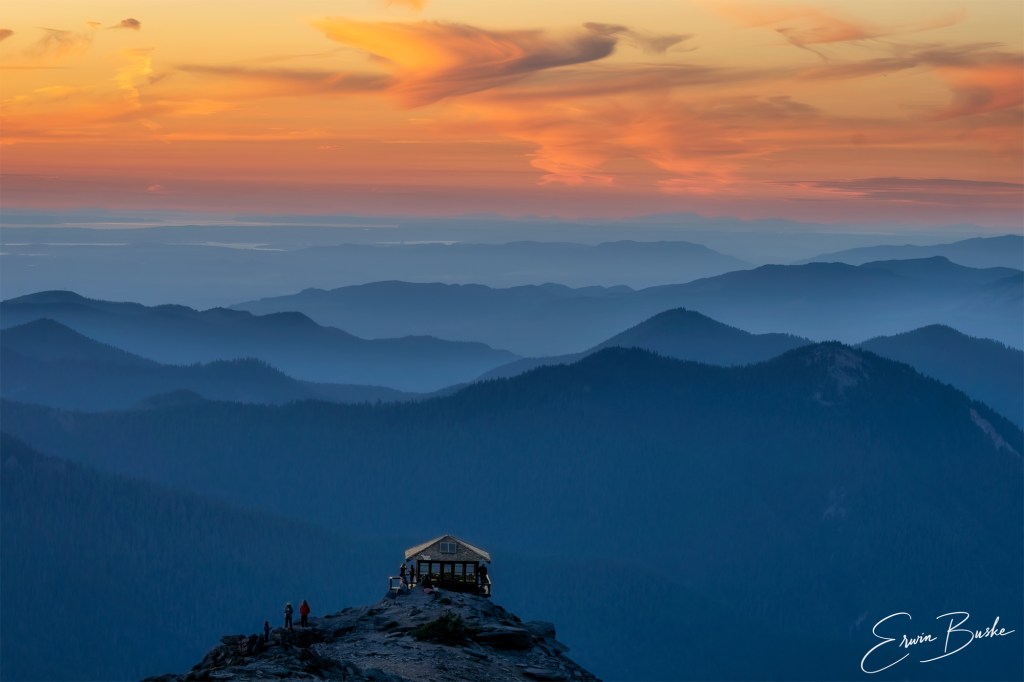
7. Mt. Fremont Blue Ridges Sunset

This is looking out from above Mt. Fremont Lookout toward the lookout catching some of the last embers of light and beautiful layered mountains with a lenticular cloud in the sunset sky. It’s hard to beat Mt. Fremont for beautiful spell binding sunsets, and every year I return to this sunset paradise.

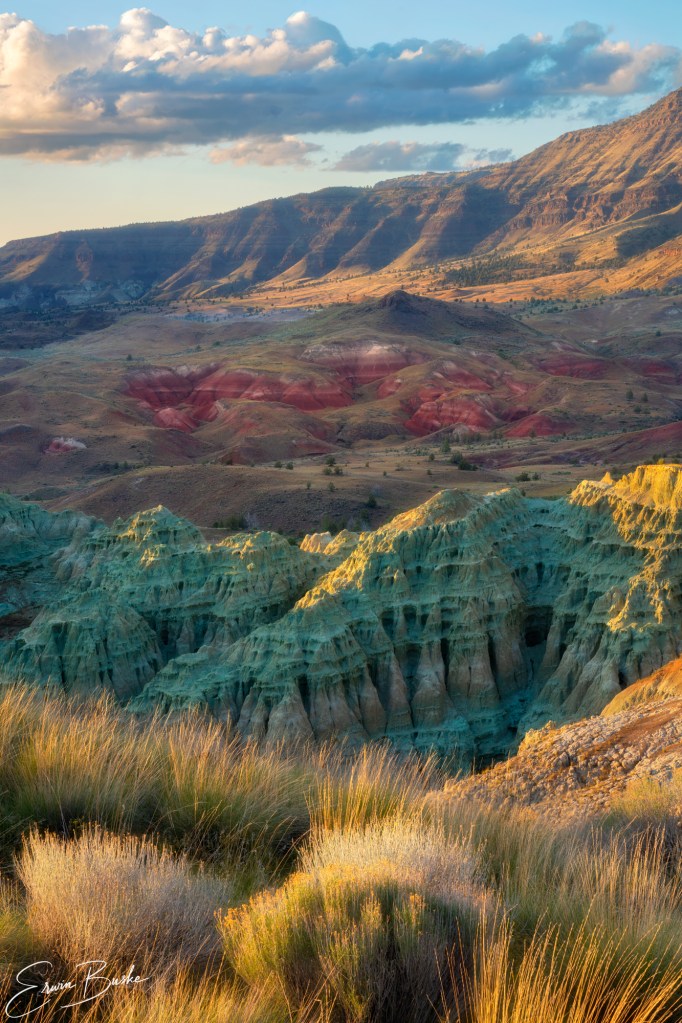
8. Spirits of our Ancestors

In early May I spent four days exploring Oregon’s John Day Fossil Beds National Monument. This area is best known for the Painted Hills which I visited and photographed, but I also spent a significant amount of time exploring all the different areas of the park on the open trail including the Sheep Rock and Clarno units. I was so surprised to see this rock with a turquoise tint alongside the red rock that is most often featured in images of this area. I had visited this place the day before and the rocks were dull in color, but the overnight T storms and rain brought out more vibrant colors. There are fossils in this rock, and the place seems to silently whisper messages of those who lived here long ago. I think I have fallen in love with this area and will return again and again!

9. Convergence

The recent heavy rains and the golden hour light really brought out the colors, textures, and lines of the Painted Hills on this evening, especially when viewed through the narrow angle of a large telephoto lens. Moisture and light play a huge role in the Painted Hills for how they appear. Although the earth may look dry, when it is colorful like this it is actually like mud.  This is one of the reasons the park does not want anyone going off trail into the hills because it will leave a definite trace and cause erosion of the sensitive soils.

10. Clouds Float in my Eyes

At sunrise, the sky above Garibaldi Lake was mostly blue, but as morning progressed patchy clouds appeared everywhere and were reflected in the beautiful water of this enormous lake. Early morning light filtered through gaps in the clouds, illuminating this beautiful grand landscape.

The surface area of Garibaldi Lake is 2,460 acres. By way of comparison Snow Lake close to Snoqualmie Pass, another very large lake, is only 153 acres. The lake was born when Mt. Price and Clinter, the somewhat reddish peaks pictured on right, erupted forming a large lava dam 980 feet in thickness which coincidently is also about the depth of the lake. In this image you can see some of the loose lava rock from this dam around the shoreline of the lake.

A quest for new horizons has brought me here. Freed from any preconceptions of what this place may be like, I was able to experience this area with more like the eyes of a child. In fact, in BC I am more like a kid in a Candy Store! So many new places and adventures in the roads and trails ahead! This will not come at the expense of my beloved Washington. I also love returning to the intimately familiar. Nature knows no boundaries. The US Canadian border is an invention of the political mind of humans, not something that originated organically through the actions of nature!

11. Garibaldi Awakening

The first embers of light make their way into the Garibaldi Lake basin as clouds form and move slowly across the lake in forever changing formations. My eyes gravitate to the island in this vast inland sea with a bonsai like tree. These islands are called battleships-I am not sure why but to the imaginative eye they do look a bit like them! The islands are made up of volcanic lava rocks, remnants of an ancient eruption of the nearby peaks.

12. “Follow Your Bliss”

This quote was originally coined by Joseph Campbell, a Mythologist and champion of the Perennial Philosophy.  The Perennial Philosophy points to common themes and archetypes that can be found in the mythology and history of all places and cultures. To follow your bliss means to have the courage to do what you really want to do in life as opposed to choosing a path forced on you by other people. This summer, following my bliss has brought me up north to Garibaldi Provincial Park Canada for several backpacking trips with more in the planning next summer!

13. Creeping Dogwood Bunchberry Forest

Bunchberry Dogwood, also know as Canadian Dogwood, is perhaps my favorite plant at the forest floor–especially underneath the large and tall trees of a deep virgin forest. Among the smallest of a genus of mostly shrubs and trees, Bunchberry prefers the moist ground and dappled sunlight found underneath large ancient trees. Red berries form in Autumn sometimes carrying forward to Winter with the leaves turning a wine red. I almost missed these hiking through the lower elevation forests of Mt. Rainier, but heard their soft whisper and caught a glimpse of their small and subtle beauty out of the corners of my eyes.

14. Mt. Shasta: Around the Bend

On the first day of my road trip to University of California San Diego to bring my daughter her car, I spent the night at a hotel in the Northern California Town of Yreka. I chose this town for two reasons: it was close to Mt. Shasta and also would put me reasonably close to the Big Sur area where I spent the next couple of days. I really had no plan for where I would photograph Shasta and thought I would just wing it. I headed down the highway the next morning well before sunrise, drove quite aways then rounded a bend where this scene opened up before my eyes. I quickly looked at my mirrors for traffic and pulled over to the side of the I-5, got out of the car, and took this image handheld at high ISO. Sometimes my usual slow approach to photography will just not work and like in the Old West one must be a quick draw to hit the target and get the shot! This light was fleeting and only lasted a few minutes. I need to search Amazon for one of those bumper stickers that say, “I break suddenly for sunrises and sunsets”!

15. The Magic Coast

This image is looking north from Big Sur out to the Bixby Bridge and toward Carmel and Monterey. If you look close there is what looks like a private residence on top of the hill above the bridge. They must have one heck of a view! It is somewhat surprising because the Big Sur area has one of the most restrictive development policies in the US and maybe the world, but they were likely grandfathered in prior to the implementation of these policies that have done a great job of preserving the natural environment.

16. You Keep Me Hanging On

Here it is mid-winter in the Alpine Lakes Wilderness Area, and the tree is still holding on to its leaves. Will the leaves still be there in Spring?

17. Happy Family of Snowy Trees

While on a snowshoe hike and on my way to Kendall Lakes, this group of trees caught my eye. Although somewhat different in size, they all seemed to have a uniform shape standing in a row belonging together. Their snow-covered boughs stood in sharp and beautiful contrast to the gray sky background.

18. This Old Farmhouse

Some scenes let us know right from the get-go that they want to be photographed in Black and White. As I made my way to the Painted Hills on a stormy day, I passed this old, abandoned farmhouse and decided to make a roadside stop. I love the old, weathered look of the wooden house against the dark stormy backdrop along with a few tumbleweeds in the front yard. Even the small amount of graffiti seemed to add an interesting touch.

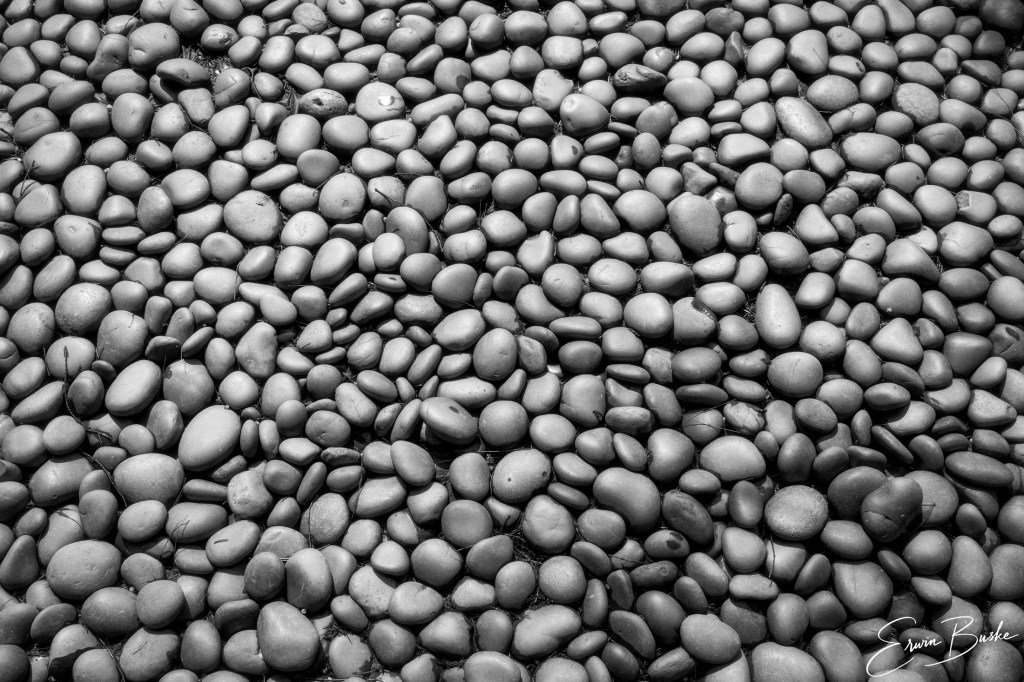
19. Zen West Rocks Monochrome

I found these smooth wet rocks lining a walkway at the Zen Garden within the Portland Japanese Garden. At first blush my eyes were drawn to the basic pattern of rocks with each stone somewhat different but most having a loosely circular shape that is never perfect. But when you look at these rocks together you will also see a circular pattern radiating both from the outside in and from the inside out. There are similar radiating patterns echoed throughout the garden. These are more than just rocks; they were put there along with other objects in the garden to move us into a more mediative and still state of mind!

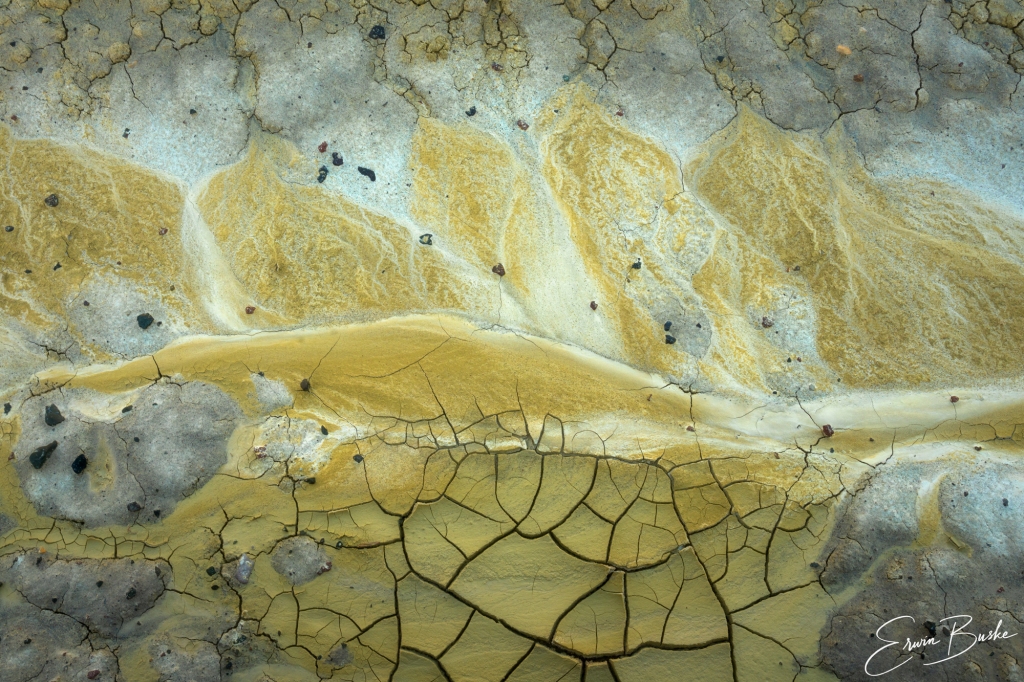
20. Painted Hills Claystone Silt Abstract

With heavy Spring rains in the Painted Hills, some of the claystone washes away with the silt quickly drying in streambeds often forming beautiful patterns with contrasting colors. These change from one rainstorm to the next and with different directional light for a constantly changing show. Who says mud cannot also be beautiful!

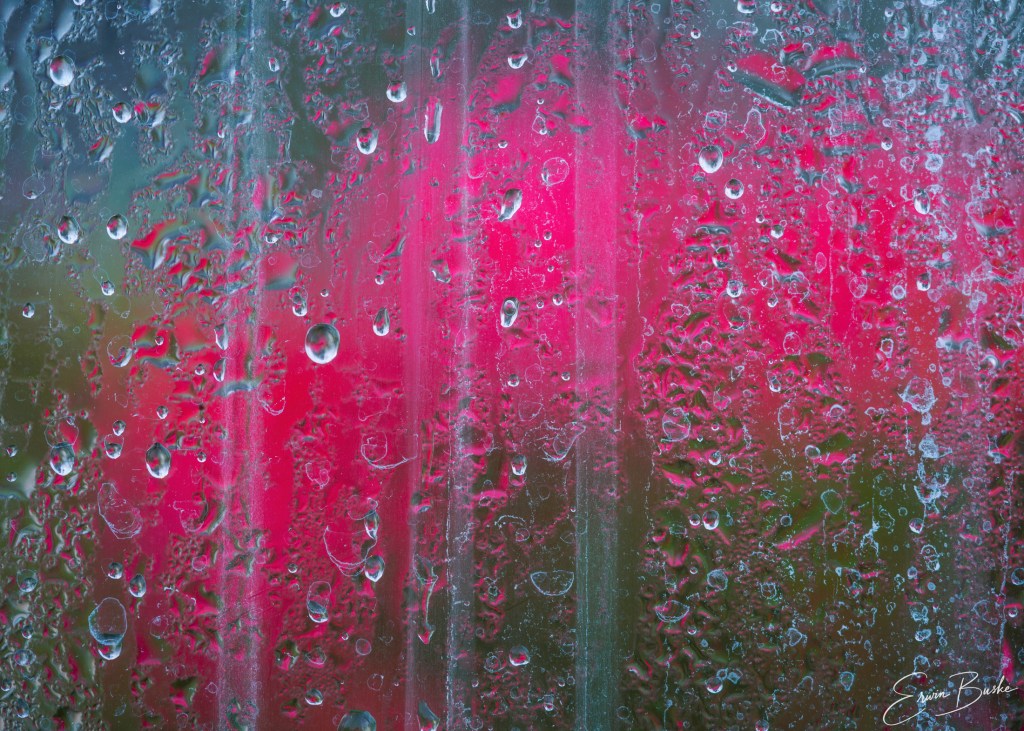
21. Tears of Sadness and Joy

Winter can often seem sad. Caught between Autumn and Spring, much of nature has gone into hibernation. But without sadness we would not know even what joy is. Although this image was taken in the middle of the Winter, new life is just around the corner. On this day, at the Seattle Conservatory, I caught a glimpse of the promise of a new life while looking through a rainy greenhouse window.

22. Maple Leaf Potpourri Melody

In addition to looking out and up, it is always a good idea to look down towards one’s feet when walking through Kubota Garden.

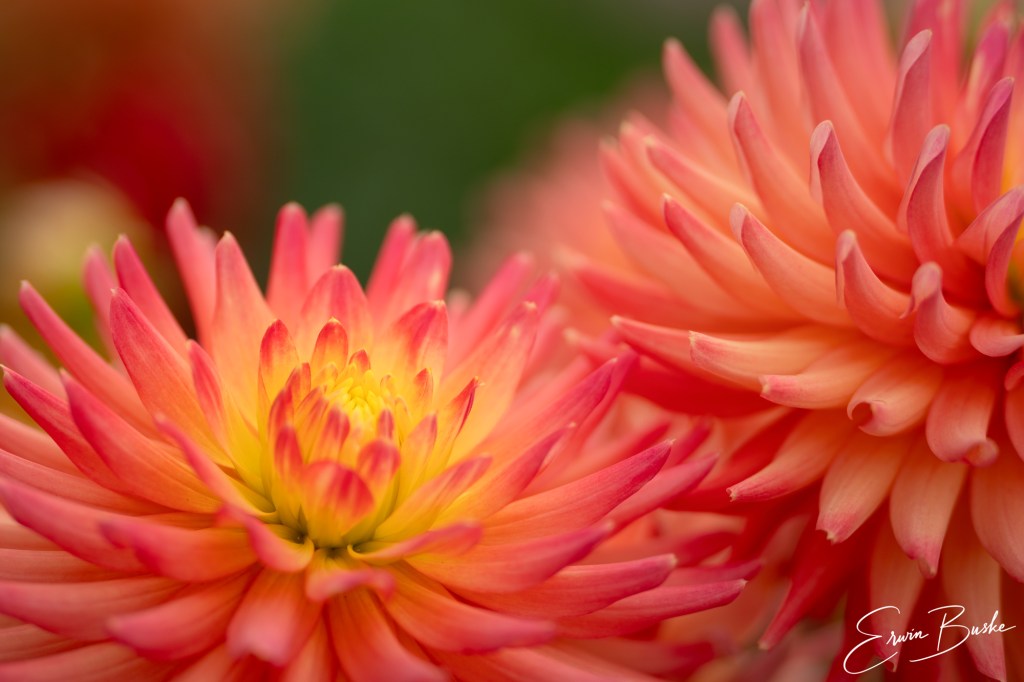
23. Petals and Nails

It’s amazing how dreamlike these dahlia flowers can appear with the shallow depth of field at 2.8 on my Sony FE 2.8/70-200 GM OSSS 2 Lens. I really like how the two flowers were leaning into each other, one with petals and the other to my imaginative eye with fingernails.

24. Karma and the Return Journey

During early October, I completed the High Divide Seven Lakes Basin Loop in Olympic National Park. AllTrails put this loop at 19.1 miles and 5,419 ft elevation gain, but with photography excursions, it was more like 26 miles and 7,000 ft elevation gain. I did it, however, over four days and three nights so the journey, although challenging, felt comfortable to me with beautiful Autumn colors at their peak. I had campsites at Deer, Lunch and Heart Lakes all beautiful in their own way. This image is of Lunch Lake, not far from my campsite, with Packman like clouds moving from North to South.

The last time I did this journey was with my much younger sister Cindy Buske decades ago. She was barely a teenager at the time and as we were driving out there announced she had forgotten her sleeping bag. Luckily, we were able to find a sporting goods store in Port Angeles and bought one of those big and heavy flannel sleeping bags more suited to teenage slumber parties! The Karma God of forgetfulness visited me once again on this return journey. At my first camp at Deer Lake, I discovered I was missing my MSR Pocket Rocket stove. How could that be? I meticulously assembled everything I needed using a check list approach. What I neglected to do was take inventory when everything was actually going into the backpack and when I returned home there the stove was swept under the rug—blame it on Precious the cat!

My first inclination was to call the trip off and head back. Then I thought what kind of story would that make other than that I am a quitter! I decided I did not need the stove and freeze-dried meals and could be like a Sadhu in the wilderness and just fast, or go part way and survive off half the daily requirements for calories LOL. No-I will not quit and went ahead with the journey, and I am so glad I did. The weather gradually transitioned over the days from foggy and moody with a little rain to blue bird skies on the last couple of days with beautiful flashback memories and new memories every step of the way.

25. Two Hearts Beat as One

This is also from the Seven Lakes Basin High Divide Loop in Olympic National Park. But this is not Heart Lake but rather Lunch Lake, same as the previous image. But from this perspective the lake took on a heart shape echoed by the heart shaped rock surrounded by a wreath of red huckleberries in the foreground. In nature all hearts beat as one.

26. Erwin’s Pond

Sunsets at a pond close to my home have were extraordinary last Spring. I was at this spot two nights earlier and witnessed a beautiful sunset but only had my phone camera with me. So, when I returned a couple of nights later, I did not have high expectations there would be encore. But an encore it was.

The official name of this pond is Wetland 14 Natural Area. That feels a little overly technical and unimaginative to me, a little like second and third beach in Olympic National Park so I gave it my own name, Erwin’s Pond. I encourage others, however, to name it as they will! I have heard from a passerby on the trail who is named Jim and has walked this area forever (He is in his upper 80’s) that this was a peat mine that filled with spring water after the mine was abandoned. The woman who lived here had the entire pond in her residence. When she passed on, she willed the land to the park system for the enjoyment of everyone.

I can imagine the sunsets she saw here living at the pond 365 days a year! It is a simple pond surrounded by second growth trees; most of the time not all that remarkable. But this body of water does collect the light in such a beautiful way, and when there are clouds, the reflections for me are beyond beautiful. I find the lily pads in bloom also very attractive. But more than all this, for me this is a place for meditation and reflection I can access frequently, maybe not 365 days a year, but at least 60 times a year!

27. Coulon Park Boulevard Reflections

Before heading to my Zumba Class on this late October morning, I headed down to Coulon Park arriving just before sunrise. It rained the night before creating a few puddles for some beautiful reflections. I only had time for a few images as people started swarming in for selfies. Somehow, I got looped into helping a couple of them out using their phones and that turned into helping several people out taking and about 100 phone images. I guess they like what they saw, but people also just assume that if you have a big camera and a tripod you must be good, LOL!

28. Autumn at Kubota Japanese Garden Pond

This pond is located at the Japanese Garden within Kubota Japanese Garden. This portion of the larger garden was actually a display garden back in the 30’s for customers to look at if they wanted to hire Mr. Kubota as their landscaper to create their own Japanese Garden on their lot. The colors at Kubota Garden were absolutely amazing this Autumn, some of the best I have ever seen at the Garden!

29. Reaching for Mother Nature’s Warm Embrace

In early November, I showed up under this tree on a rainy day at Kubota Garden. Some beautiful midday light was making its way through the rain clouds. The rain helps even the exposure and paints a glow on the autumn color that pops into focus. When it rains in early November, I make sure I go to Kubota Garden!

30. All the Fallen Leaves

Kubota garden has always held a special position in my heart. For many years, while still working at the close by Boeing Developmental Center Plant, I would come here for lunch and a welcome relief from the stresses of the corporate world. The garden was not very well kept back then and had a very wild look. It’s much better maintained now with many improvements. I am glad the foundation has elected to keep much of the wild less manicured feel of the garden. This really sets it apart from most other Japanese Gardens. Although my life is much less stressful now, I still feel a sense of peace and calm anytime I come to this garden which is often.

31. Foggy Lake Sawyer at Sunrise

Last August I received a call from my cousin Mark Tullis just about when I was ready to head out to his place on Lake Sawyer for sunrise. He said the lake was totally fogged in and asked if I still wanted to go. I thought to myself, that is exactly when I want to go! Yes, of course I want to go! Well before actual sunrise we set out in his platoon boat into the thick fog with visibility no better than 10 or 20 percent. Mark knows the lake well, so this was not an issue. As twilight progressed to sunrise the sun’s rays penetrated the fog that gradually lifted creating many opportunities for some beautiful moody and mystical images.

32. Autumn Forest Reflections

Autumn came to the Middle Fork like I have not seen before in years. Based upon my experience in previous years, it was early, and I was surprised to see so much fall color in an area that is not really known for this. The surprise was welcome, and I thoroughly enjoyed hiking in this close by area on this day! The fall colors, even at peak, are more subtle here, but I love the challenge of finding compositions where everything just seems to work. In the following two images the color is primarily coming from the broad leaf Maples. Larches, I will see you next year–sorry about the breakup!

33. Middle Fork Autumn Moods

Fog rises ever so slowly from the river valley creeping up the mountainside to reveal glimpses of the forest of Maples and Fir Trees. Then the fog descends again and lifts again in an Autumn dance with no two steps ever to be repeated in exactly the same way.

34. Autumn Flow

“Eventually, all things merge into one, and a river runs through it. The river was cut by the world’s great flood and runs over rocks from the basement of time. On some of the rocks are timeless raindrops. Under the rocks are the words, and some of the words are theirs.
I am haunted by waters.”
― Norman Maclean

35. Fallen Blossoms and Umbrellas in the Rain

From an early April morning at the UW Quad, my eyes were drawn to fallen cherry blossoms and colorful umbrellas in the rain. What a difference from the prior day-with the rain falling, there were only a few people taking pictures of the Cherry Blossoms. Every time I go here, I swear I see a ghost of myself walking around LOL, as I spent 4 years at this campus getting my undergraduate degree with many fond memories and perhaps a few not so good memories!

36. Cherry Blossom Garden: By the Light of the Golden Lamps

I just love the UW Cherry Blossoms at twilight with the blending of natural light and the glow of these soft yellow lamps. Its a wonderful place to just sit, breathe, and take in all in!

37. Lemon Rose Tulips at Sunset

After about an hour of sideways rain and hail, along with the blustery winds, and me wondering why I was even here, springtime finally prevailed.  The sun broke through the clouds illuminating these yellow rose-like tulips! Some people mentioned to me that these are actually peony tulips. To me peonies look like roses and roses a bit like peonies, but when both grow as tulips the effect in these long rows at springtime is nothing short of spectacular! This was taken at the Wooden Shoe tulips fields in Oregon. 

38. Mirror Lake Sunburst

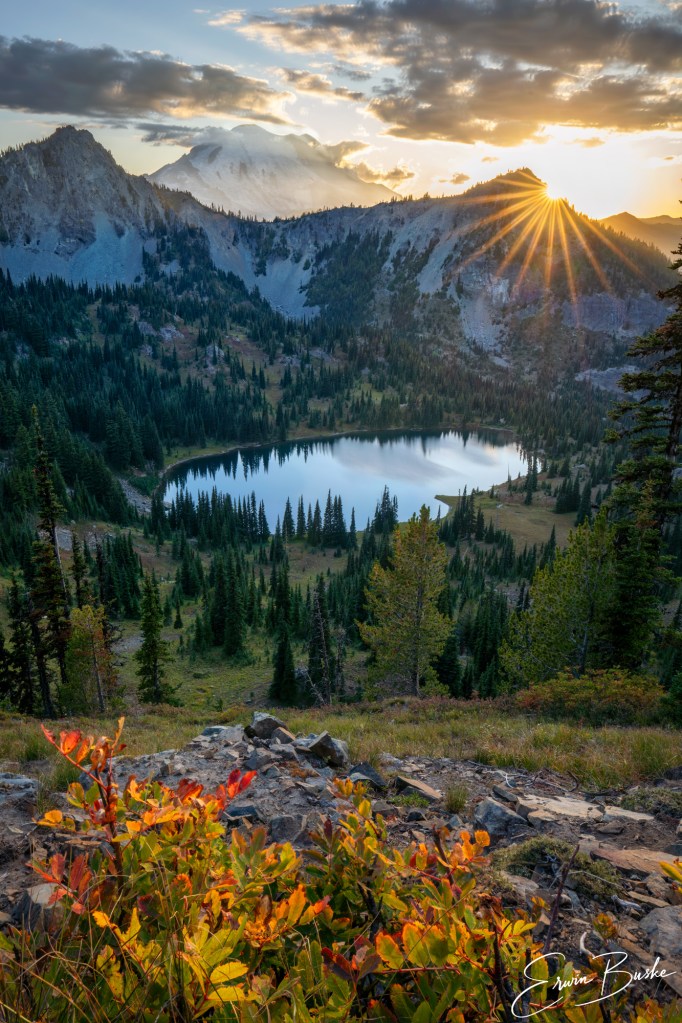
Around sunrise and into early morning, Mirror Lake was deep in shadow. But when the sun peaked over one of the ridges of Pyramid Peak and found an opening in the trees, golden rays of sunlight burst upon this beautiful petite lake. It is at moments like this that I am reminded what a gift it is just to be alive and able to experience such sublime beauty–truly a moment of golden tranquility. Mt. Rainier National Park

39. Waterfall Girl

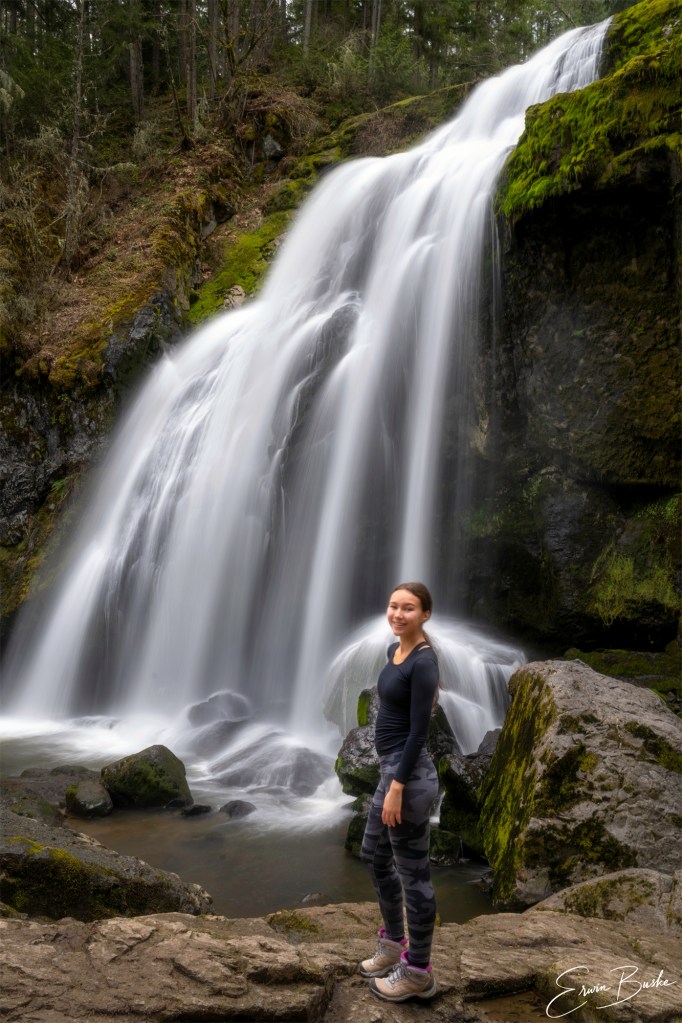
During her Spring break from UCSD, my daughter Caroline and I hiked to Little Mashel Falls. As you can see in the photo, the falls are not so little. Caroline especially loved getting behind the Falls and getting a bit wet! She liked the place so much she told me she wants to bring back her friends to do a trail run in this area!

40. Bayshore Harbor Sunrise

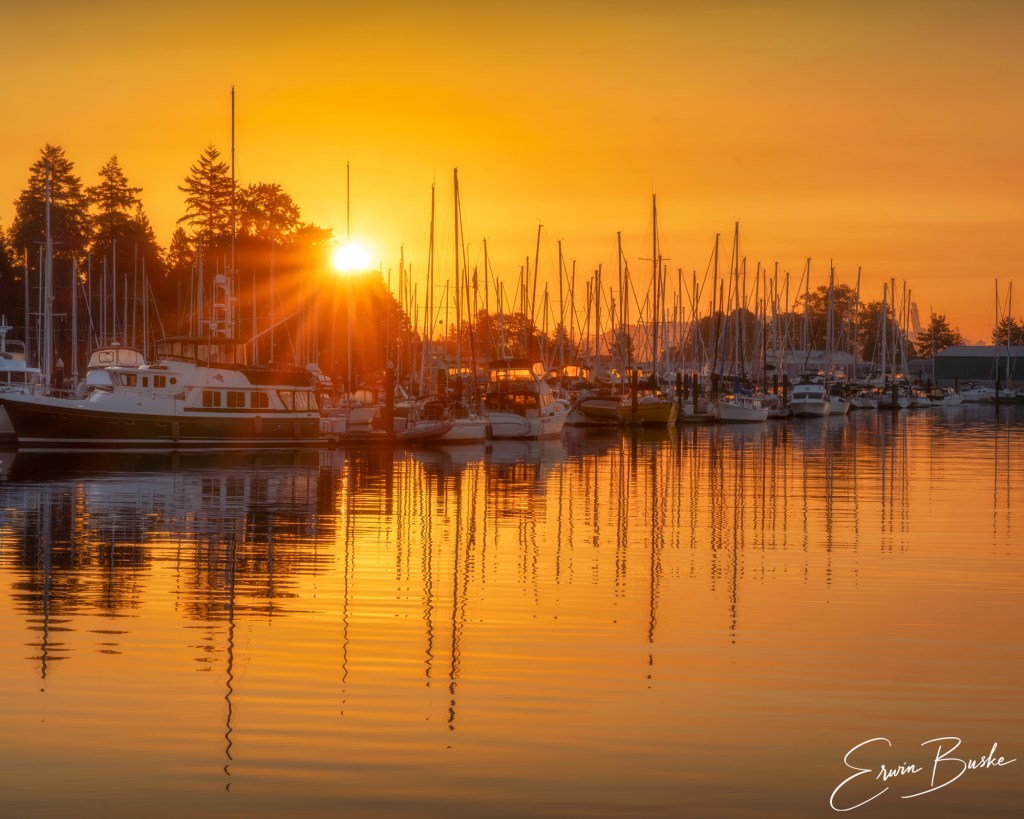
Here is an image of sunrise from Bayshore Harbor and Stanley Park-only a short walk from the Westin Bayshore hotel, where my daughter and I stayed during our end of summer vacation before she headed back to college at UCSD. We had plenty of time for swimming and city shopping making Sweet Caroline happy! The hotel provided us complementary bikes to ride around Stanley Park and Caroline navigated us to some very authentic Japanese Ramen on Robson Street. She developed a taste for authentic Ramen while an exchange student in Japan. This was followed up by some super thick European style hot chocolate at the Mink Cafe in downtown Vancouver! Did I mention the Gelato the night before? Time to hit the gym and trail’s LOL! But what a way to cap off a wonderful summer and give her a memorable send off! 

41. On the Foggy Autumn Tral

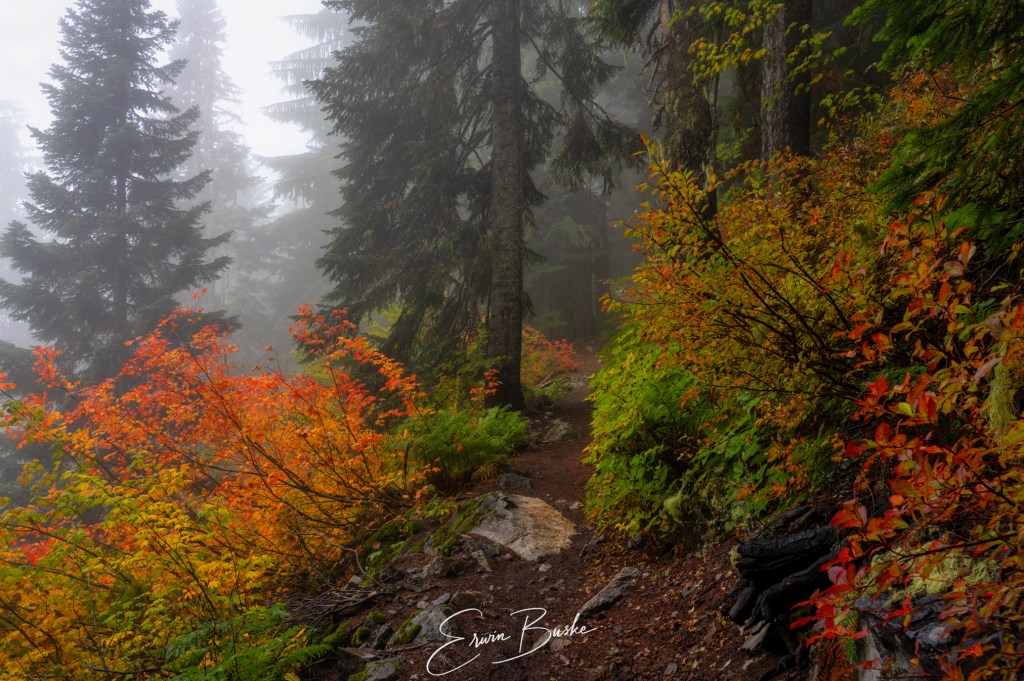
From late September, I am walking through an inversion layer of fog, beautiful autumn foliage and a forest, on my way to the Pacific Crest Trial Catwalk.

42. Mushroom Paradise

Part of me believes that one can only find the best images by hiking way in and doing the hard work, and often this is true. But sometimes an image will present itself right at the beginning of the trail. These are the images that are the easiest to miss because our minds are already travelling somewhere way down the trail. That is why it is important to open to discovering beauty at all times. These mushrooms were literally glowing in the forest right outside the parking lot at the Middle Fork. But I watched hiker after hiker just walk on by. 

In this scene I felt drawn not only to the glowing mushrooms in a family huddle along with the surrounding moss, but also the diagonal roots on both sides of the mushrooms which echoed the shape of the trail leading into the forest. I loved the way the golden centers of the mushrooms matched closely the golden color of the tree where the trail vanishes in the distance.

43. On the Autumn Trail to Poo Poo Point

It was absolutely an amazing experience in November hiking into the sunlight and the forest of broadleaf maple trees! Colors were at their peak and in excellent form. I do not think I have ever seen Fall Color this good before on the trail to Poo Poo Point! I go here mainly for a quick workout, but occasionally I get blown away by its beauty!

44. Flow-Wu Wei

The Tao is nameless and unchanging.
Although it appears insignificant,
nothing in the world can contain it.
All things end in the Tao
just as the small streams and the largest rivers
flow through valleys to the sea.
From Tao Te Ching by Lao Tzu

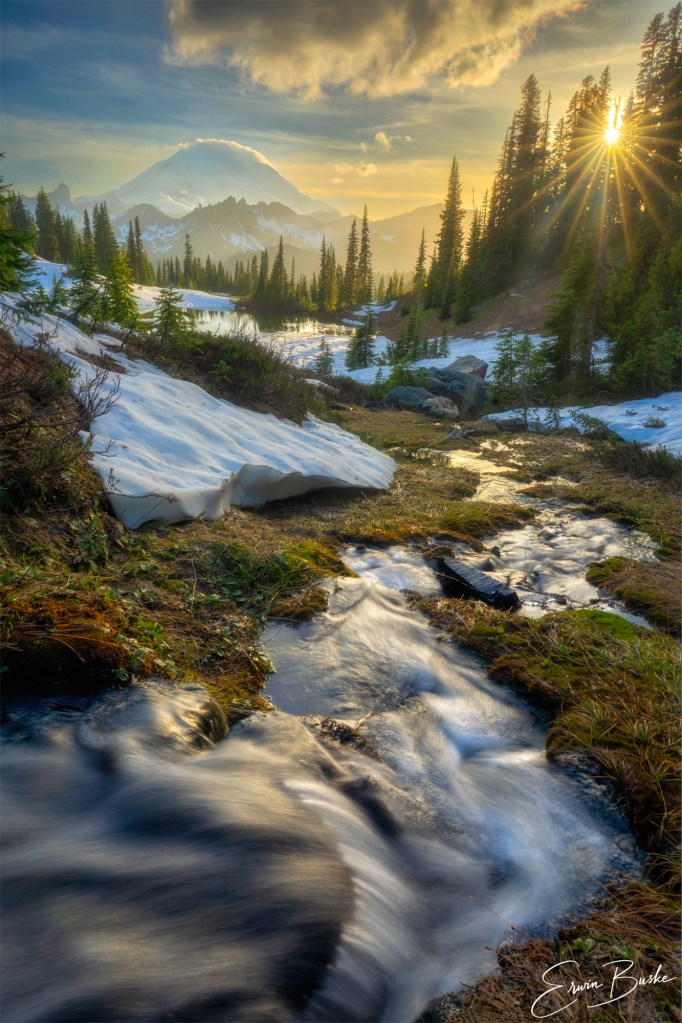
I love small streams often more than large rivers. They are closer to the source, and ultimately can be closer to us. This water from the Spring melt down has a long way to flow before it reaches the sea, evaporate into the sky, and make the return journey once again and forever without end. How long could you sit by this stream? I was there about two hours! I wish it was longer!

45. Freedom in Nature

“Man is born free but everwhere is in chains” Rousseau.
As important as these things are, I do not find freedom in hopes for political change, a new employment opportunity, a new hobby, new material possessions, or even a change in relationships. I find freedom in nature. In nature I feel connected to all of creation, and yet I know I still can express myself as an individual. But I can only do this because I am connected to all that is around me: the setting sun, mountains, beautiful mountain ash turning color, the water, sky, air, wind and earth.

46. Tiger Mountain Super-bloom Bouquet

I just loved this bouquet of daisies, fireweed and foxglove flowers looking out from West Tiger 3 to West Tiger 2 and Mt. Rainier during the golden hour. This area was logged a few years ago opening up views. Now the wildflowers have established themselves and this year to my eyes have reached super bloom status!

47. Day of the Eagle

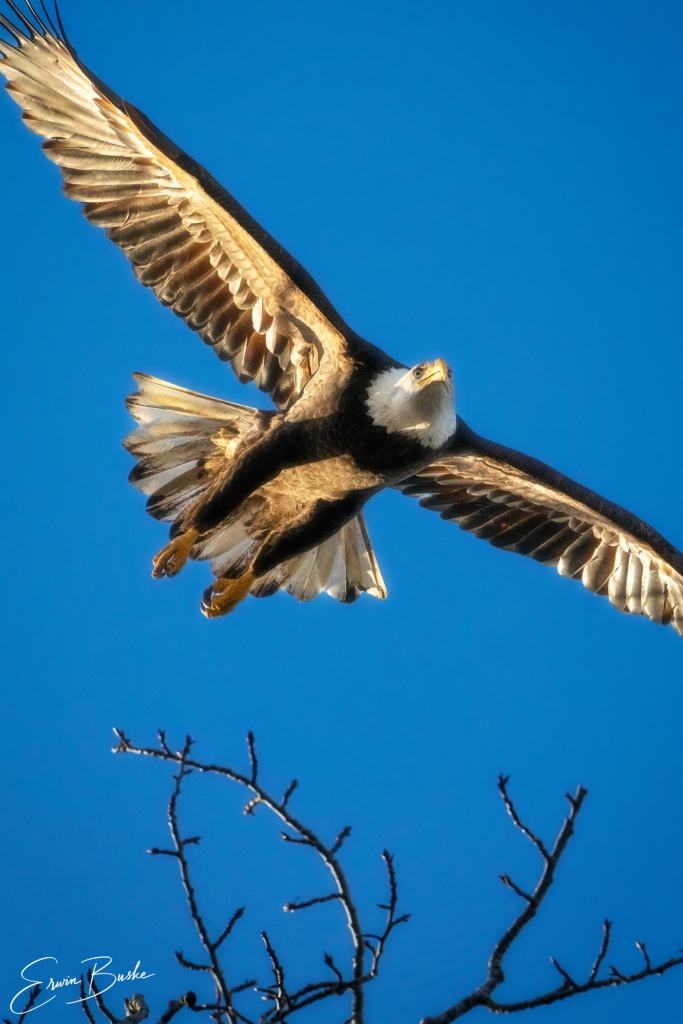
This was taken on a beautiful February day close to sunset. We were looking for the elusive Bobcats that allegedly have been seen in this area but settled instead for these awesome eagles. The Bobcats will have to wait for another day!

48. Palouse Meditation

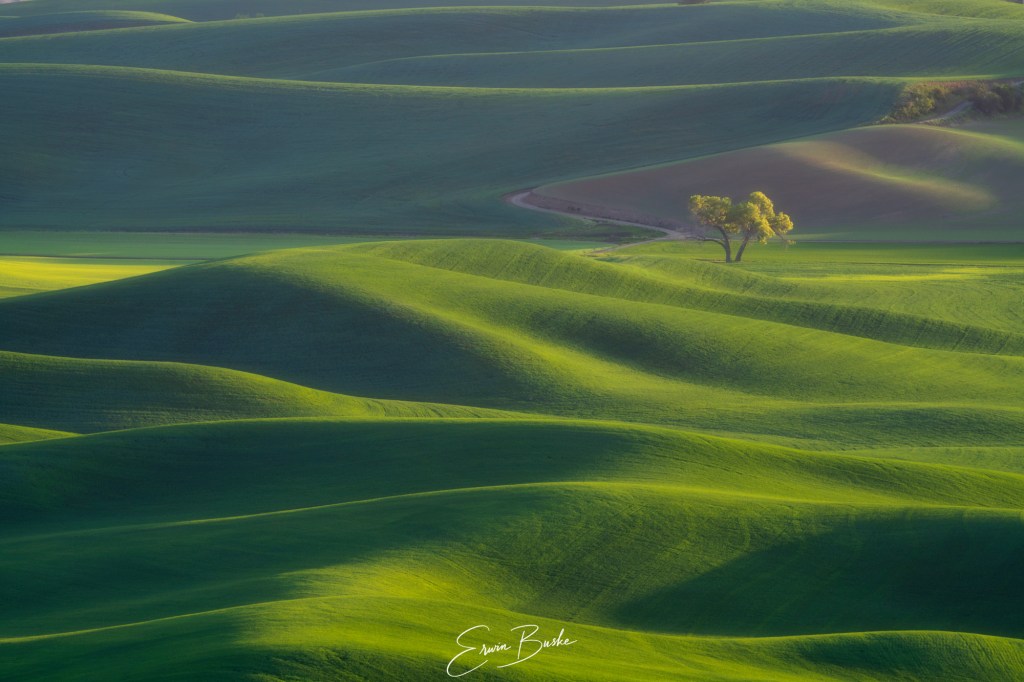
On my first evening in the Palouse during May of this year, I was almost immediately drawn to this beautiful scene. Like in meditation or yoga practice, the tree was the calming focus of my attention. But even with my eyes drawn to the tree, I was also aware of the surroundings–beautiful wavy fields, light cresting the tops of the hills, a small road leading to the tree, contrasting green and brown fields, the play of light and shadow, and myself-all seamlessly integrated into a harmonious whole.

49. Come Walk With Me

It was a beautiful, serene morning on this Autumn day at the Japanese Garden, as I walked across a foot bridge into double sun stars, a burring Japanese Maple and beautiful pond reflections of surrounding sculpted Black Pines.

50. Light Beams in a Foggy Forest

The Japanese have a word for light beams in the Forest, Komoebi. Many of my hiker friends call them God Rays. The feeling one gets walking through the forest, with the sun shining through the fog and filtered into directional beams of soft light, is ultimately beyond words. The experience is transcendent as we feel ourselves dissolve into the ether. We are the light shining in the forest.
The Stories We Tell Through Our Images–With or Without Words

Images have the power to immediately impact our mood and bring to our awareness an emotional reaction much more so than words can. Testimony to this are several common phrases in our language the we frequently hear.

“A picture is worth a thousand words”

“Images speak louder than words”

“No Words” (phrase uttered after seeing an inspiring image”

“No Words Necessary”

“A picture that needs no words”

“The Picture Speaks Volumes”

“Beyond Words”

“Silence is Golden”

There are of course others, but I think you get the picture!

Words alone, however, are also powerful and can impact our imaginations, thoughts and emotions in a way an image cannot. When there are just words and no visuals, we have no choice other than to use our imaginations to conjure up our own images of the scene based upon our reading of the authors skillful integration of words. Our words can also provide a bold affirmation of our innermost thoughts and emotions in a way that others will also be able to understand. It is unlikely that our innermost thoughts and emotions will flow directly from just viewing a photographic image and must be communicated through the use of words.

A mile at sea, Cake Rock, against the blue,

Lifts its seafowl sanctuary. Harsh squawks

Float from the monoliths. A few

High breakers begin their crest and churns,

As I watch the sun sinking toward sea stacks,

And the world turns.

Nelson Bentley from Iron Man of the Hoh 1979

Nelson Bentley was a Pacific Northwest Poet and also Poet Laureate at the University of Washington with whom I had the honor of taking a few evening, for credit, poetry workshops during my college days. Bentley was a champion of writing about his personal experience firmly anchored in the landscapes of the Pacific Northwest. At one of these workshops he said something that I remember to this day: “There’s no such thing as a cliché image — any more than there’s a cliché maple tree. You don’t walk by a maple tree and say “Oh God, there’s another maple tree!”” Although he was talking about the use of words to paint images, I believe the same thing applies to images themselves. It does not matter if the image is a cliché or not if you are able weave into the creation of the image in an expressive way your own personal experience. When this is done best, others will also be able to relate to your personal experience in a way that is meaningful to them. But as photographers and storytellers, how do we best do this, with words, no words, or some combination of the two?

UW Cheerful Cherry Blossom Morning
UW Cherry Blossom Morning Reflections

Stories

With Landscape and Nature images we tell several types of stories, sometimes using words but sometimes also using no words. For the purposes of explanation I will put these stories into the following categories: (1) the Journal Entry, (2) the Documentary, (3) the Metaphor, (4) the Message, (5) the Short Story, (6) Title Only, (7) No Words, (8) and the Evocation. Keep in mind, however, that these types of stories (with the exception of no words) can also be combined in the narrative. Nevertheless, one of these story types will usually stand out from all the rest.

The Journal Entry

The story we most often see in the narrative is the Journal Entry. The most basic journal entry is just a matter of fact descriptive story of where the shot was taken and some comments about the weather and light. Quite honestly this is what most of the time I see in image narratives. A more detailed journal entry may also discuss some of the photographic technique and thought process that went into creating the image. But just like in our private journals, a Journal Entry can also get into discussion of our emotional state at the time we took the image, and why this image has meaning to us. Some on social media even take it a step farther and make their journal entries something more like a confessional where they bear their innermost thoughts and secrets!

The Way of Hope The conditions along the Oregon Coast were starting to get us down with the gloomy overcast, wind and on and off again rain. Then we came across these rocks with layers of sea salt turned orange pointing out to the sea stacks and sun breaking through the gloom. There is hope in just about any situation and in photography there is no such thing as bad light. One just needs to rise to the occasion!

The Documentary

The Documentary, in the sense I am using it for this discussion, is a primarily factual description of either the natural history of the geographical area and or a history that also includes human involvement in the landscape. Some documentaries may also involve a discussion of how the environment is changing, either through natural causes or due human causes and possibly what we can do to reduce threats to the environment.

Walking Into A Dream
This image was taken in early August att Indian Henry’s Hunting Ground, Mount Rainier National Park. This cabin is in as beautiful setting as I could ever imagine and is like walking into a dream. Indian Henry, known as Soo-Too-Lick, early on (1883) guided several familiar names to Mt. Rainier including the Hunting Grounds. These familiar names include James Longmire Philemon Beecher Van Trump and John Muir. Indian Henry was a Cowlitz Indian, beloved by many people.

The Metaphor

The metaphor uses words to imply something that is not literally in the image in order to suggest a resemblance such as “Nature’s Church.” In the case of images the metaphor usually relies on objects in the image that have symbolic value to suggest the resemblance-for example rainbows and hope. Although the metaphor may be implied in the image itself, it is usually more of a conceptual creation that requires the author to establish the symbolic resemblance through the skillful use of words in the narrative.

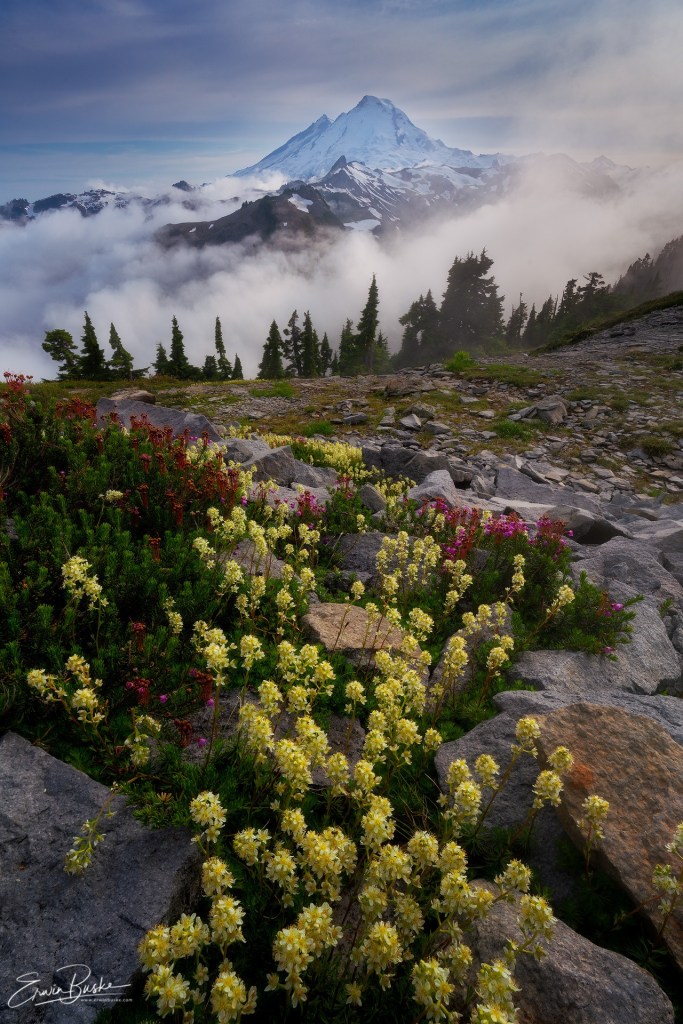
Mt. Baker has Rising Above the Clouds.
The moment when something changes after a long day in the clouds, Mt. Baker has risen.
The mountain was still lost in the clouds, which to me felt a lot like soul searching
and a process of self discovery. I know the mountain is out there and will eventually emerge
from the fog, clouds and mist. Just as I know my authentic self, the essence
who I am, has always been there just waiting to be rediscovered. When the
mountain comes into view, this validates the process of self discovery. The
image and story here is something others can relate to, share in the vision, and
participate in the metaphor of self discover
y.
Middle Fork Bridge to the Spirit of the Shire
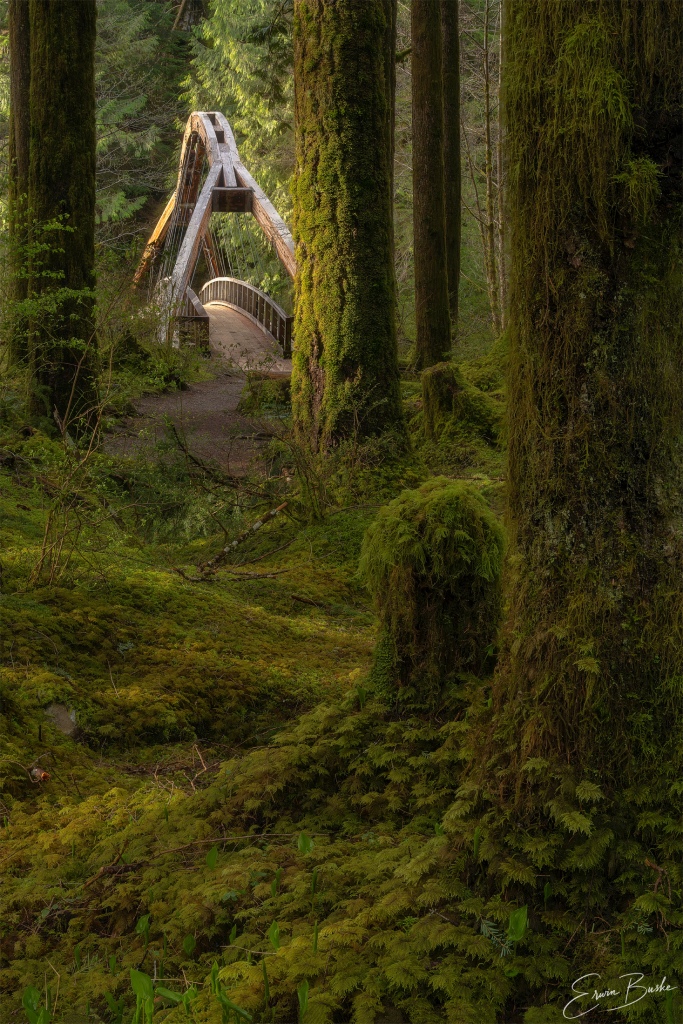
This has to be my favorite hiking suspension bridge and I return here often to visit this beautiful, lush forest and the wild Middle Fork of the Snoqualmie River, both which remind me of Tolkien’s world and the spirit of the Shire.

The Message

The Message, as I am using the term here, uses the image as an avenue to inspire others or as a call to action. The image may not relate directly to the inspirational message or the call to action, but it does help bring forward even ignite an emotional response that gests associated with the message through the skillful use of words. We see this often with the use of quotations from famous authors, but the resourceful photographer can craft his/her own words to accomplish the same result.

Let the Light Always Be With You
In the early morning at Cape Disappointment the sun finds an opening in the clouds to fill the entire atmosphere with wonderful angelic light. Every day in life is such a blessing and it is in moments like this I remind myself to live each day to the fullest. Every day is a new beginning. Who knows what is around the corner. Plan for tomorrow, but always live for today as if it were the last and welcome the light of dawn!

The Short Story

The short story (or in the case of images some might even call this a mini story!) goes way beyond what we typically see in an image narrative and includes a story usually in the form of a linier narrative centered around a sequence of events. Although short, the story will include key elements of any story–a setting, a protagonist, plot, dramatic conflict or tension, and resolution. Telling such a story coupled with an image can go a long way toward elevating a viewer’s reaction to the image beyond what would have been possible with just a simple narrative or no words at all. But the risk here is that the story itself will be primarily what holds our attention, with the image just being what initially grabs our attention. This is why if you choose to tell a short story that it is important to couple it with a compelling image that invites us to look deeper, and that could easily stand on its own with or without a narrative. Then the image and story, coupled together, will be far greater than the sum of the two constituent parts.

Hot August Meadow in the Goat Rocks
In the middle of a hot August, I started my long loop trip hike into the Goat Rocks at sunrise and did not finish until well after sunset. I suppose I could have finished sooner, but what is the hurry? In the evening I passed through this happy meadow just below a ridge top and decided just to hang out and enjoy nature at her finest for an hour or so. For the hike down from the ridge to the car, I eventually had to use a headlamp to help guide my way. In order to not surprise animals I played Neil Young music through my JBL speaker attached to my belt. No sooner than I set up the headlamp and music, I peered out onto the trail about 50 feet ahead and saw two narrowly spaced bright glowing eyes staring at me. At first I thought it was a person because the eyes were fairly high off the ground. Then I saw like a shadow a big and long bushy tail. It could have been a wild dog or cat, I do not really know for sure. The animal would not move so I turned up the music a bit more, now Neil Young’s Natural Beauty Song. The animal then slowly with grace, almost like our family cat Precious, started moving up the rock talus and perched onto a flat rock like a silhouette and sat down like a royal cat still looking at me with those glowing eyes. Amazingly calm, I proceeded back out onto the trail but it later occurred to me that if this was a cat it may have just positioned itself in a prance position. Nevertheless it was all ok and good—Perhaps thanks to some mellow Neil Young music!

Just a Title or No Words

In the early days of photography most images were presented without the use of words with the possible exception of the title. Although the title might give the viewer some information about the image such as location or time of day, the image itself tells the story or touches people in such a way that they can tell their own story in a way that speaks to them individually. I do acknowledge that a well chosen title can give the viewer a meaningful clue of how to interpret the image and this is why some purists do not use even a title and opt for no words. Some nature and landscape images may tell a story relatively easily, such as a transition from one season to another; or a river that meets the sea. But most will need to have sufficient emotional impact to stir the viewers subconscious and imagination in such a way that it invites them to go deeper into the image and tell their own story.

Although I titled this image “Express Yourself”, this is an example of an image that tells its own story, and the story is not dependent on a title or narrative.

At least one third of the time I do not include a narrative at all with my images other than a title for identification purposes. On my Instagram stories, I often even abandon the title. The reason I do this is a conscious choice. I believe that a particular image is sufficiently strong that it will immediately cause an emotional reaction in the viewer. The viewer will connect with the image and tell their own stories as evidenced by detailed social media comments that resemble a narrative. Anything I say in my own narrative will likely just get in the way of this spontaneous story telling.

One of the ways of displaying images without words that I like best is a slide show synched to just instrumental music. Although the music complements the mood of the show, most of the emphasis is on the images, their sequencing, and transitions for image to image. The images collectively work together to tell the story in such a way that is far greater than the sum of the individual images. Here is a recent slide show I put together, the Rhythm and Moods of the Pacific Northwest, with my daughter Caroline playing the piano. One can do something similar in a portfolio of images, putting the emphasis on the images rather than the narrative to tell the story-a much more challenging task than combining the images with a narrative because the story needs to develop from just the images themselves.

North Cascades Autumn Magic
Orange Rays and Tulips at Sunset

The Evocation

The evocation recognizes no words can describe the wonder and beauty of nature. The image itself is actually the best expression of the wonders and beauty of nature. But if we want to also use words to complement the image, the best a person can do is to use evocative rather than literal language. Literal language seeks to fully describe the mystery of nature often in scientific terms but always somehow falls short. Evocative words as described by the Zen poet Ryokan are like a “Finger Pointing at the Moon”. Symbolically the finger represents the words and the moon nature or reality. The finger only points at the moon, it is not the moon itself. Words only give us an expression of the wonders and mystery of nature, and are not to be confused with nature itself. The evocation usually uses more poetic language to express to the reader a sense of what he or she experienced in the process of creating an image. Words will be carefully chosen for their sound with extensive use of alliteration and consonance (repetition of sounds), rhythm and perhaps even rhyme. Words chosen for the narrative will often be metaphors in their own right such as “Foxglove” and “Avalanche Lilies”.  Where sound is implied in the image, the writer will use Onomatopoeia– words that, through their sound and well as their sense, echo and mirror the sounds implied in the image. Frequently but not always, such words are natural sounds.  Beez buz, cows moo, birds chirp. The narrative will be rich imagery, symbols and descriptions of feelings that do not just literally describe the photography but complement it so that the photography and narrative together take us beyond the literal and allow us to better appreciate the mystery of nature. For more on the mystery of nature, see my blog post Mystery: The Holy Grail of Nature Photography.

There are moments when my soul is a mirror to everything around me. Forms, shapes and patterns bathed in light rise out of the dark void and return again in an endless cycle. In such moments I feel I am the mountains, the sea, the setting sun, and the tree spread out over the bay. There is no me, mountains, sea, setting sun, or tree spread out over the bay–Satori.

Contemplative Photography and No Words

It seems to be in vogue right now within the professional landscape photography community to insist that all images need a narrative. This is in part a reaction to their tiring of images on social media whose primary purpose is to grab our attention immediately in order to garner likes. I understand this frustration, but this kind of skepticism goes too far when applied to all images with no narrative. The Contemplative Photography Movement which is known for images that are not immediately attention grabbers offers a case for using no words, not even in the title. Lets review some of the key precepts of the Contemplative Photography Movement.

One of the primary precepts of Contemplative Photography is that our thoughts and words are like filters that alter reality. In order to connect more directly with what we are seeing we need to quiet the mind. This is done through a more mediative approach to photography. In this regard a precursor to the contemplative approach is slowing down, spending time in nature, and developing an unfiltered awareness of ourselves, nature, and the landscape. Words themselves are considered a filter. Once I name and label something with words, I am already picking out something in my surroundings and in effect objectifying it, giving it special importance. But this very process interferes with my ability to connect with all of my surroundings and downplays interrelationships. Many of you are likely saying by now, but is not this what we do in photography-identify a subject and separate it from the background? Contemplative photography definitely will identify a subject in the image, but the process for doing this will be quite different, one that preserves a more fluid relationship and interconnection between myself, the subject and my surroundings.

Andy Karr and Michael Wood offer a description of the contemplative process in their book “The Practice of Contemplative Photography (1). The contemplative process involves three stages of creativity as they apply to a photograph:
  • Connecting with a Flash of Perception
  • Visual Discernment
  • Forming an equivalent to what we have seen

Flash of Perception

A flash of perception comes in the gaps in the flow of our mental activity. Mental activity is often characterized by sticky attachments to our conceptual thoughts that surround what we are feeling at any given moment. Through time in nature, slowing down, meditation, and mindfulness these conceptual thoughts loose some of their grip. Then when one of these gaps in our mental activity occurs we are more ready for a flash of perception. This is also the stage where the dialogue begins with our unconscious self and we become more aware not only of our surroundings but also our inner selves. A flash of perception is not an intentional activity, one cannot plan for it, and is a bit like seeing something out of the corner of ones eye. Most people with miss this flash of perception, and only those who are ready for it will recognize the flash, those with a open mind and heart.

The state of mind of the photographer while creating is a blank… But it is a very active state of mind really, a very receptive state of mind, ready at an instant to grasp an image, yet with no image pre-formed in it at any time.

Minor White
Rock Tapestry

Visual Discernment

Visual Discernment involves staying with the contemplative state of mind after the initial flash of perception. Here we rest with our perception and allow the basic qualities of form, light, patterns, tones and textures to be recognized through our intuitive non-conceptual intelligence and the feelings we are experiencing. Visual discernment slows us down even more and gives us some space that allows our photographic vision to emerge.

Misty Mountain Forest

Forming a Visual Equivalent

Forming an Equivalent involves forming an equivalent of your perception, taking and processing the image. The image will be the equivalent of your perception and it should be obvious it will not be the same thing as this is impossible. The Contemplative Photography approach as it was originally envisioned involves a more representational style, but the resulting image is not so much a documentation of our experience as a creative expression of our experience, especially our inner experience. This is what makes the resulting image unique and always creative.

My Approach

Although some who practice contemplative photography do not title their images or use a narrative, this is not the approach I adopt 100% of the time. Helmut Mohelsky in his book Seeing With Your Own Eyes, offers a defense for not using titles or a narrative.

“To leave one’s images untitled is consistent with the contemplative approach to photography. A clear vision leads to images that are self-explanatory. Generally speaking photographers give a title to their work when they identify with the particular subject. The titles are the result of a mind that reflects, associates and interprets what it sees. In contemplative photography, we are engaged in a very different process. We do not base it on identification with a particular subject, idea, or emotion. We don’t prepare for the content of a flash of perception, nor do we base it on an idea, nor do we pre-visualize or imagine it. While the clarity of the flash lasts, our mind is not reflecting. It is unobstructed. ” (2)

My approach is more flexible depending upon the image and what needs to be communicated. If the image is my equivalent of a flash of perception, I may opt for no words. But there are times words are absolutely necessary. If I am using an image to provide background on an environmental threat to landscape I will need to use words. If I am using a image to inform people of actions they need to take to protect a threatened environment, I will need to use words. If my intention is to establish a metaphorical connection between objects in the image and a idea, I will also need to use words. If I feel the sequence of events leading up to taking an image are a part of a personal story that would entertain others, I will let the drama unfold in a short story. But if I am using an image to express my connection to the wonders and mystery of nature, I may opt to use no words. Or I may use more evocative and poetic language that like “a Finger Pointing at the Moon” helps the viewer to connect, participate in, and live for themselves my personal vision. The use of evocative language coupled with the image ultimately creates visual poetry and for me this is my preferred approach to writing a narrative.

The Trail to the Pacific Northwest

Copyright 2022 Erwin Buske Photography

References and Additional Reading

(1) Andy Karr and Michael Wood, The Practice of Contemplative Photography, Seeing the World with Fresh Eyes, 2011

(2) Helmut Mohelsky, Seeing with Your Own Eyes, 2019

(3) Erin Babnik, How Landscape Photographs Tell Stories , 2015

(4) Erwin Buske, The Hidden Landscape, 2021


Thanks so much for reading and viewing the images of this blog post. I encourage you to share your reactions, thoughts, comments, impressions on this post here. If you think others would enjoy reading this post please also share it with your friends and communities. If you would like to see more content like this subscribe to the blog so you automatically receive future blog posts. To learn more upon my perspectives on nature be sure to check out my Ebook, the Hidden Landscape: The Inside Passage. This image rich book is 248 pages and provides insight how nature, mystery, the Tao, Zen, and the American Transcendentalism of Thoreau inform my photography and can provide sources for you own inspiration. Here is the link to the EBOOK along with a preview. https://payhip.com/b/FCI4z. Thanks again and happy trails!

Announcing My Quarterly Newsletter

I just published my first quarterly newsletter. In this first newsletter I provide some guidance for visiting at peak bloom the wildflowers at Paradise Mt. Rainier. There also is a short article on a method I find very useful in creating compelling images of the wildflowers in their larger environment titled: “To Focus Stack or Focus Stack, That is the Question”. You will also find a summary of my new Apprentice Program where I work one on one with a photographer over a period of time of one year for skill set development and to help the photographer creatively find his/her vision. There are also special offers available only to newsletter subscribers and announcements of upcoming trips I lead for the Seattle Mountaineers.

Wildflower Rapture
Focused Stacked Image

Here is the link to my first newsletter: Summer 2019 Erwin Buske Photography Newsletter

Here is a link to where you can subscribe to the newsletter. Subscribe

I will of course continue to post informative and inspiring article here on this blog, but as has been the practice, blog articles will explore subjects in greater depth. The newsletter will only contain short articles that are easily read in a failry limited period of time. I encourage everyone to also subscribe to the newsletter and in many ways the blog and newsletter are designed to work even better together, although they will also stand on their own. Thanks so much everyone for being part of my photographic journey!

2019 Calendar: The stories behind the images


I am excited to announce that my 2019 Calendars are now available.  Here are the stories and also hopefully some of my not too random ruminations  to go along with the images!

There are two calendars available, a standard size offered at $21 and a large size calendar offered at $35. 50% of the proceeds from the sale of the Calendars will go to support the Washington Nature Conservancy and the remainder will help offset my operational costs.


Spirit Angels in the Forest SS

January: Spirit Angels in the Forest

When I fell asleep Saturday evening I had no plans hiking the next day.  But when I woke up about 5AM feeling wide awake and calculated that if I left for Poo Poo Point soon I could be at the top before sunrise–this all changed. I decided to go and I am glad I did! It was one of those mornings where the valleys are filled with a sea of fog moving like spirits through the forest. As the sun rose interesting combinations of warm and cool light ensued. I used my 200-500 telephoto lens to capture about 700 images and the constantly changing drama and action.  Even in the field, however, I knew this image was the one that best captured the feeling of this place and time!  Sometimes one is just in the zone and it all comes together-weather and atmospheric condition, the forest, imagination, vision, ones inner state of mind, emotions, weather, and technique–all working together seamlessly together in a state of flow to bring to the light of day an image that lurks just below the level of consciousness.   For more on capturing this type of image see my blog post Forests in the Mists: Windows into the Active Imagination.
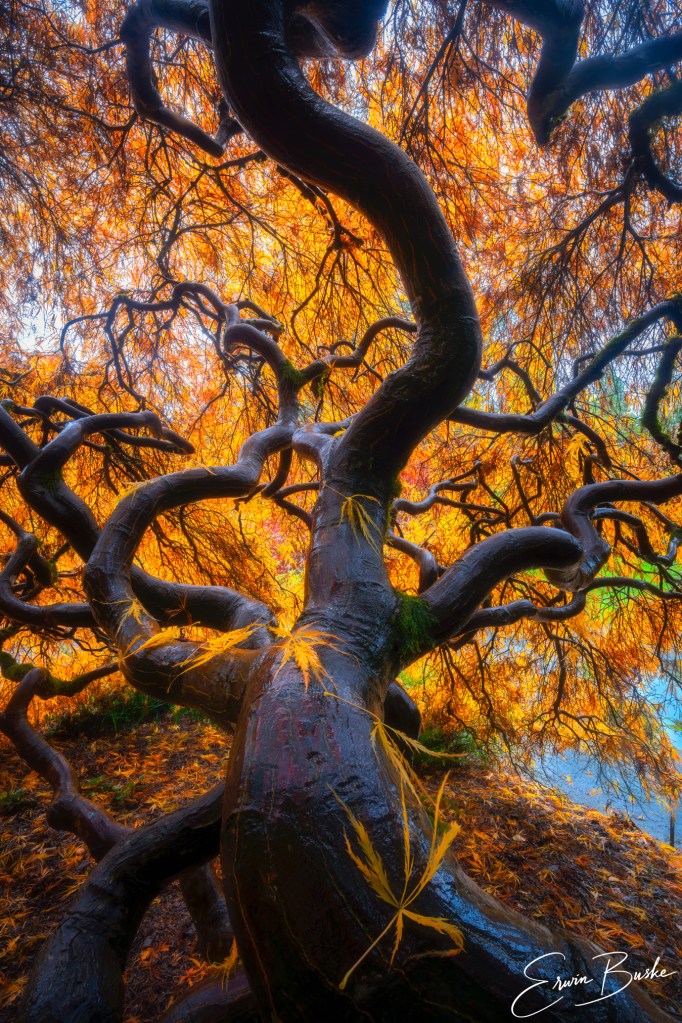


Gold Creek Pond Eastside170-HDRcomp

February: Gold Creek Pond Winter Skies

This image is of Gold Creek Pond close to sunset on a late December evening. It was cloudy most of the day but toward sunset there were brief openings in the clouds to let in some beautiful light.   Kendall Peaks are in the distance which were the destination for many of my previous snowshoe trips.   On this trip, the snow around the pond and up the valley was very compact so my micro spikes were sufficient and snow shoes were not needed.  As I stared across the pond I noticed the bridge and Kendall Peaks rising above the forest.  Often I have hiked around this pond on snowshoes and also up the long winding trail to the top of the peaks.   In the long moments of reflection leading up to this image I would often flash back to these earlier experiences, but some how the beauty of this place—its silence, interspersed by the occasional duck calling or light wind blowing– would bring me back to the here and now .   In the mountains it is almost like we experience eternity one moment at time.   In this moment I knew I would return to this place again and again.  In landscape photography there is a lot of waiting for the right moment to arrive.  But it is this waiting in beautiful place like this that I often like the most, experiencing the timeless wonders of nature.
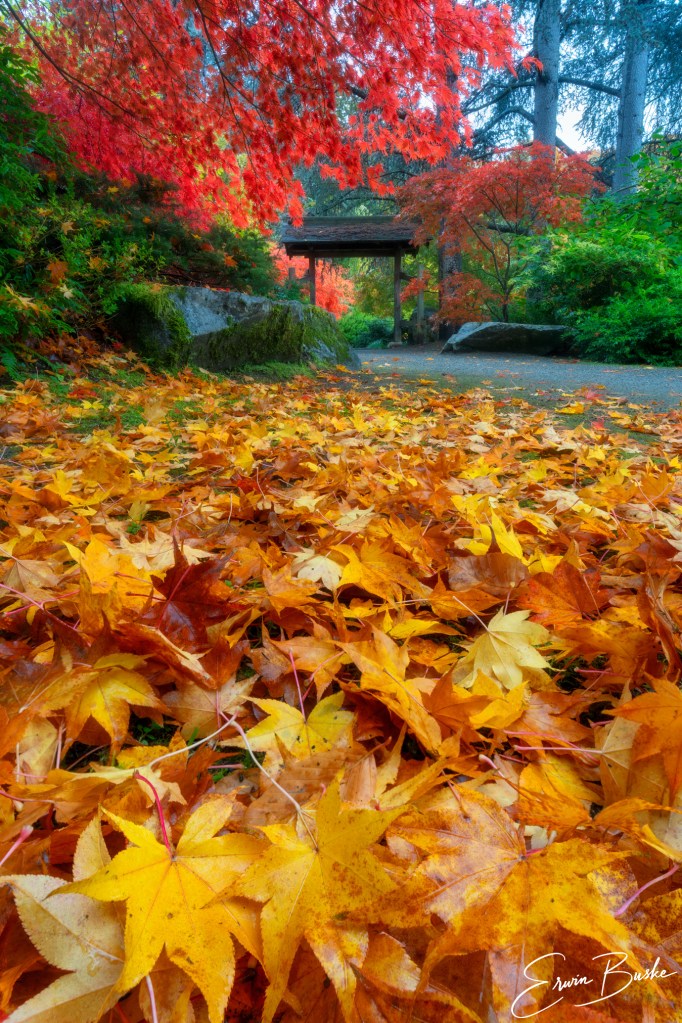


Taming of the Storm

March–Mobius Arch: Taming of the Storm

On my first full day at Mobius Arch in the Alabama Hills there was an unrelenting wind and rain storm for a good part of the day until just before sunset. I lost power at my Hotel in Lone Pine, but when I saw the sun break through the clouds and the wind subside I went back to the Arches and was able to get set up just in time for this image. By the next morning is was nothing but Bluebird Skies as far as the eyes could see   For many, stormy weather is a signal to cancel plans for an outdoor excursion.  But for us photographers it is often a signal to us that it is time to go!


Skagit Mid March Daffodils 053 copy

April–Daffodil Field Evening Reflections

Daffodils bask in the evening light and are reflected in the water spanning long rows of flowers.  Bright yellow daffodils are the first to bloom in the flower fields of the Skagit valley often as early as late February.  The weather at this time is usually still cool and damp, sometimes even cold.  The fields are wet and muddy making setting up to take images an invitation to play and roll around in the mud!  This is one of the beauatiful Roozengaarde fields that are scattered throughout Washington’s Skagit River Valley.  The Roozen family business of growing Tulips, Daffodils and Irises is the largest in the world, covering Skagit Valley with more than 1000 acres of field blooms and 16 acres of greenhouses.


Morning Dew.JPG

May–Morning Dew

The Roozengaarde Tulip fields in Washington’s Skagit Valley awaken to a fine mist of morning dew as the sun arms reach over the distant mountains and envelop the fields. This year heavy spring rains flooded many of the field rows with standing water creating wonderful opportunities for silhouettes and reflections. A few of the fields were so bad that Roozengaarde closed them to any public access. Please respect their wishes and remember we only have access to these private field due to the good graces of Roozengaarde.  Getting to these fields for sunrise can be a bit of a challenge for those of us in the Seattle area which is about two hours away.  This year I scouted the fields the day before, spent the night in a comfy hotel, and made the long walk to this field using headlamp to be on site before dawn.  Had I not  scouted earlier, finding this spot in the dark would have been difficult if not impossible!


Diablo Lake Sunset

June–Diablo Lake Sunset

I have always just sped by this lake on my way back from the North Cascades, but last June on the way back from a hike and seeing the parking lot empty, I decided to spend a couple of hours exploring this iconic overlook. I love the fjord like quality of this lake and the teal color of the water seals the deal with me! With the earlier hot weather and rapidly melting snow, the water was flowing very good in the North Cascades now and it seemed like every quarter of a mile there was a seasonal waterfall, some spilling water directly onto the road!


Dead Hoarse414-HDR copy

July–Heather Pillows at Sunset

I just love where I live in the Pacific Northwest. I left my house one day in July on an impromptu trip and three hours later here I was in Paradise heading up the Dead Horse Ridge Trail to Panorama Point! If I was a dying horse these heather pillows would seem to be a beautiful final resting spot. How do these trails get their names anyway?  Heather are some of the first flowers to bloom after the snow melts usually right after the Avalanche and Glacier Lilies make their appearance.  The contrast of the pink magenta flowers and the surrounding new green foliage to me is just striking.  Spring comes to these meadow a little later than down in the lowlands, around the middle of July!


Lostine River Loop1669

August–Islands in the Sun

A beautiful bonsai rock is bathed in light from the sun that is setting below a ridge above Chimney Lake in Oregon’s Eagle Cap Wilderness.  I took this image on the last night of a week long multi-day backpacking trip with the Sierra Club.  The day before I did some scouting around the lake and was immediately drawn to this series of rocks leading up to this bonsai rock.  Chimney lake is somewhat difficult to photograph because the shoreline close to the water lacks remarkable features and the mountain on the backside of the lake is a long and fairly uniform ridge also lacking distinctive features.  This bonsai rock I thought would give the lake character and a more distinctive identity.

Capturing the scene at  sunset would be a challenge because the sun sets behind the ridge a good 90 minutes before the actual sunset leaving the lake and surrounding mountains in deep shadow.   I decided to photograph the rock earlier in the evening and when I approached the site I noticed  sun’s star also reflected in the lake.  At this time the light was way too intense causing massive flare even with a lens that is not prone to flare.  There was a short window of time, however, about a couple of minutes, when the flare was manageable and the sun star was still reflected in the lake.  It was during this brief period of time I captured this image!  A few seconds later the sun star reflection disappeared, and about a minute later the sun sank below the distant ridge and the entire lake area was in deep shadow.


Rock Tapestry

September: Rock Tapestry

The grand vistas of Death Valley Park including Zabriskie Point, the Badlands, Badwater, and Mesquite Flat Dunes seem to get all the attention.  But what I found most interesting at Death Valley are the more intimate and often abstract small area scenes deep inside the various slot canyons.  I am sworn to secrecy about the location of this image, but the location really does not matter so much for an image like this.  Venture into any of the canyons and wander deep inside, then pause not just for moments but extended periods of time to take in the small wonders of these canyons.  Study small areas on the walls and look for interesting patterns, lines, shapes, and contrasting colors.  Images will reveal themselves to you in time.  One just needs to stop and listen to the silent sounds written on the canyon walls.


Enchantments and Tumwater0395

October: Clearing of the Morning Mist

As the early morning mists clears out of the Enchantments Basin and Leprechaun Lake, a thin mist still hovers over Prusik peak creating a soft and airy feel on the granite walls of the peak extending down to some of the autumn larches.    I find Leprechaun to be the most interesting of all the Enchantment Lakes with its various peninsulas and channels spread out across the lower Enchantments basin. To me it is more like a half of dozen lakes than just one.  Soon after this clearing high winds would blow in snow clouds with flurries at night and a full fledged snow storm the next day.  We found a nearby high location with cell phone reception and learned that the storm would last several days.  We decided to leave the next morning heading down the steep mountainsides in at least six inches of snow with micro spikes on our boots and gloves on our hands!


Kubota 10.25

November: Kubota Maple Early Morning Light

I took this image in November at Kubota Garden as the diffuse sunlight making its way through clouds and trees was just beginning to illuminate the delicate now bright orange leaves of this legendary Japanese Maple.  Part of the look and feel of this place is the stream and water that surrounds this tree that sits on a small peninsula.  The tree is also surrounded by and sits below a mixed forest of much taller deciduous and evergreen trees providing a sense of enclosure. With my frequent pilgrimages to this place only 15 minutes from my home, I think it is safe to say that I periodically worshiped this beautiful tree!

It was a sad day for me, however, when I returned to the tree in April of this year and found out that an almost unbelievable rumor I heard was in fact true.  This legendary Japanese Maple Tree fell victim to a huge fallen tree in a storm, fatally crushing the Japanese Maple and now the tree is no more. They have planted a new smaller Japanese Maple from another location in the garden that has good form and symmetry, but it will take years for it to reach the size and stature of the one in this image. The long process of renewal now begins.  The lesson I learned from this episode is not to take anything in nature for granted.  The only thing that is eternal in nature are the ever renewing cycles of creation and rest.  Somewhere it is always Spring, and somewhere it is also always Autumn.  And somewhere a new tree has just sprouted from seed that will be the next beautiful legendary tree that captures the imagination of our children’s children children.


Mt. Si Reflections
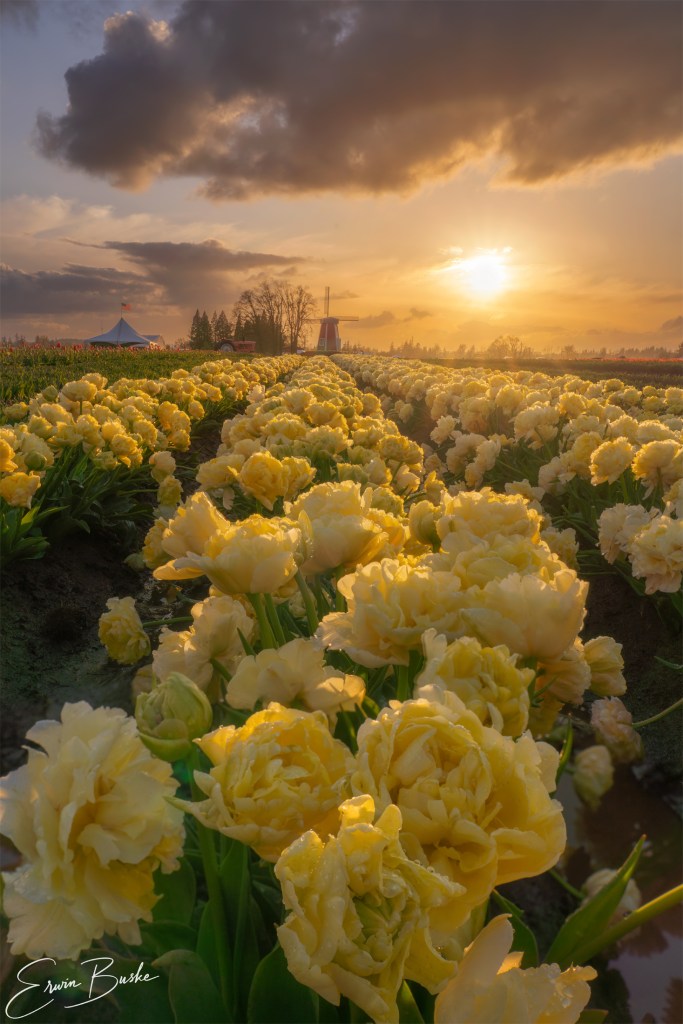
December: Mt. Si Winter Solstice

One can feel a tremendous sense of accomplishment and inspiration through finding beauty in familiar and ordinary places.  Often this beauty is not obvious and may be hidden.  This is one such place, no more than a half hour from my house at a park in the Snoqualmie Valley used primarily to walk dogs.  To approach this pond I needed to go through sticker bushes that found their way into my boots and skin, and finding a relatively uncluttered perspective was no small  exercise.  But nowhere have I gained more traction in developing my skill set than in presenting an ordinary place in the best light.  This is also the ultimate confirmation to others that you have arrived as a photographer through your ability to make even the ordinary look good.  Often this beauty was recognizable to us all along, but conveying this beauty that is often very personal  to others remains a huge challenge.  But if one can communicate a sense of your “Feeling” of a place at these somewhat ordinary and mundane locations, think how much easier it will be to do this at iconic sites and other places where the beauty is so obvious to everyone!  For more on finding sources of inspiration see my blog post Sources of Inspiration for Nature and Landscape Photography: Finding Your Photographic Vision.
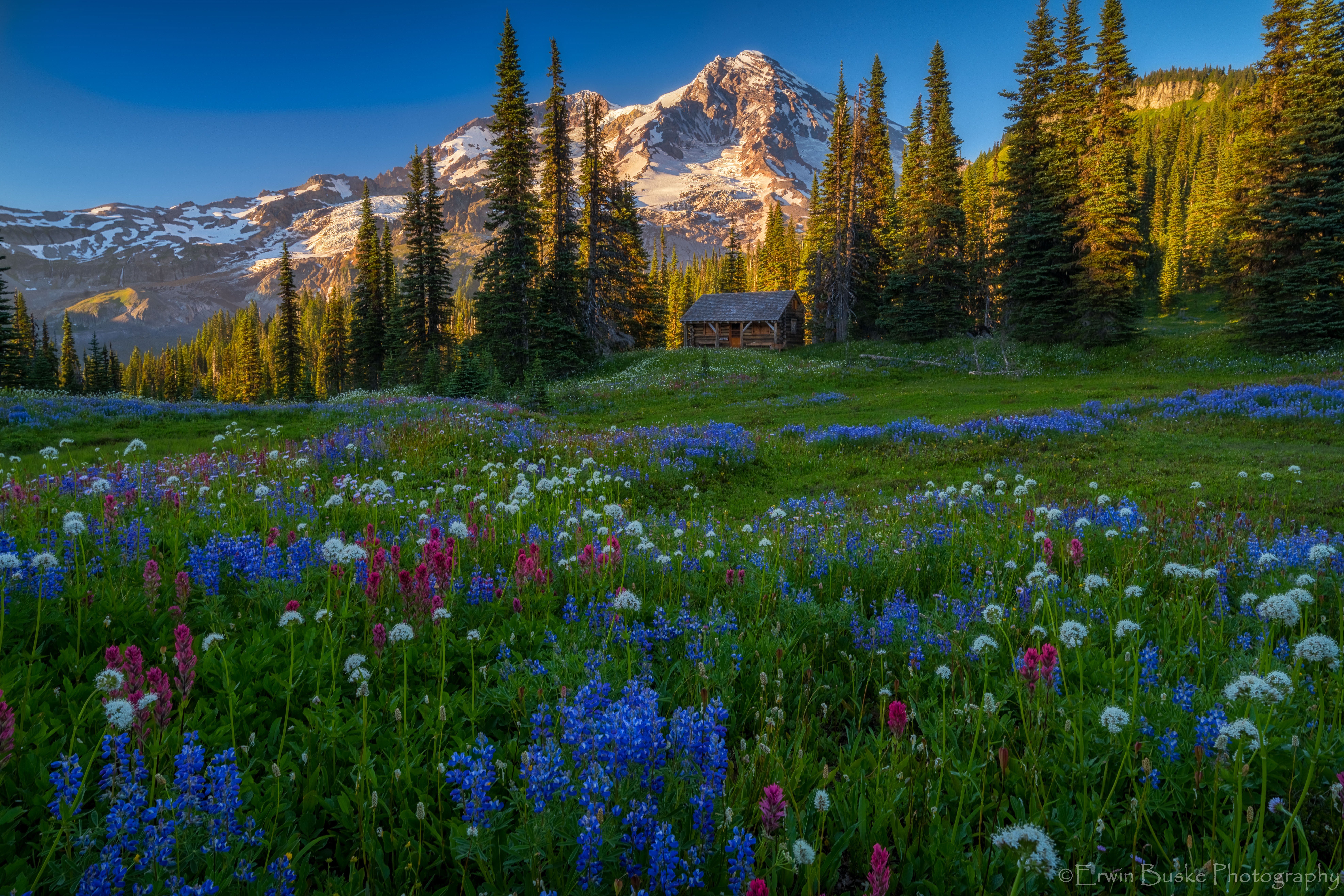



2018 Calendar: The stories behind the images

I am excited to announce that my 2018 Calendar is now available and can be purchased through this link  Erwin Buske Photography 2018 Calendar.  As was the case last year, I will donate ALL proceeds to the Nature Conservancy.  Here are the images for each month along with some stories behind the images.  All images were taken in about the last twelve months and feature locations either in Washington State or somewhere near Washington.  Thanks everyone for your support and interest over the past year!


Gold Creek December072

January: Early Winter Magic

This image is of beautiful Gold Creek Pond close to sunset yesterday evening. Operating the camera was quite a challenge in the freezing cold temperatures made worse by occasional gusts of wind across the pond, but well worth the effort. I took out my water bottle to stay hydrated and placed it on a snow covered log-less than 15 minutes later is was more ice than water! The hike up Gold Creek was awesome also. I just love this area! Sony A7R2  22MM F16, 1/10S, ISO 100


Kalalockl0498 r1

February: Hall of Mosses Deer Crossing

My daughter Caroline and I spent three days at Kalalock along Washington’s Pacific Coast over her spring break, with visits to Ruby Beach, and the Hoh and Quinault Rain Forests. The weather was at least ten degrees cooler there than here in Seattle and the rain storms came at intervals of about every 15 to 30 minutes. In between storms, however, there were epic conditions for photography with frequent sun breaks and also a few bright colorful rainbows!  Here in the Hoh Rainforest as soon as we parked the car the rains subsided creating an opening for us to hike the Hall of Moses trail along the Hoh River.  Beautiful filtered light entered through the forest canopy creating a soft glowing mysterious look. I set up my tripod at this group of Maples and Caroline said “Daddy there is a deer!”. I said where! And sure enough a deer walked into the scene I had already set up as I was looking through the viewfinder, at which time I cranked up the ISOs to freeze motion and started firing away the shutter!  Nikon D810, 36MM, F14, 1/200s, ISO 1250 to freeze motion.


Untitled1A

March: Ecoloa Beach Overlook: Flying West

It was a very awe inspiring experience this early evening to watch the movement of clouds and play of light on the waves. The perspective from the Ecola Overlook is one I never tire of and I find that the early evening light is best for this scene. It was particularly inspiring this evening with the dramatic clouds forming a ring around the sky and a passing gull flying through the scene.  Nikon D810, 28MM, F14, 1/320S, ISO 200.


Sunrise 1.7 stop five comp

April: Ballad of Big Pink

This image is of sunrise at Roozengaarde Tulip Fields.  This is an example of an image that I did not consciously plan to take and by the good graces of the universe I arrived at the scene with little if any time to spare in order to capture the sun rising.  I planned to head out to the Skagit Valley from my home nearly two hours away around noon.  But at about 3AM I awoke wide awake from sleep and on a quick impulse decided to go then in order to make sunrise.  I arrived at the general area of the Tulip Fields but could not find a suitable field and place to pull the car to the side of the road even as the sunrise was starting and beautiful colors will filling the sky.  I thought at this point that I totally missed it in terms of “getting the shot” and as I was driving to get some coffee and breakfast I noticed a group of cars parked at the edge of what appeared to be a Tulip Field.  I quickly pulled into a field parking area and more clearly saw these pink tulips about a couple of blocks away.  I quickly grabbed my photo pack and  ran down the muddy path arriving just in time to setup and shoot!  Sony A7R2 35MM, F16, 1/2S, ISO 125


_DSC3881_2518r2


May: Palouse Waves and Patterns

This image is of Palouse Waves and Patterns as viewed from Steptoe Butte.  When one  first arrives at Steptoe Butte the temptation is to take wide sweeping panoramas of the area, but in my experience the best shots are more of the narrow field images that emphasize the waves and patterns of the rolling wheat fields.   This image was taken with my 300MM lens with a 1.4 teleconverter attached.  Nikon D800, 300MM, F13, 1/15S, ISO 100


Rebirth

June: New Morning

At no time is the transformation of Mt. St. Helens more apparent than early summer when the first flowers appear in large drifts cascading down the mountainsides. Within my own lifetime I have witnessed a change going from ashes to Eden~  This image was taken just after sunrise.  This is a focus stack of several images taken at F8, 16MM,1/50s, ISO 400mm, Sony A7R2.


Indian Henry0470-HDR

July: Walking into a Dream 2

The best wild flower meadow that I know about is this one at  Indian Henry’s Hunting Ground, Mount Rainier National Park. This cabin is perfectly situated in as beautiful setting as I could ever imagine and when approaching the cabin through the meadow it is like walking into a beautiful dream. Indian Henry, known as Soo-Too-Lick, early on (1883) guided several familiar names to Mt. Rainier including the Hunting Grounds, these familiar names include James Longmire, Philemon Beecher Van Trump and John Muir. Indian Henry was a Cowlitz Indian, beloved by many people.  Sony A7R2 29MM, F16, 120S, ISO 200


Glacier Peak 2017 Images1896 copy

August: Image Lake at Sunrise

Beautiful pasque flowers gone to seed and Image Lake awaken to a rosy sunrise underneath Washington’s most remote volcanic peak, known by the Suak Indian Tribe as “Tda-ko-buh-ba”, but also known as Glacier Peak. This location in the Glacier Peak Wilderness comes as close to heaven on earth as anything my imagination can possibly conjure up. Looking out across the meadow and lake to Glacier Peak one feels the pure essence of a wilderness area, an area where the earth and its community of life are untrammeled by people, and where we are just visitors who cannot remain in a place of such unspoiled beauty. Image Lake is not very accessible and I approached the lake as part of an extended 7 day backpacking trip with the Sierra Club in August of 2017. Our route took us up and over Spyder Gap’s Lyman Glacier, scrambling down into the Lyman Lake Basin, up and over Cloudy Pass, over to Image Lake, and out through Flower Dome and Buck Creek Pass-about a 60 mile loop trip including side trips.
Western pasqueflower, or Anemone occidentalis has a less than showy bloom but you won’t miss the next stage, which resembles a fuzzy mop of hair. An early bloomer, the seed pods last all summer on mountain slopes and meadows in middle to high elevations. This is a focus stack of 6 images taken at F11, 29MM, 1/5s, ISO 800 (to reduce movement caused by wind.


Mailbox0113-HDRr2

September: Where the Angels Roam

This image is from my trip to Mt. Rainier in September of 2017. While driving up US 410 to circle around Rainier I passed through thicker and thicker smoke. This summer almost half of the days have been like this, drab and smoky due to forest fires in the area including the Norse Peak Fire on the northeast side of Rainier. The smoke actually helped me at Silver Falls as it combined with clouds to produce some spectacular mid-day filtered light. But this same layer of clouds and smoke did nothing but diminish the view of Mt. Rainier to the point where it was almost unrecognizable through the haze. I felt some winds blowing in the area and on a hunch, I thought Bench Lake would be a good place to go for sunset if some of the smoke would just blow away. It took almost ten minutes before sunset for this to happen, but for ten precious minutes the reward was absolute bliss, and some of the best light I have ever seen in this area!  Sony A7R2 23MM, F16, 1s, ISO 100


2016 Enchantments0001

October: Guardian of the Camp

The small peninsula in the Enchantments upon which we made our camp was evidently the home of this particular Mountain Goat who was our almost constant companion during our stay at the Enchantment Lakes!  The closer I moved toward the goat the closer she also moved toward me.  With the Kid goat not far away, I decided to go not closer than this!.  Sony A7R2, F14, 1/160S, ISO 100


Elowah Falls

November: Elowah Mystery of Autumn

This image is of beautiful Elowah Falls looking through the veil of moss covered boulders sprinkled with maple leaves, moss covered branches and the warm atmosphere of Autumn.  Getting this image was no small challenge, not so much because of the difficulties of navigating a steep and slippery hillside down to this shooting location, but because once I arrived I saw about six unattended tripods planted right in the river in front of me.  Luckily the workshop leader agreed to temporarily move his group out of the way so I could capture this shot.  I am hoping this area will be spared by the recent Eagle Creek Fire, but if not it will be wonderful to experience the renewal of this area in the years ahead.   Sony A7R2 16MM, F11, 1/4s, 1S0 160, this is a focus stack of several images.


Middle Fork Snow on Garfield comp

December: Garfield Whispers of Winter Approaching

In early December, I took one of those long hikes in the light rain that makes me happy I live in the Pacific Northwest-yes I love hiking in light rain! This time I headed west (rather than east) along the Middle Fork of the Snoqualmie River, past rainy creek and on to Pratt River. What a spectacular section of trail through the rain forest! I especially like the sounds of the light rain falling on the trees and bushes against the constant roar of the Snoqualmie River occasionally with the accompaniment of small creeks and streams swollen with near constant rain. There was only one brief opening and I retook this image, this time with a dusting of snow on Garfield Mountain and some clouds rolling through the valley.  This image won third place in the Washington Wild (a Conservation Advocacy Group) 2017 photo competition.  Sony A7R2, 16MM, F16, 8s, ISO 125, 5 stop neutral density filter