Learning to See Like an Impressionist: A Photographer’s Journey 

Sunlight filtering through mist in a forest, creating a luminous atmospheric landscape.
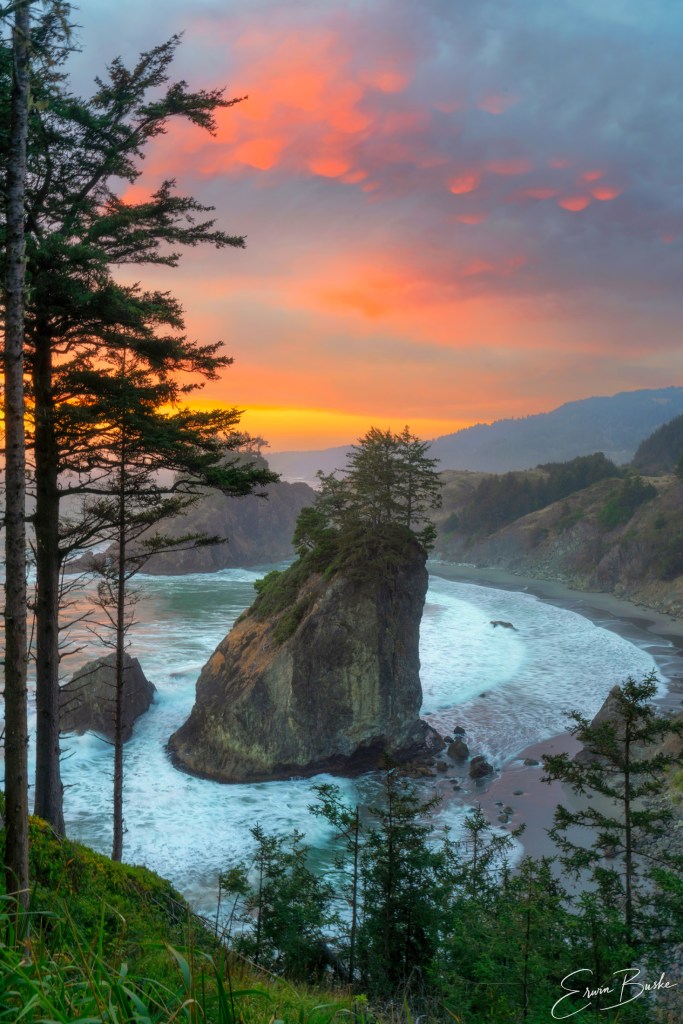
Where the Angels Roam

For much of my photographic journey, I have been drawn to those fleeting moments when light, weather, color, and atmosphere transform the familiar into something more mysterious and expressive. Only gradually did I recognize how much this way of seeing connects with my lifelong appreciation of Impressionist painting. In this essay, I explore six lessons from the Impressionists that have helped shape my photographic vision.

Introduction — From Recording to Seeing

A camera is extraordinarily good at recording what is there. But recording a landscape and expressing our experience of that landscape are not necessarily the same thing. Drawing inspiration from the Impressionists, I have become increasingly interested not simply in rendering mountains, forests, flowers, water, and clouds accurately, but in creating images that communicate something of what it felt like to be there. For me, true seeing includes light, atmosphere, color, mood, and the fleeting nature of experience itself — in other words, my impression. My goal is not to make photographs look like Impressionist paintings. It is to draw upon lessons from the Impressionists to help me see more deeply and create photographs that remain unmistakably photographic while also carrying something of my emotional experience of the landscape.

Learning from the Impressionists

My Early Influences

My first serious forays into photography began long ago, shortly after college. Even then, I was drawn to experiences in nature that felt more emotional than descriptive — moments I wanted not merely to document, but somehow to share. On backpacking trips, I often encountered landscapes that already carried what I now recognize as an Impressionist sensibility: fog moving through trees, light filtering through clouds, reflections softening the world, or color shifting at the edges of the day. In such conditions, detail was often obscured, colors bled gently into one another, and the landscape seemed less literal and more suggestive. These were the moments that stayed with me. Although firmly tethered to my experience in nature, they also seemed to possess a dreamlike, mystical quality — something almost transcendental. That impulse to move beyond documentation toward something more enduring later became central to what I described as transcendental nature photography.

Soft mist and light filtering through a forest in Spirit Angels in the Forest.
Spirit Angels in the Forest
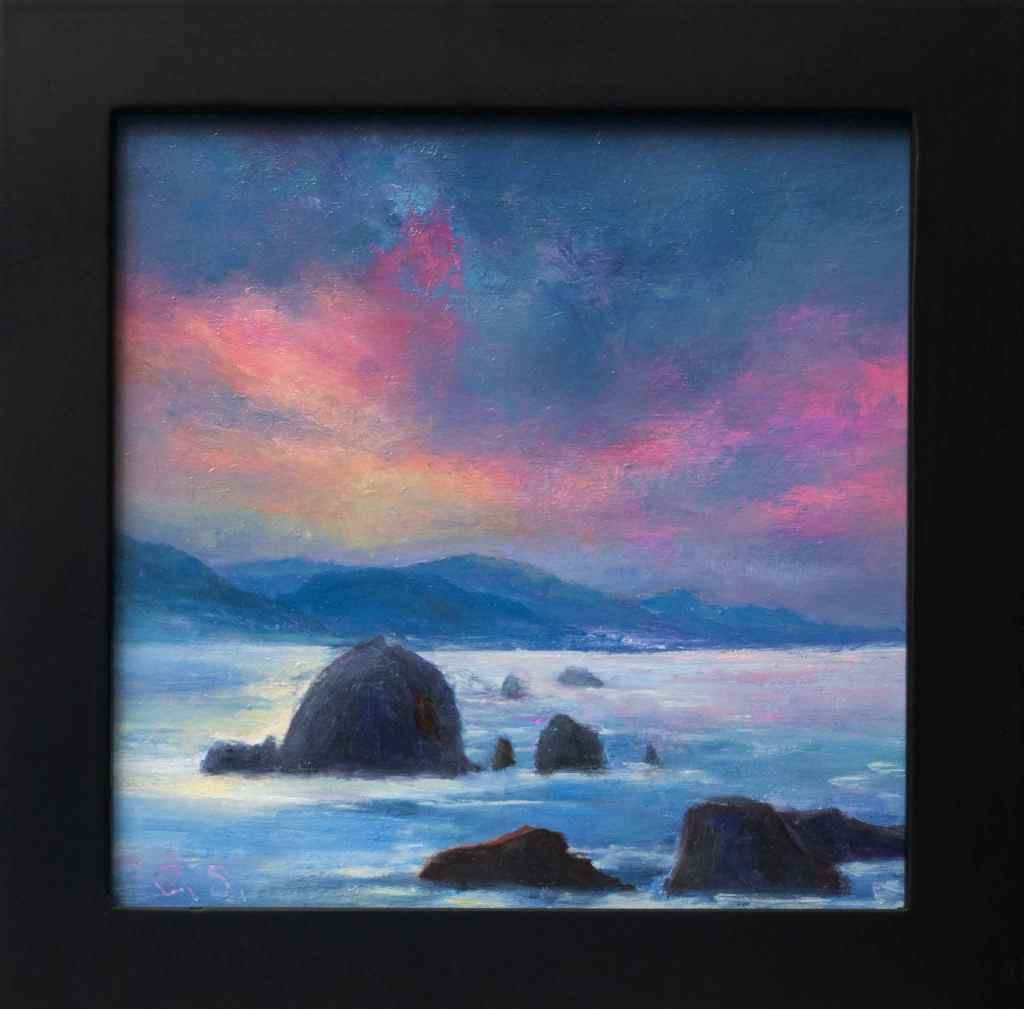
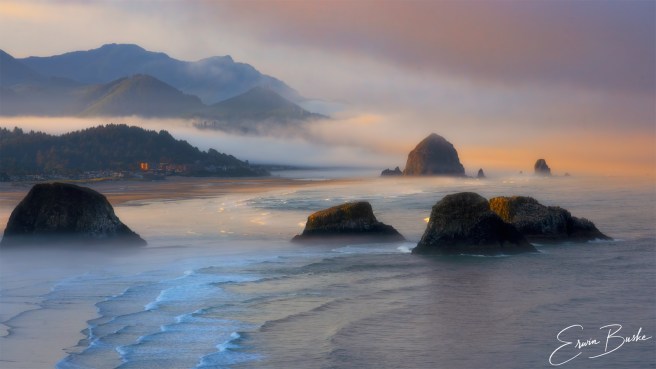
Morning light over the Oregon coast at Ecola State Park.
Good Morning Ecola
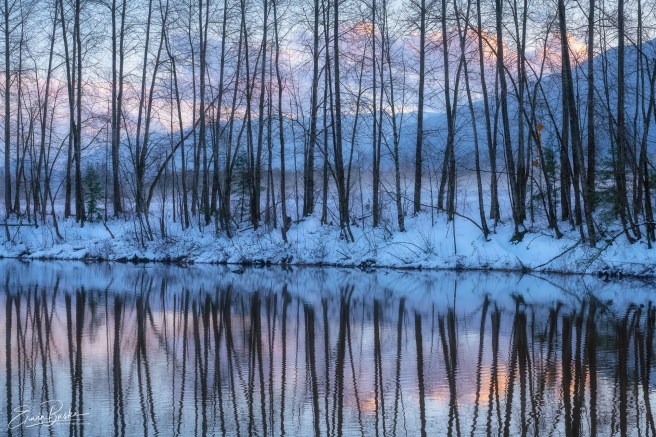
Bare winter tree reflected in calm water beneath soft winter light.
Bare Tree Reflections in Winter Light

Only later did I begin to understand how closely those experiences connected with my early exposure to Impressionist painting. Monet’s Water Lilies, with its mauve color, reflection, and softened reality, made a particularly strong impression on me. Renoir’s Luncheon of the Boating Party affected me in a different way — through warmth, light, people, color, and the feeling of a particular moment being lived. What mattered to me in both was not simply the subject, but the visual and emotional experience of the scene. These images were clearly of this world, but also transformative. Looking at them, I felt I was participating in something of how these Impressionist painters experienced the scene — not only what they saw, but what they felt. That idea has stayed with me and has gradually found its way into how I approach landscapes, nature, architecture, and even people with a camera.
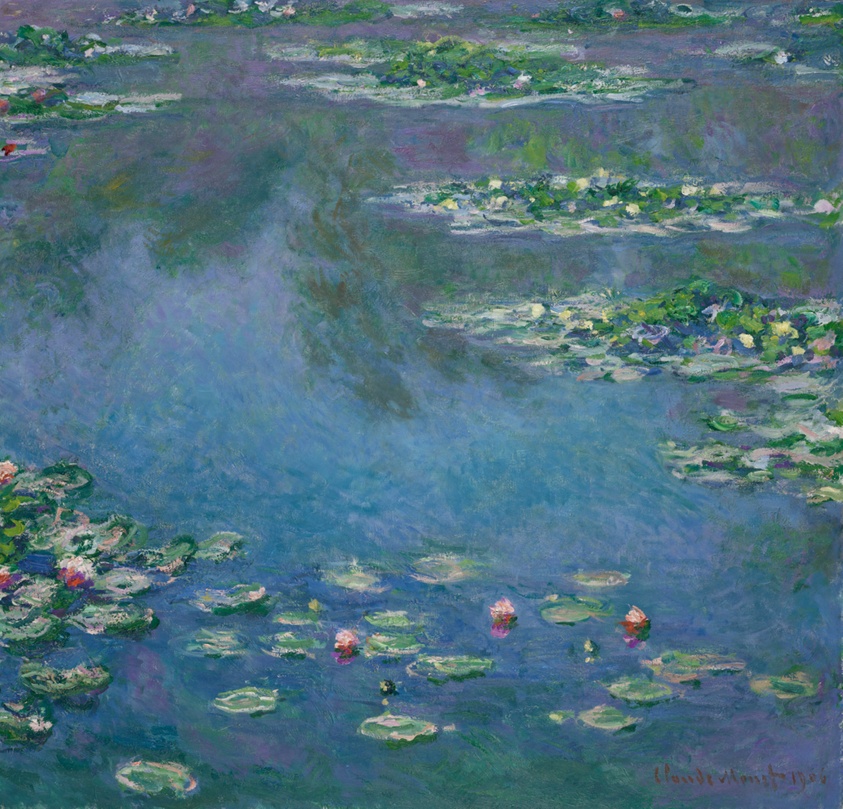
Claude Monet Water Lilies painting with mauve flowers and soft reflections on water.
Claude Monet — Water Lilies 1906 Art Institute of Chicago CC0/Public Domain
Pierre-Auguste Renoir Luncheon of the Boating Party, with figures gathered in warm outdoor light.
Pierre-Auguste Renoir — Luncheon of the Boating Party, 1880–81 Google Arts & Culture Public Domain

Monet’s Water Lilies offers a quiet, almost dreamlike world of mauve color, reflection, and softened reality, while Renoir’s Luncheon of the Boating Party is filled with warmth, light, people, color, and the sense of a fleeting moment being lived. Long before I had language for ideas such as atmosphere, relational color, or suggestion rather than description, I responded to these paintings emotionally. In retrospect, they helped prepare the ground for the way I would eventually learn to see photographically.

Four Influential Impressionist Painters

Four Impressionist painters have been especially influential in shaping how I think about landscape and photography: Claude Monet, Alfred Sisley, Camille Pissarro, and Pierre-Auguste Renoir. All were active in the late nineteenth century, with Monet and Renoir continuing their work into the early twentieth century. I do not look to them as models to imitate, but as different lenses through which to think about light, atmosphere, structure, and color.

Monet — Light and the Fleeting Moment

Monet’s work taught me perhaps more than any other painter about the primacy of light and the fleeting nature of experience. His repeated studies of familiar subjects under changing conditions demonstrate that the subject itself can become secondary to what light, season, atmosphere, and color are doing to it. His paintings of stacks of wheat are a particularly clear example: the forms remain, but the experience changes with each shift in illumination and weather. Shadows progress from being softer and more subtle to being more pronounced.  Colors also range from more muted to more vivid depending on the angle of the light source and atmospheric conditions.
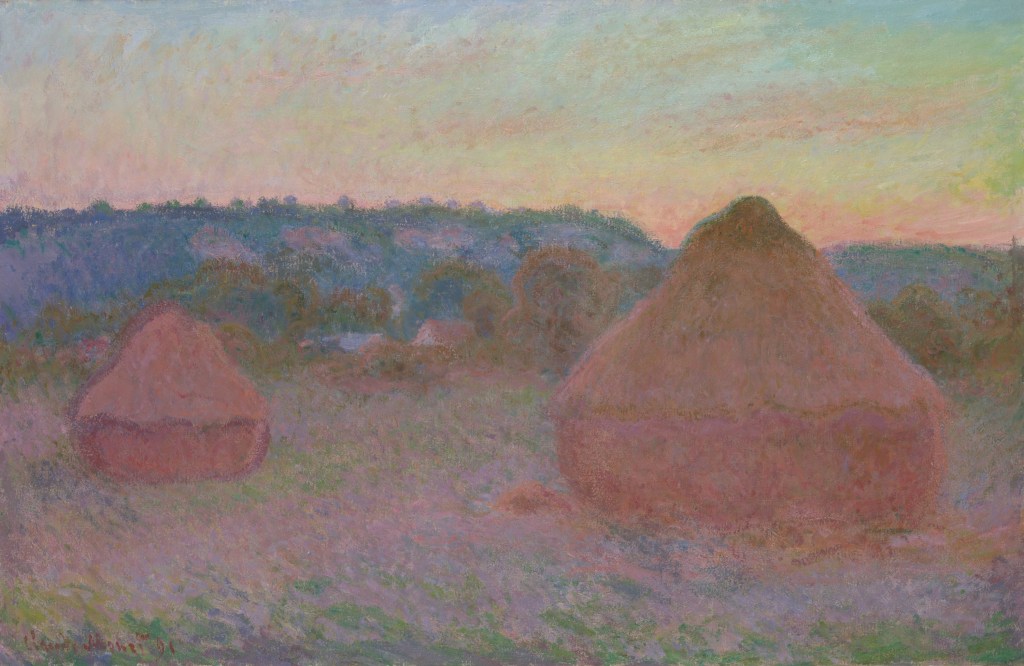
Claude Monet Stacks of Wheat at the end of an autumn day in warm changing light.
Claude Monet — Stacks of Wheat (End of Day, Autumn), 1890–91. Art Institute of Chicago. Public Domain/CC0.
Claude Monet haystacks under snow and sunlight, showing cool winter atmosphere.
Claude Monet Haystacks Effects of Snow and Sun 1890-1891 Metropolitan Museum of Art Public Domain

That idea connects naturally with my own tendency to return to familiar places and wait for conditions to change — for fog to move, clouds to part, light to strike a mountain, reflections to appear, or a landscape to briefly reveal itself. When mist is moving through a scene or the sun is rising or setting, I will often make multiple images because each interval can carry a distinctly different feeling. I may return to the same place many times, but I am never really photographing the same landscape twice.

Sisley — Atmosphere and Landscape

Sisley’s understated landscapes reinforce for me how central weather, sky, snow, water, atmosphere, and changing light can be to an image. In his work, atmosphere creates depth, shadows carry color, and reflections soften and transform physical reality. I am especially drawn to the quietness of his paintings because that restraint resonates with some of my own quieter photographs.
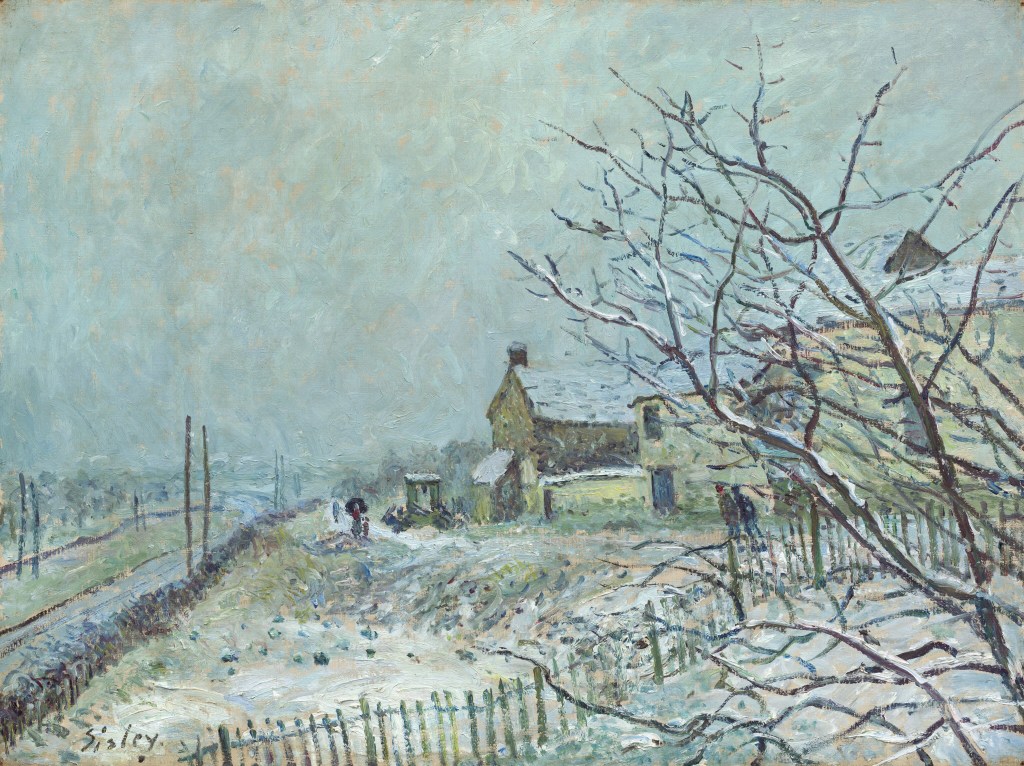
Alfred Sisley First Snow at Veneux-Nadon, with blue-violet winter shadows.
First Snow at Veneux-Nadon (1878) NGA Public Domain

In First Snow at Veneux-Nadon (1878), the snow is not simply white. Cool blue-violet tones move through the shadows, allowing the sky and atmosphere to influence the entire scene. The result feels less like a catalog of objects and more like an experience of winter light.
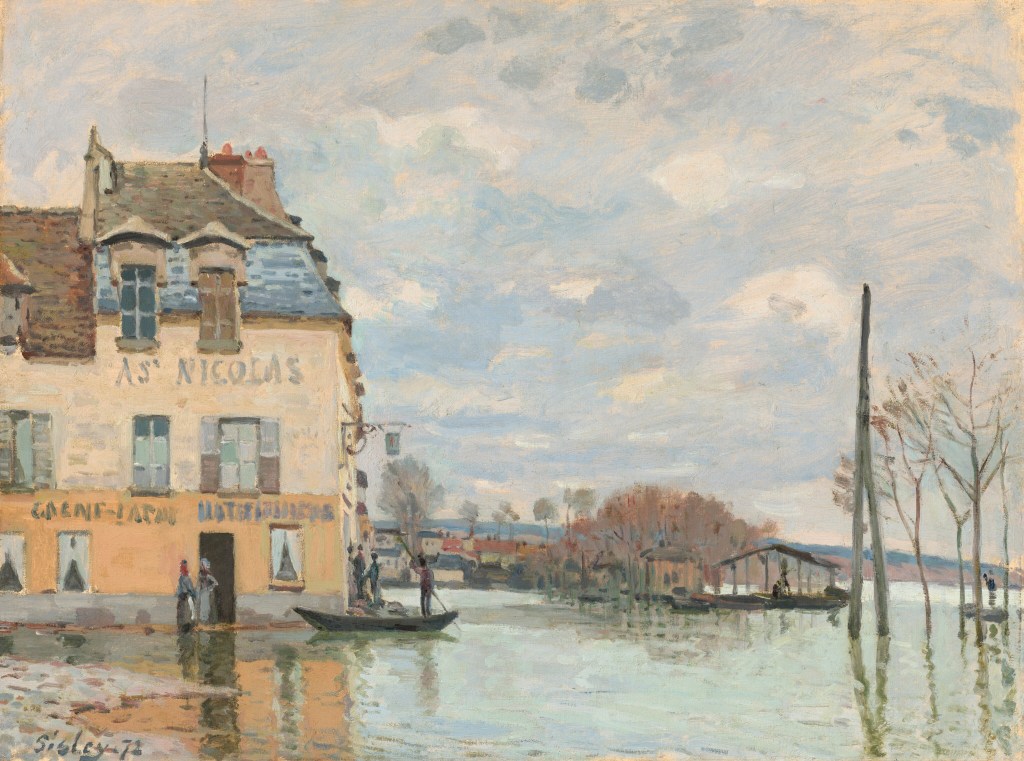
Alfred Sisley Flood at Port-Marly, with buildings and trees reflected in floodwater.

In Flood at Port-Marly (1872) NGA Public Domain

In Flood at Port-Marly (1872), reflections, subdued color, changing weather, water, and atmosphere all become part of the interpretation. The subject is still recognizable, but the conditions through which we see it are just as important as the subject itself.

Pissarro — Structure Beneath Atmosphere

Pissarro reminds me that Impressionism is not simply about softness. Beneath the sensation of light and atmosphere there is still composition, structure, rhythm, and visual organization. This is especially important to me as a photographer. Even when I lean toward a more painterly or suggestive interpretation, my photographs remain anchored in what the camera recorded and in the compositional structure of the scene. I am not trying to simulate painting. I am using lessons from painting to help communicate my experience of place more fully.
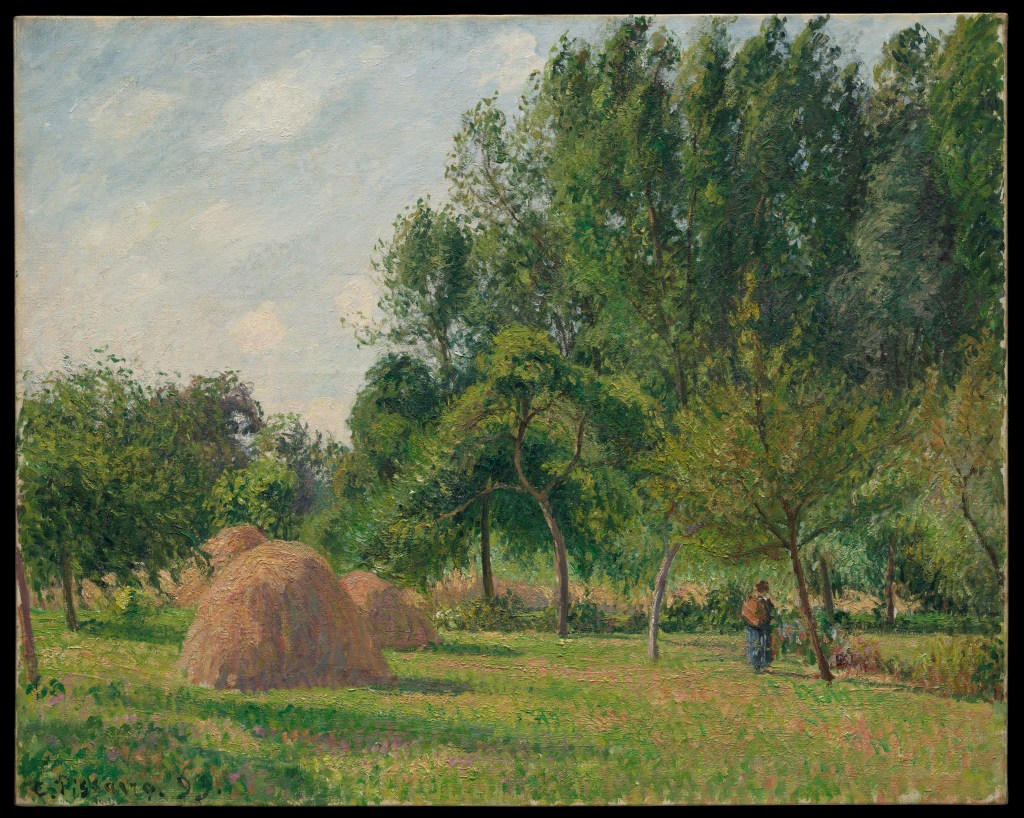
Camille Pissarro Haystacks, Morning, Eragny, showing haystacks in soft morning light.
Haystacks, Morning, Eragny (1899) Metropolitan Museum of Art Public Domain

Haystacks, Morning, Eragny (1899) has a solid underlying structure even as light and atmosphere soften the scene. Like Monet, Pissarro returned to the haystacks under changing conditions, exploring how different illumination could transform a familiar subject.
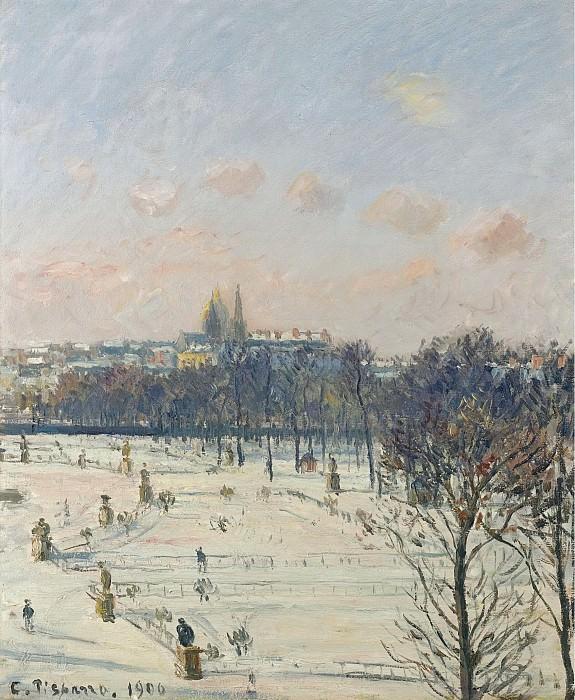
Camille Pissarro Garden of the Tuileries, with trees, figures, architecture, and patterned clouds.
Garden of the Tuileries 1900 Metropolitan Museum of Art Public Domain

Pissarro also painted the Garden of the Tuileries multiple times from the same vantage point while observing changes in light, season, weather, and time of day. Notice the repetition of forms — trees and people leading to architectural elements, along with the pattern of clouds in the sky — all bringing a sense of rhythm and structure to the scene. Together these works reinforce another lesson I value: an extraordinary photograph does not always require an extraordinary subject. Changing conditions can make a familiar place extraordinary. In my own photography, I feel a special sense of accomplishment when light, atmosphere, color, or perspective reveals beauty in a scene that might otherwise be overlooked.

Renoir — Color and Luminosity

Renoir’s paintings remind me that shadows are not simply dark or black. Color persists throughout the scene, including in the deepest values. That idea has long influenced the way I process photographs. Rather than forcing the black point to true black or neutralizing every naturally occurring color cast, I often lift the beginning of the black curve slightly so that color can remain present in the shadows. In View of the Seacoast near Wargemont, warm and cool tones continue into the darker areas of the painting, while the entire scene retains a sense of luminosity. Renoir also worked quickly outdoors to respond to changing light, reinforcing a theme shared by all four painters: the importance of being receptive to a moment that will not last.
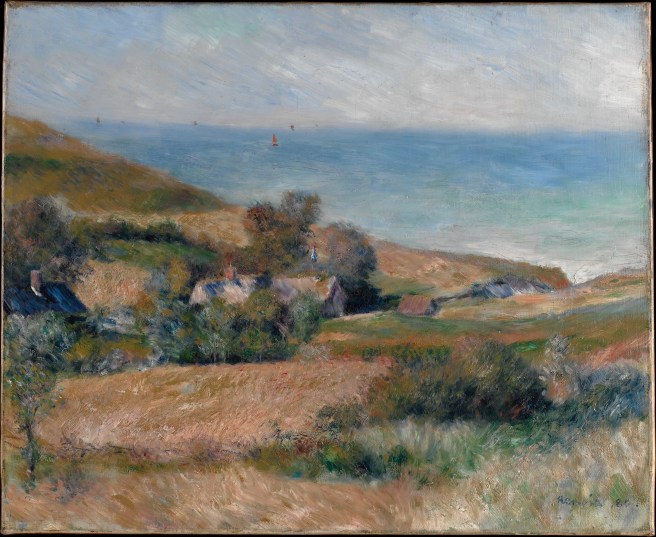
Pierre-Auguste Renoir View of the Seacoast near Wargemont in Normandy, with luminous coastal color.
View of the Seacoast near Wargemont in Normandy, 1880 Metropolitan Museum of Art Public Domain

My Approach — Impressionism Without Imitation

Let nature do most of the work. My approach to Impressionism in photography begins with scenes that already contain qualities that make the landscape less literal and more suggestive. I am not trying to make photographs look like paintings. Instead, I look for conditions that carry mystery, emotion, and a sense that not everything is being revealed at once. Fog, mist, reflected light, moving clouds, snow, rain, backlight, twilight, atmospheric haze, and changing weather can simplify and transform a scene before I ever touch a processing slider. These conditions soften detail, allow colors to mingle, and create a visual game of hide and seek, simultaneously revealing and concealing. When they are absent, I am perfectly comfortable taking a more traditional photographic approach. I do not try to force every landscape into an Impressionist mold. I explored this idea more directly in Mystery: The Holy Grail of Nature Photography.

  • Fog removes detail.
  • Reflections dissolve solidity.
  • Backlight simplifies form.
  • Snow reduces the palette.
  • Atmospheric perspective separates layers.
  • Moving clouds conceal and reveal.
  • Golden-hour light alters ordinary color relationships.
  • In other words, the landscape becomes the first artist.

Processing in service of the experience. Because I begin with scenes that already carry many of these qualities, I do not need to manipulate them heavily to create a painterly feeling. My processing is intended to preserve the experience of the scene, including my emotional response at the time. When appropriate, I may reduce contrast, clarity, and texture; slightly lift the blacks; control microcontrast; or use a restrained Orton effect. These adjustments are not meant to manufacture an Impressionist appearance. They are meant to keep the inherent precision of modern digital photography from overwhelming the qualities I experienced in the field. I do not want processing to announce itself. I want it to gently move the photograph away from clinical description and toward lived experience, while preserving recognizable detail, believable light, optical depth, and the sense that this was a real moment before the camera.

Six Lessons from Impressionism

Lesson 1 — Light Is the Subject

Landscape photographers are often told that an image should have a definite subject. But what if the mountain, tree, field, or flower is not always the true subject? For the Impressionists, what light was doing to the landscape was often more important than the object being illuminated. Monet’s Stacks of Wheat offers a clear example: the forms are simple, while the changing light becomes the real event of the painting.
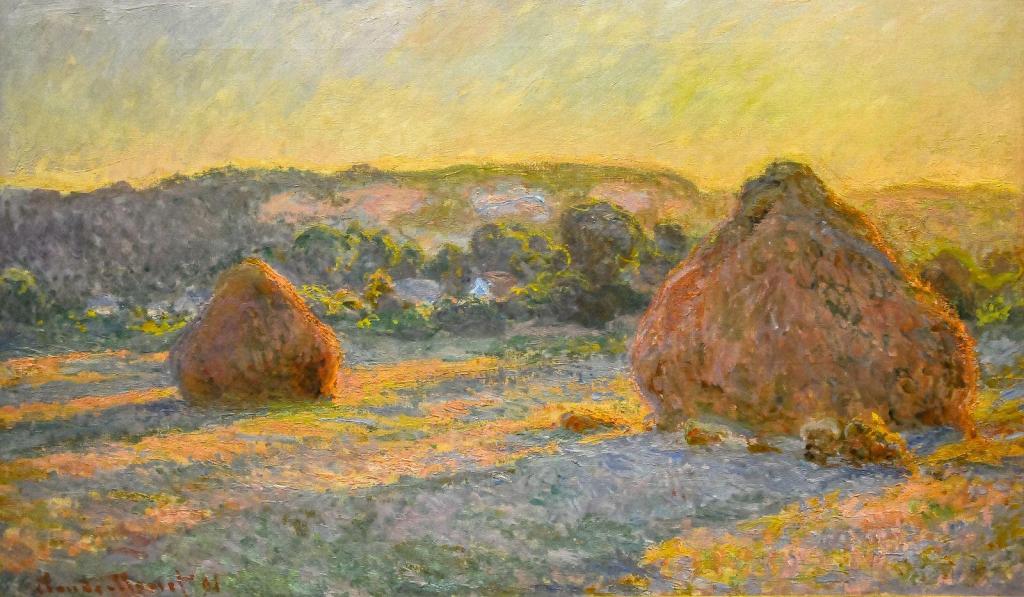
Claude Monet Stacks of Wheat at the end of summer in warm low-angle light.
Claude Monet Stacks of Wheat End of Summer 1891 Art Institute of Chicago Public Domain

I see the same possibility in my own work. In Palouse Meditation, the hills become bands of illumination and shadow, while the lone tree serves almost as visual punctuation. The subject is no longer simply farmland. Light creates the structure, separating one rolling form from the next and turning a familiar agricultural landscape into an arrangement of luminous shapes. Without that low-angle evening light, the image would not have the same visual power.
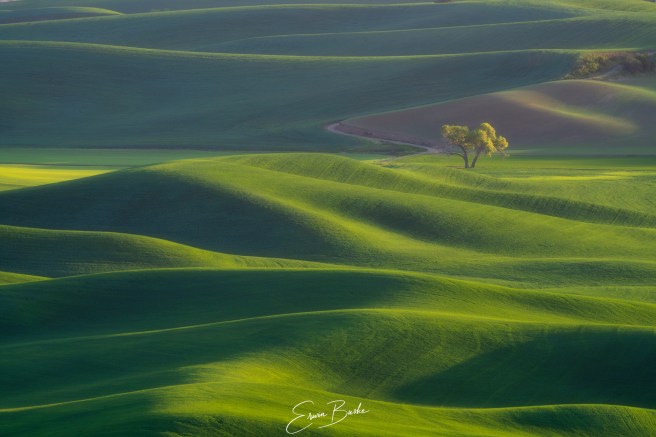
Rolling Palouse hills shaped by bands of evening light and shadow with a lone tree.

Palouse Meditation

In the next image, Falling into a Beautiful Dream, light acts very differently. Instead of simplifying the landscape into shape and shadow, it makes the entire scene glow. Flowers, haze, hills, water, and atmosphere all take on their character from the setting sun. If I had to name the main subject of this photograph, it would not be the flowers or even the sun itself, but the effect of sunlight moving through the entire landscape.
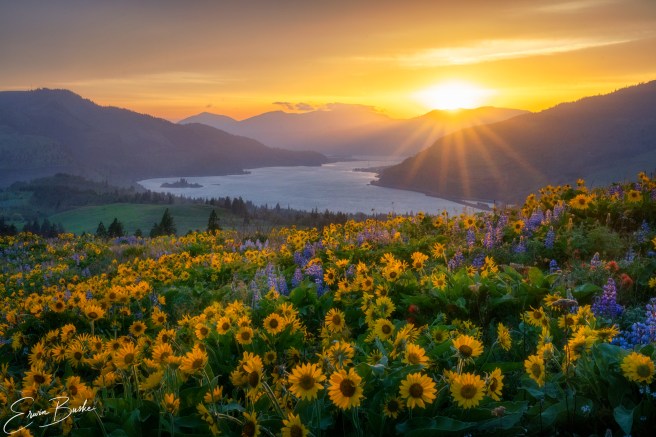
Wildflowers glowing in warm sunset light above the Columbia River Gorge.
Falling into a Beautiful Dream: Columbia Gorge

In the field, one of my guiding habits is to follow the light first and then ask where it might lead me compositionally. If I were compelled to rank the elements in the visual hierarchy of many of my landscapes, light would very often come first. That is one of the most important lessons I learned from the Impressionists.

Lesson 2 — Color Can Describe Experience

I have never shied away from color when color was genuinely present in the scene. The Impressionists helped me understand that color is relational rather than absolute, and that relationships among colors can communicate experience. In Columbia Gorge Mountain Meadow Bouquet, rather than looking first at balsamroot, lupine, and paintbrush as individual objects, I invite the viewer to step back and notice yellow, blue-violet, red, and green interacting across the frame. The flowers become almost like brushstrokes of color. The image functions as a field of color before it functions as a literal description of a meadow, and that color relationship is central to how I remember the experience.
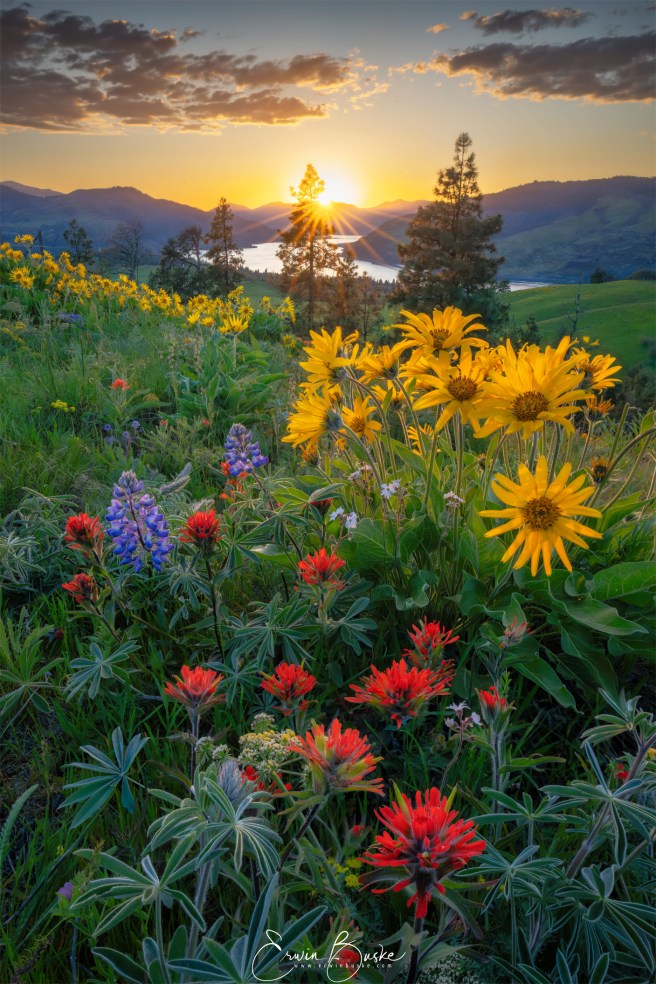
Balsamroot, lupine, paintbrush, and green meadow in the Columbia River Gorge.
Columbia Gorge Mountain Meadow Bouquet

In The Bridges of Snoqualmie Valley, color works more quietly. Autumn foliage is echoed and transformed through reflection. The scene is not simply a collection of yellow leaves and green trees; it is built from gold, orange, green, red, and their softened counterparts in the water. The reflected colors are less literal than the objects above them, yet they are essential to the emotional character of the photograph.
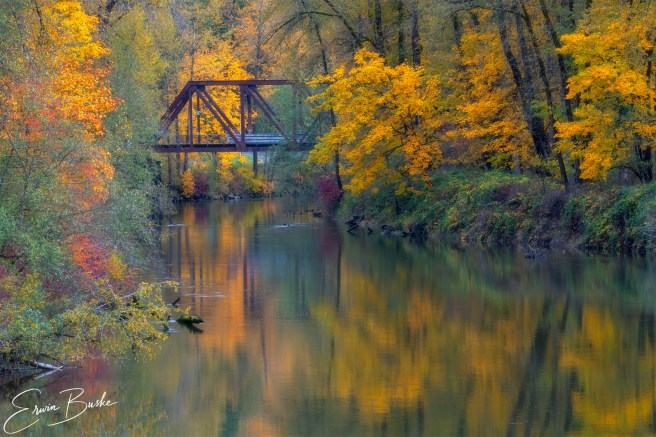
Autumn foliage and a bridge reflected in water in the Snoqualmie Valley.
The Bridges of Snoqualmie Valley

Monet explored this transformation of color and reflection more vividly and with a greater degree of artistic license in Waterloo Bridge, London, at Sunset (1904).
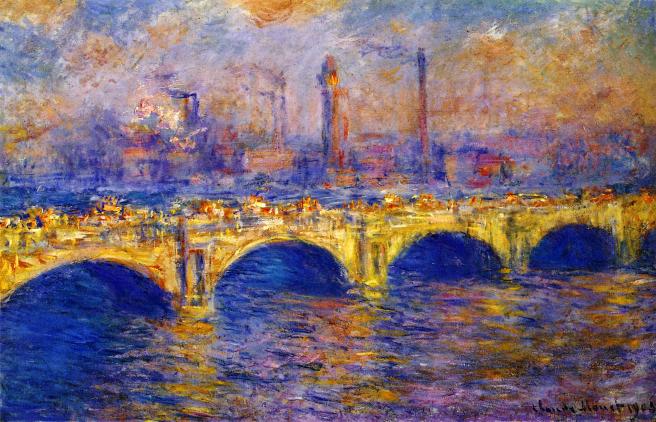
Claude Monet Waterloo Bridge, London, at Sunset, with vivid orange, pink, blue, and green reflections.

Waterloo Bridge, London, at Sunset (1904). NGA Public Domain

The bridge remains recognizable, but its reflection is not a literal duplicate. Blues, greens, oranges, and pinks merge in the Thames until the reflected world becomes softer and more about color and sensation than description. Monet pushes this far beyond what I do photographically, but the underlying lesson resonates with me: observed color can describe an experience without severing its connection to reality. My goal is not to mimic Monet, but to let that way of seeing inform photographs that still maintain a recognizable relationship to what the camera recorded.

Lesson 3 — Atmosphere Creates Depth

The Impressionists frequently used atmosphere not simply as weather but as a structural element. It is worth returning to Waterloo Bridge here because the contrast between Monet’s interpretations makes an important point: the subject has not changed, but the experience has. In the more muted Waterloo Bridge at Dusk, the bridge seems to materialize out of turquoise-green haze. Forms in the water are softened almost to abstraction, while distant structures emerge as faint vertical marks. The atmosphere does not merely obscure the scene; it organizes how we move through it, separating what is near from what is far and creating depth through varying degrees of visibility. Compared with the more vivid sunset version, the muted palette strengthens the sense of distance, while the more saturated colors of the earlier painting create a greater sense of presence. I use both approaches in my own photographs — sometimes even within the same image — depending on the original scene and the feeling or mood I want to convey.
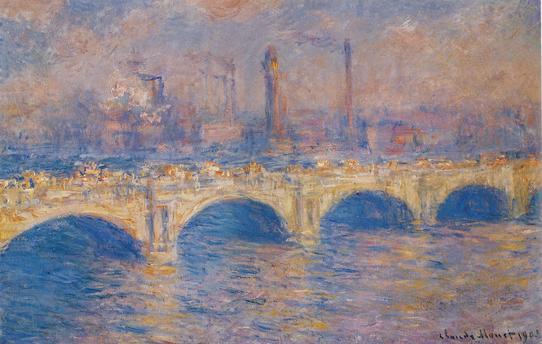
Claude Monet Waterloo Bridge at Dusk, emerging through turquoise-green haze.
Waterloo Bridge at Dusk 1903 NGA Public Domain

Atmosphere can both conceal and reveal, and that paradox is one of the things I find most compelling about photographing fog and mist. In Forest Carpet of Clouds, fog removes information and, in doing so, makes the pattern of the forest, the movement of the clouds, and the tonal relationships more apparent. Distracting detail disappears. Shape, rhythm, and depth become stronger. In this photograph, atmosphere is not simply present in the scene — atmosphere is the subject. That fascination with fog as a creative force also shaped my earlier essay Forests in the Mists: Windows into the Active Imagination.
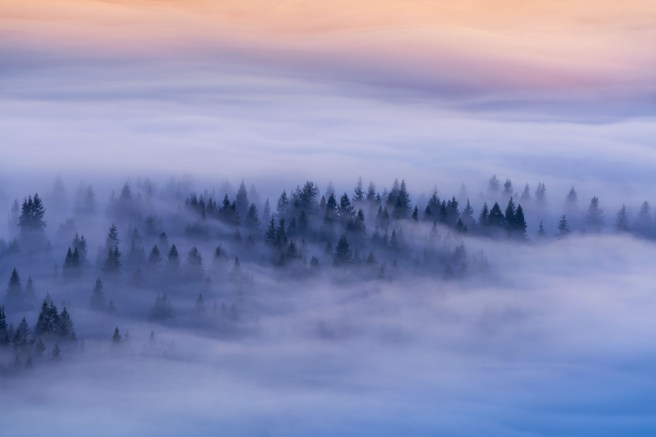
Fog and low clouds drifting between layers of evergreen forest in the Pacific Northwest.
Forest Carpet of Clouds

The next image, Middle Fork Mystical Morning, uses atmosphere differently. Here the distant mountain becomes almost ghostlike, while the nearer foliage retains more form, color, and definition. That progression from relatively distinct foreground elements to increasingly veiled distance creates spatial depth and also leaves room for the viewer’s imagination.
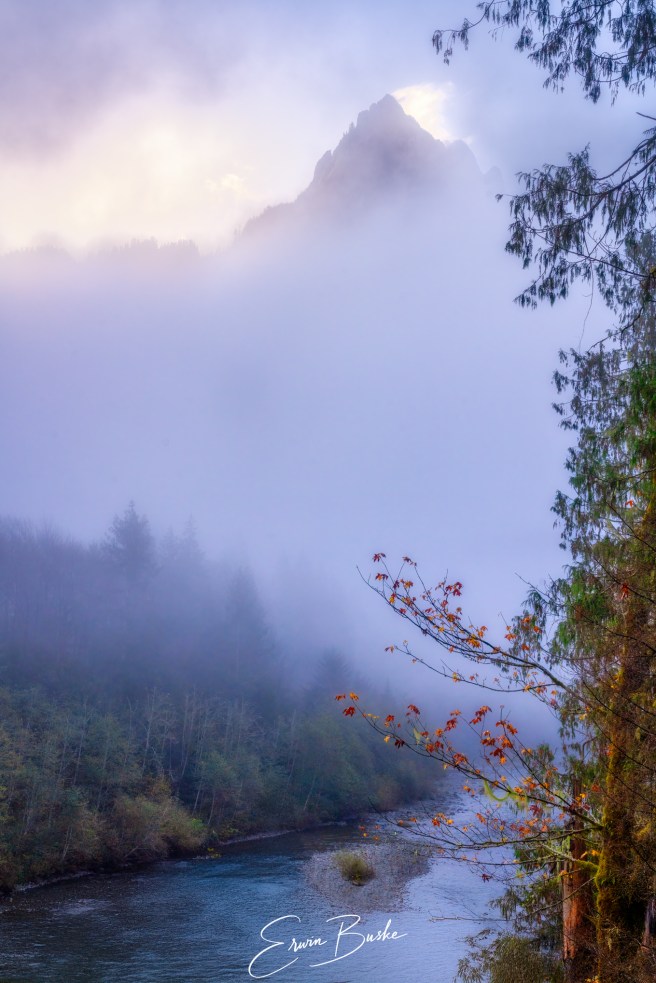
Distant mountain fading into mist behind layered forest in the Middle Fork Snoqualmie Valley.

Middle Fork Mystical Morning

Lesson 4 — Reflections Transform Reality

Reflections can do more than duplicate a landscape. They can soften it, break it apart, rearrange color, and transform solid forms into something more suggestive. Monet’s Japanese Footbridge paintings are an obvious touchstone for this idea: water becomes an active visual medium rather than a passive mirror.
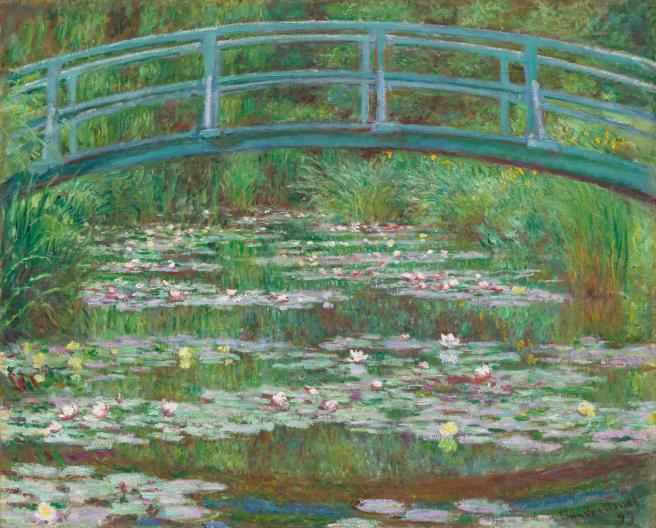
Claude Monet The Japanese Footbridge, with water lilies, foliage, and reflections.
Monet, The Japanese Footbridge, 1899 NGA Public Domain

As photographers, we do not need to imitate Monet to experience this transformation. In the soft light of morning or evening, water naturally converts mountains, clouds, vegetation, and architecture into softened fields of color and form. In Dawn’s First Whisper, the reflected peaks and illuminated clouds take something solid and convert it into a more interpretive experience — color, shape, and suggestion rather than simple symmetry.
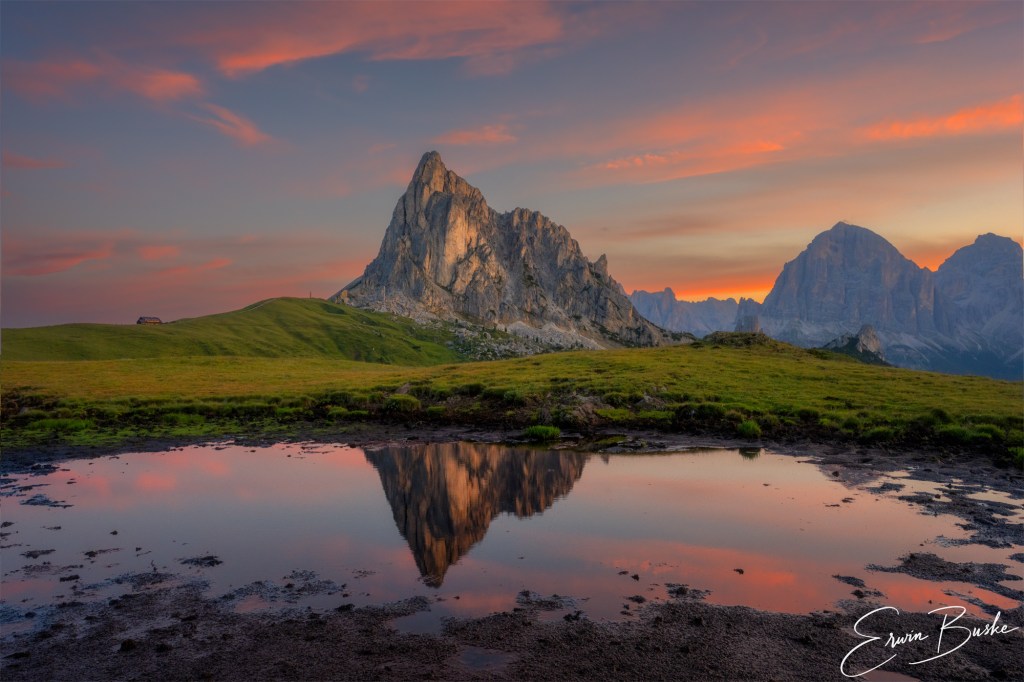
Dolomites peaks and glowing dawn clouds reflected in still mountain water.
Dawn’s First Whisper — Dolomites

In the next image, Venice Canal Reflections, the effect moves even closer to abstraction. Architecture dissolves into bands of red, green, yellow, and blue, broken and reshaped by the surface of the canal. The photograph is still unmistakably photographic, but the reflection allows reality to become fluid.
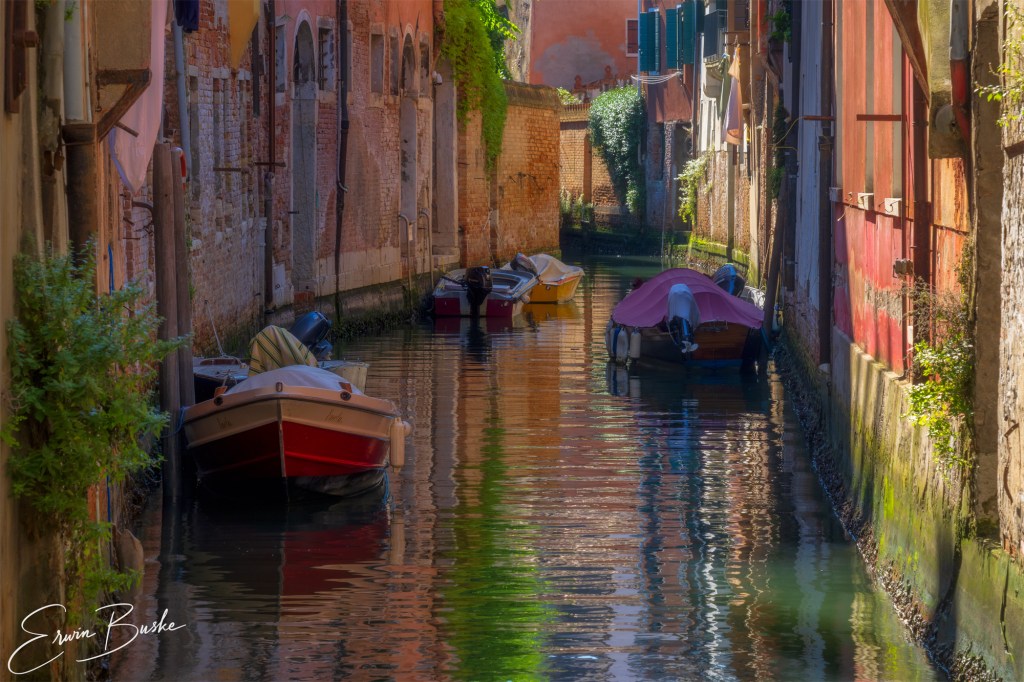
Colorful Venice architecture broken into abstract reflections on canal water.
Venice Canal Reflections

Lesson 5 — Embrace the Fleeting Moment

Monet’s Woman with a Parasol has a special resonance for me because a hand-painted reproduction has hung in my home for years. What increasingly interests me about the painting is not simply its beauty, but its sense of impermanence. The wind catches Camille Monet’s dress and veil, grasses move beneath her, clouds pass overhead, and sunlight flickers across the scene. Monet was not describing a static landscape; he was responding to a moment that was already changing as he painted it.

Claude Monet Woman with a Parasol, showing Camille Monet and her son in wind and sunlight.

Monet, Woman with a Parasol, 1875 NGA Public Domain

Monet returned to the woman-and-parasol motif years later under different circumstances and with a different model. The subject remained recognizable, but light, color, gesture, and atmosphere created a different experience. That idea resonates deeply with my own photography. I may return to the same mountain, forest, or shoreline many times, but I am never really photographing the same landscape twice. What matters is not merely the place, but the particular experience of the place under conditions that may never occur in quite the same way again.

Landscape photography therefore requires a willingness both to return and to pivot — to prepare for one possibility while remaining receptive to another. The scene I imagine may never happen, but something better may appear during a brief interval of changing light, weather, movement, or chance.
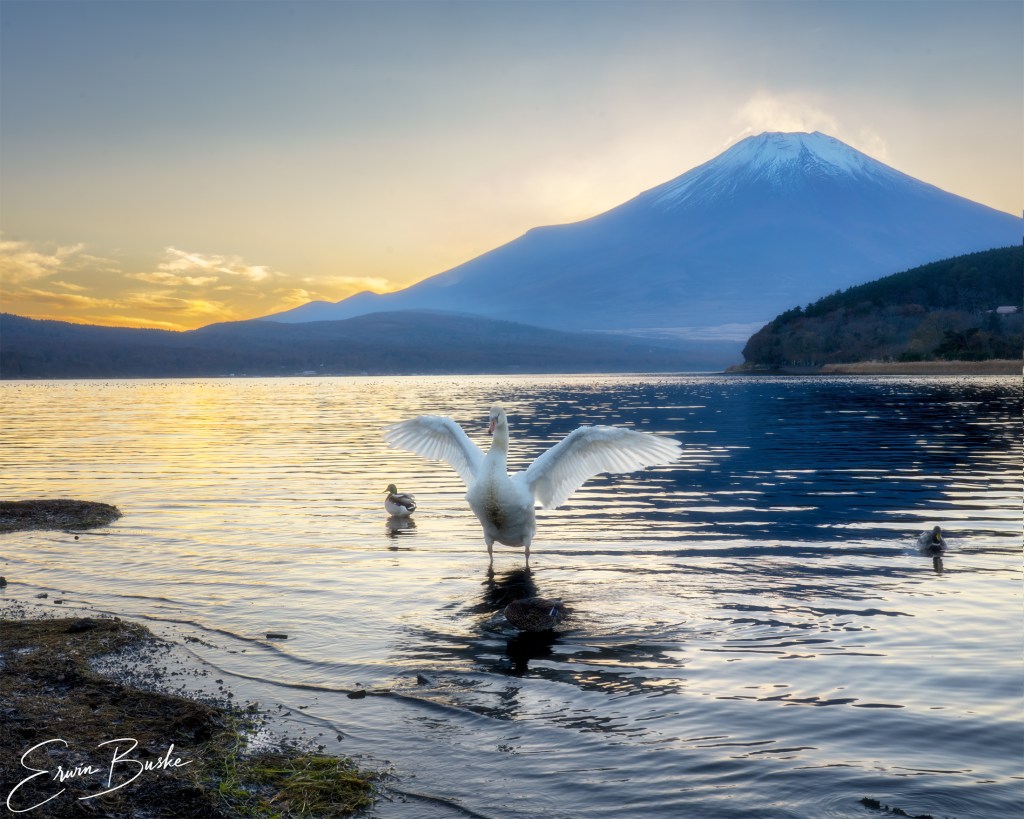
Mount Fuji above a lake as a swan spreads its wings in sunset light.
Mt. Fuji Swan Lake

At the foot of Mount Fuji, a serene scene changed in an instant. A swan had been gliding calmly across the lake, but just as I composed the photograph it unfurled its wings, catching the luminous colors of the setting sun. The gesture lasted only moments. It was a reminder that some of the most memorable photographs arrive when preparation meets something unpredictable — and when we are willing to accept the image nature gives us rather than insist on the one we had planned.
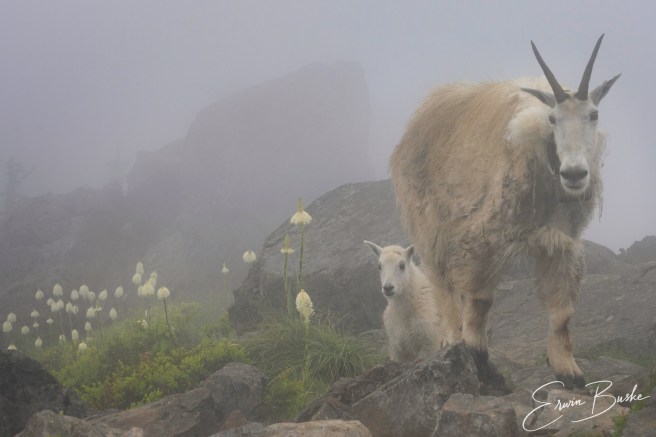
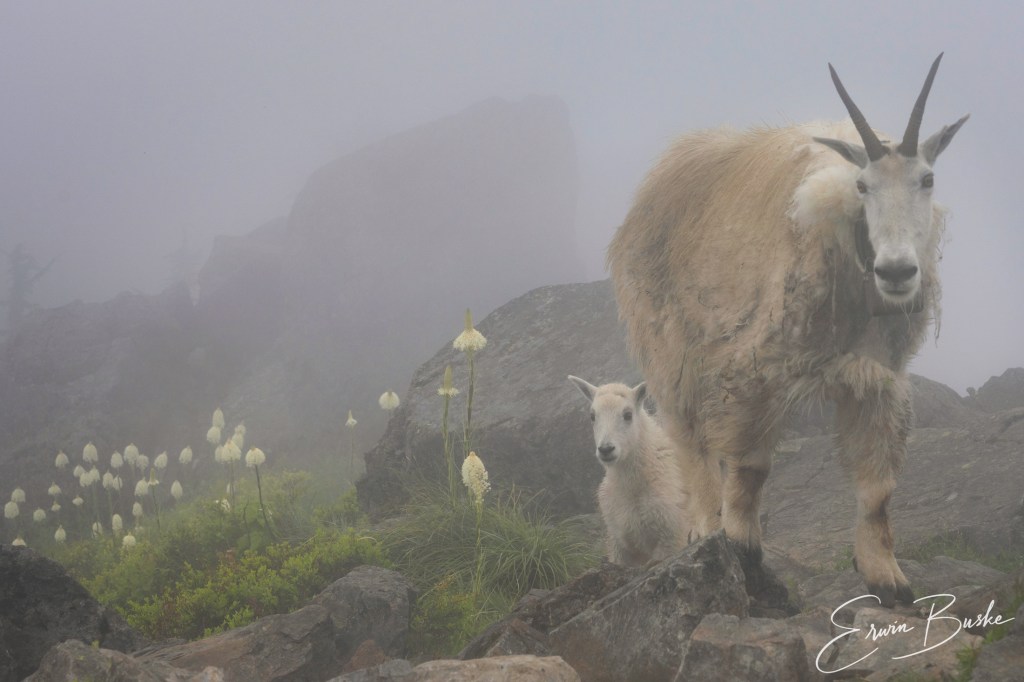
Mother mountain goat and kid moving through a foggy beargrass meadow on Mailbox Peak.
Mother Goat and Kid

When my daughter and I arrived at the top of Mailbox Peak, we were surprised to find a mother mountain goat and kid moving through a foggy beargrass meadow. I have climbed and photographed this peak many times; returning has become something of an annual ritual. Yet it took years of repeated visits before weather, place, and wildlife converged in a way that expressed the experience of the summit for me. The scene could not have been planned. It had to be recognized when it appeared.

Lesson 6 — Suggest Rather Than Describe

Impressionist painting often gives us enough information to recognize a subject without describing every detail. What is communicated is not simply the literal scene, but an impression of experience. Monet’s Morning Haze (1888) demonstrates this beautifully.
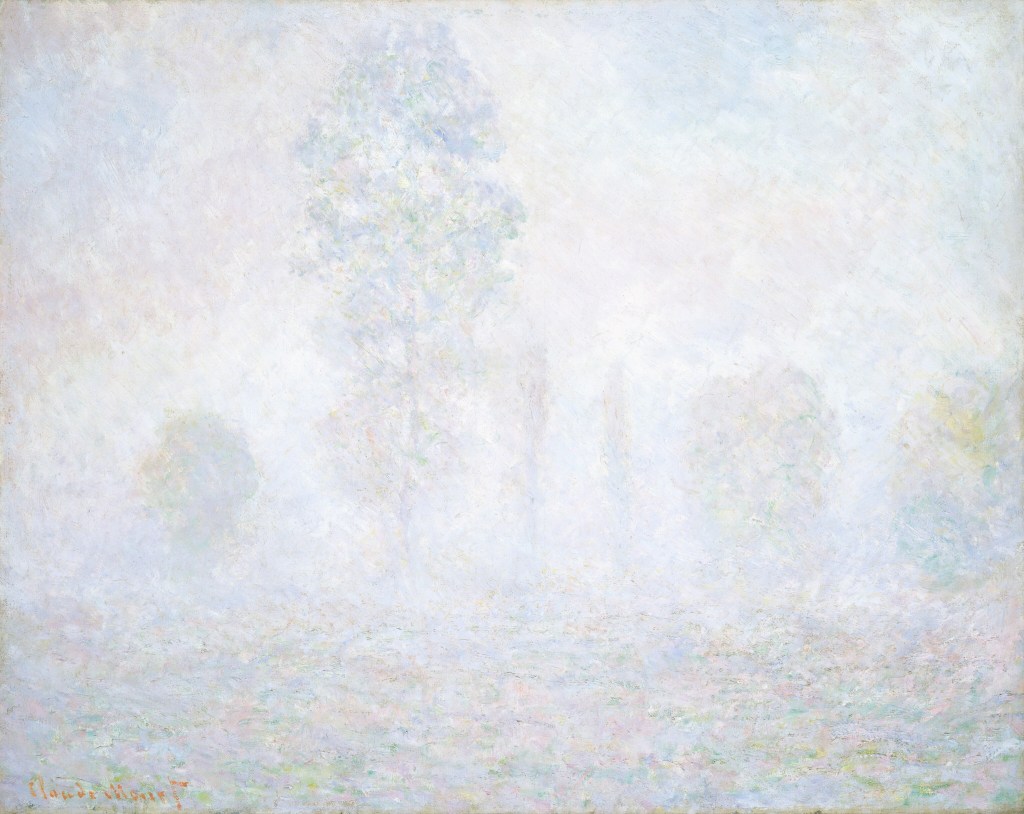
Claude Monet Morning Haze, with faint trees emerging from pale mist.
Monet, Morning Haze, 1888 NGA Public Domain

Trees barely emerge from a field of white, pale blue, pink, lilac, and faint yellow. Their outlines are indistinct. Monet gives us just enough visual information for our minds to recognize a foggy landscape without describing every branch, leaf, and spatial relationship. Importantly, nature itself is doing much of the simplifying. The fog removes information; Monet responds to what remains.

That lesson — allowing a scene to suggest rather than fully describe — has inspired many of my photographs.
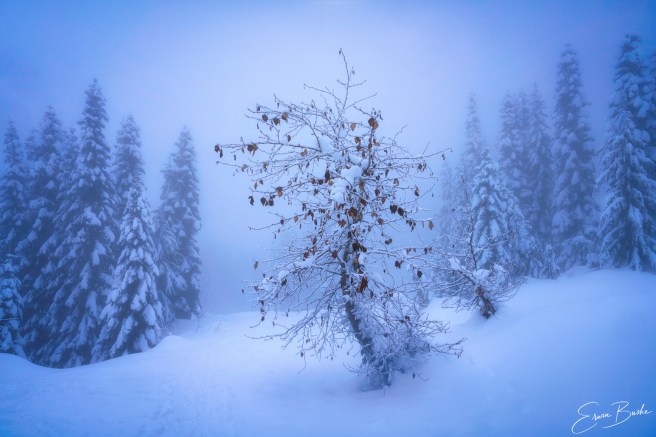
Lone deciduous tree holding leaves against a nearly featureless foggy winter background.
You Keep Me Hanging On

I passed this lone deciduous tree on a foggy winter morning while snowshoeing toward Kendall Lakes. The tree was still holding on to its leaves, suspended against a nearly featureless background. Here the fog dissolves the surrounding landscape, the palette is reduced, and much of the scene is implied rather than spelled out. Yet the photograph remains clearly photographic. Nature has done most of the abstraction for me.

Most of my photographs, even when dreamy or painterly, maintain a close relationship with the recorded image. I generally rely on natural conditions to move a scene toward a more impressionistic interpretation. Occasionally, however, I loosen that connection and become more experimental. These images are not my dominant style, but they allow me to explore the boundary between representation and impression.

Sometimes I Go Further

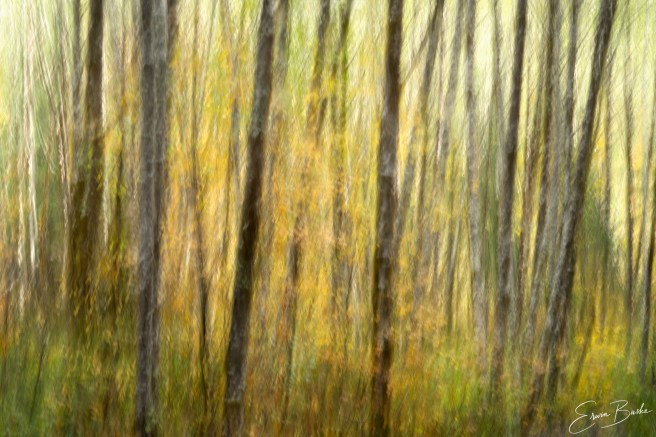
Photographing through wet glass or intentionally moving the camera allows me to relinquish some literal description while still remaining engaged in a photographic encounter with the world. The subject does not disappear; it becomes something the viewer completes through suggestion.
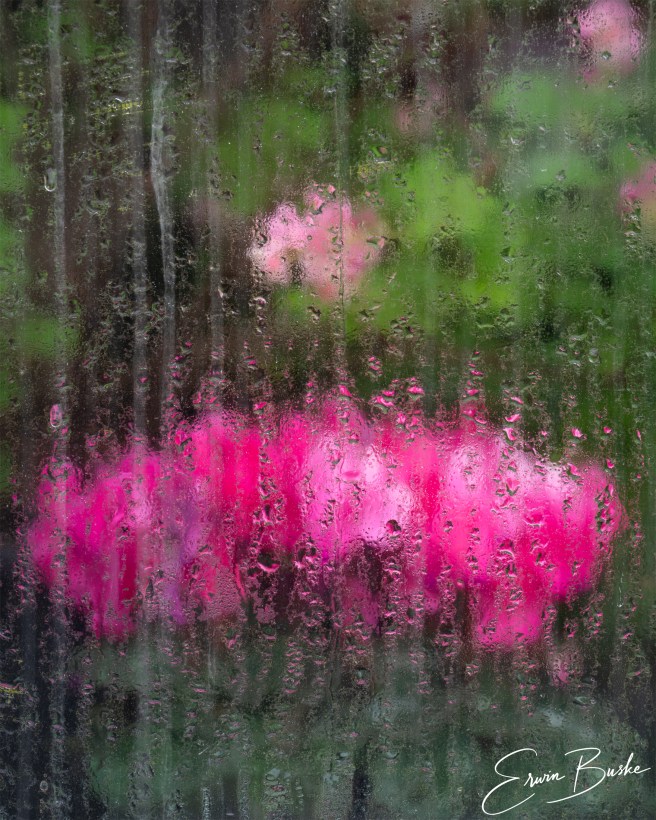
Flowers and greenhouse forms seen softly through a rain-covered conservatory window.
Valentine’s Day Through a Greenhouse Window
Intentional camera movement photograph of a snowy forest, creating vertical impressionistic streaks.
A Walk in the Forest — ICM

Bringing It Into the Present

I do not consciously run through a checklist of Impressionist principles when I make a photograph. Over time, these ideas have simply become part of how I see. Looking across the progression of my work, I can recognize a thread becoming more visible: an increasing attraction to atmospheric light, softened detail, relational color, revealing and concealing weather, reflections, and fleeting moments. This does not mean that every photograph I make needs to express all six lessons. It means that these ideas have gradually become part of my visual vocabulary. I explored this broader process of developing creativity and photographic vision in Nature and Nurture: Creativity and Skill in the Art of Photography.
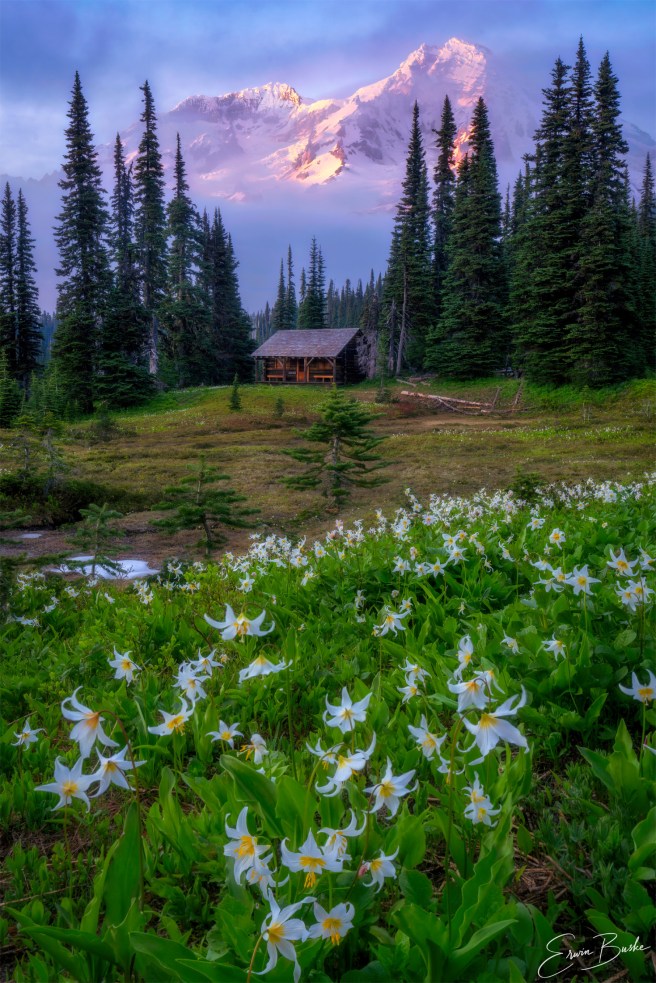
Atmospheric landscape in Mount Rainier National Park softened by fog and light.
Going Home — Mt. Rainier National Park
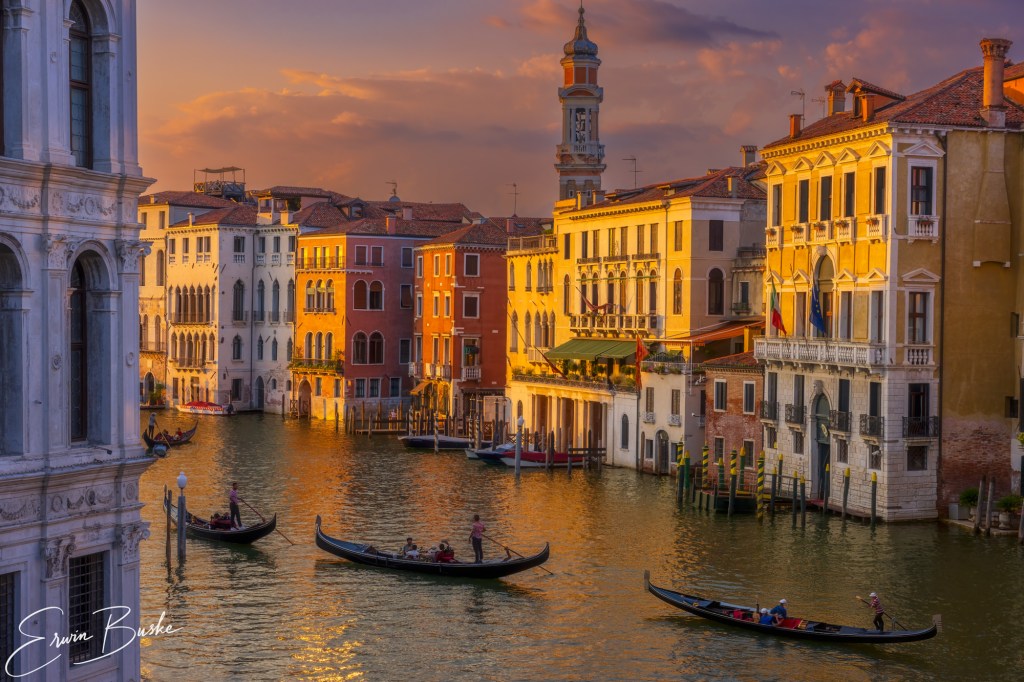
Venice gondolas silhouetted against warm sunset light on the lagoon.
Venice Gondolas at Sunset

Both of these photographs were recently recognized by the Seattle Photography Society. I appreciated the recognition, but what interested me even more was realizing how clearly the photographs reflected qualities I have increasingly sought in my work: atmospheric light and weather that soften detail and reduce contrast; color that carries emotional weight; clouds, fog, or atmosphere that reveal and conceal; and the sense of a fleeting moment briefly coming together before the camera. The awards were gratifying, but the deeper satisfaction was recognizing that these ideas are no longer concepts I have to consciously apply. They are increasingly part of how I see.

The Road Ahead — Toward Less Description, More Experience

Over time, I have become less interested in asking:

How accurately can I photograph this landscape?

and increasingly interested in asking:

What did it feel like to be here?

And, going one step deeper:

What was it about this moment that caused me to stop and look?

My camera remains a recording device, and my photographs remain photographs. But what I choose to include, what I allow to disappear, how I respond to light, and how I interpret the resulting image are becoming increasingly personal. For me, photography is not less truthful when it acknowledges experience. It can remain faithful to the visible world while also expressing something of the photographer who stood before it.

The Impressionists did not teach me how to make photographs look like paintings. They helped teach me that faithful representation and personal expression need not be opposites. The landscape provides the light, weather, color, and atmosphere. The camera records what was there. My task is to recognize the fleeting moment when those elements come together — and to make a photograph that preserves not only what I saw, but something of what I felt.

Sources and Further Reading


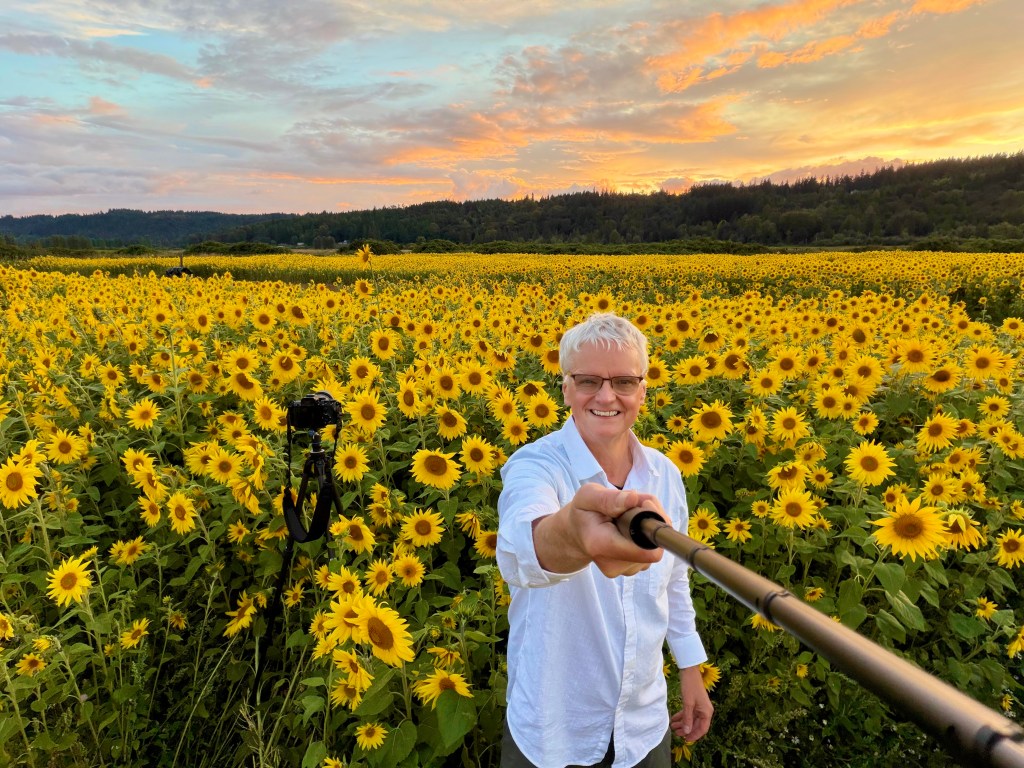
Landscape photographer Erwin Buske standing in a sunflower field in Duvall, Washington.
Selfie 9.26 Lora Lee’s Sunflower Field, Duvall Washington, USA

I am a nature and landscape photographer based in Fairwood, Washington. My work focuses on capturing the essence and emotion of the Pacific Northwest’s mountains, forests, and coastlines. Recently I have also explored landscapes abroad in Japan, Patagonia, Venice and the Dolomites. I witness and interpret nature. I aim to convey my inner vision and personal connection to the landscape through images. I am also a writer. I couple my images with stories. I publish articles covering a wide range of philosophical and spiritual subjects. These subjects also relate to nature and photography. I am available for private in the field workshops and zoom sessions, speaking engagements and presentations, along with longer term apprenticeships.

2022: Beginnings and Endings, Lines and Circles, and Somewhere Over the Rainbow

“We do not come into this world; we come out of it, as leaves from a tree. As the ocean waves, the universe peoples. Every individual is an expression of the whole realm of nature, a unique action of the total universe.”

Alan Watts

In our modern goal driven western world, we have grown accustomed to thinking about progress in terms of beginnings and endings, starts and finishes. This helps us fulfill our need for accomplishment and closure. There is a mountain ahead of us, a definite starting point and a clear goal of reaching the top. We love lines, a straightforward way of thinking about progression, and are not very tolerant of ambiguous goals. Nature often has other ideas. Before the starting point there was multitude of events and happenings that brought us there, and the ending is usually not an ending at all but merely a brief resting point on an infinite circle of life. Nature is more of a circle than a line and repeats itself again and again. Witness the turning of days, seasons, generations even millenniums.

In the words of Alan Watts “We do not come into this world; we come out of it, as leaves from a tree. As the ocean waves, the universe peoples. Every individual is an expression of the whole realm of nature, a unique action of the total universe.” We are not so much starting point as we are a reflection of mother nature who gave us life. When we leave this world, nature and our unique imprint will have fully merged together and live on for generations to come. Which is to say the circle will not only repeat itself but will change, forever expanding as it breathes in our unique contributions to the circle of life. When we climb to the mountain most of us want to think of our accomplishment as an act of personal will that gets us from the starting point to the top. But it is easy to forget who is lifting us up. We are not putting nature beneath feet and finally conquering her once we make it to the summit. Nature and the ground beneath us are lifting us up every step of the way. We are moving with her, and she will also be there at the beautiful summit to transport us to ever expanding circles as our journey continues.

“The life of man is a self-evolving circle, which, from a ring imperceptibly small, rushes on all sides outwards to new and larger circles, and that without end. The extent to which this generation of circles, wheel without wheel, will go, depends on the force or truth of the individual soul..”
― Ralph Waldo Emerson, Circles

Emerson published his famous essay Circles in 1841 and his usage of the English language may seem a bit archaic to us today, but the central ideas of his essay are as relevant to us today as they were back then. Early in the essay Emerson references St. Augustine who described circles as an infinite sphere, whose center is everywhere and whose circumference is nowhere. I have read the essay several times, and each time I draw new insights to help me on my journey. Circles reflects on the endless circles found in nature and the fluidity of all experience. The natural state for each of us is to forever expand our circles which is also a metaphor for personal growth. Emerson, however, also points out that for many of us our circles stop expanding, often in middle age and older, when we believe we have somehow already arrived at our destination. For Emerson there was no destination to arrive at, only a continuous journey. To settle down and stop reaching out to new circles is a kind of metaphorical death. Emerson did not fear actual physical death, because this is just part of the endless cycle of nature. The only thing to fear is not reaching one’s true potential before the time of our passing. Unlived potential happens because one gives up too early, settles into old habits and just good enough. This causes the death of the spirit whose natural inclination is always for us to move forward.

“There are no fixtures in nature. The universe is fluid and volatile.”
― Ralph Waldo Emerson, Circles

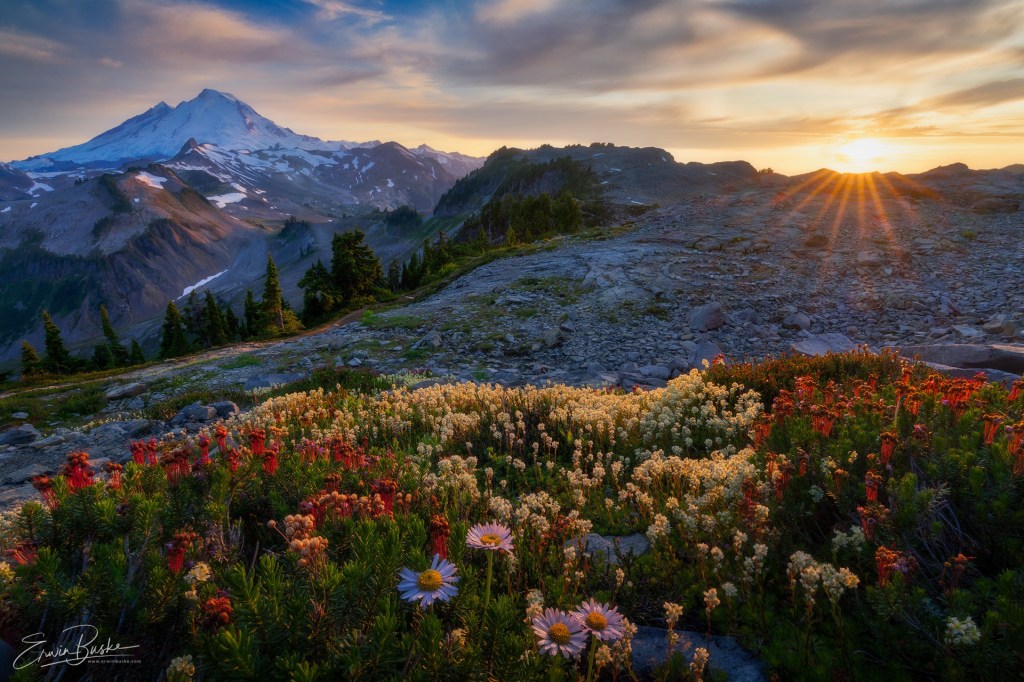
This was a most memorable sunset at Artist Point during my weekend stay at the Mountaineers Mount Baker Lodge. I am not sure how the rocks forming the sundial or labyrinth below the sunburst came to be. Although it seems like an interesting feature, someone definitely left a trace through the construction of the dial. Part of me wanted to disperse the labyrinth, but I thought if the forest service did not want it there, they would have done the same long ago. A few of my viewers mentioned that it was a meditation circle put there to guide circular walks in nature. I often find myself going around in circles when in the beauty of nature. Circles and nature seem to walk hand in hand!

I myself have experienced some apparent endings in the past year, my daughter Caroline leaving home for College at the UCSD and Julia and I finalizing our divorce. But these events are also gateways to ever expanding circles. Caroline will make new friends and connections in Southern California, learn to surf and grow in both her mind and her heart. Julia will also expand her circles as she establishes her new home in California and tries out new activities, forms new relationships, and reshapes her identity. I am still listening to my heart for where to go from here, but I do have some plans. These plans are notional and a bit like looking out “Somewhere Over the Rainbow”. The rainbow points in a direction but what is over the horizon remains to be seen. I will move forward with abandonment trusting my heart that I will create new and ever-expanding circles. Emerson concludes his essay Circles with this quote where he instructs us to follow our heart and move forward with a kind of abandonment.

“The one thing which we seek with insatiable desire, is to forget ourselves, to be surprised out of our propriety, to lose our sempiternal memory, and to do something without knowing how or why; in short, to draw a new circle. Nothing great was ever achieved without enthusiasm. The way of life is wonderful: it is by abandonment”. ― Ralph Waldo Emerson, Circles

Juanita Bay Golden Hour Rainbow

I am excited about some of the new friendships I have formed and how these friendships will support collaborations in photography. Friendships are so important in providing the spark to expand our circles into previously unexplored areas. I also have a couple of books in process that hopefully will soon be published along with several trips planned, including one to the Italian Dolomites. Near term I will travel to Southern California both to see my daughter Caroline and to photograph Anza Borrego, Joshua Tree and other places that are calling me. I am also excited about taking my photography in new directions, integrating music more closely with photography, photographing people (models) in the landscape, intentional camera movement, photographing birds and wildlife in the landscape, building new theme portfolios and more closely integrating my writing with photography. And by the way there are a few peaks I still want to climb, but they will just be departure points into ever expanding and newer circles!

Here is a collection of my best and favorite images from 2022, along with the backstory for many of them, my thoughts, impressions and a few photography tips. They are not in any particular order, some were very popular some not so much so, but all are meaningful to me. Thanks for looking!
1. Two Tree Point

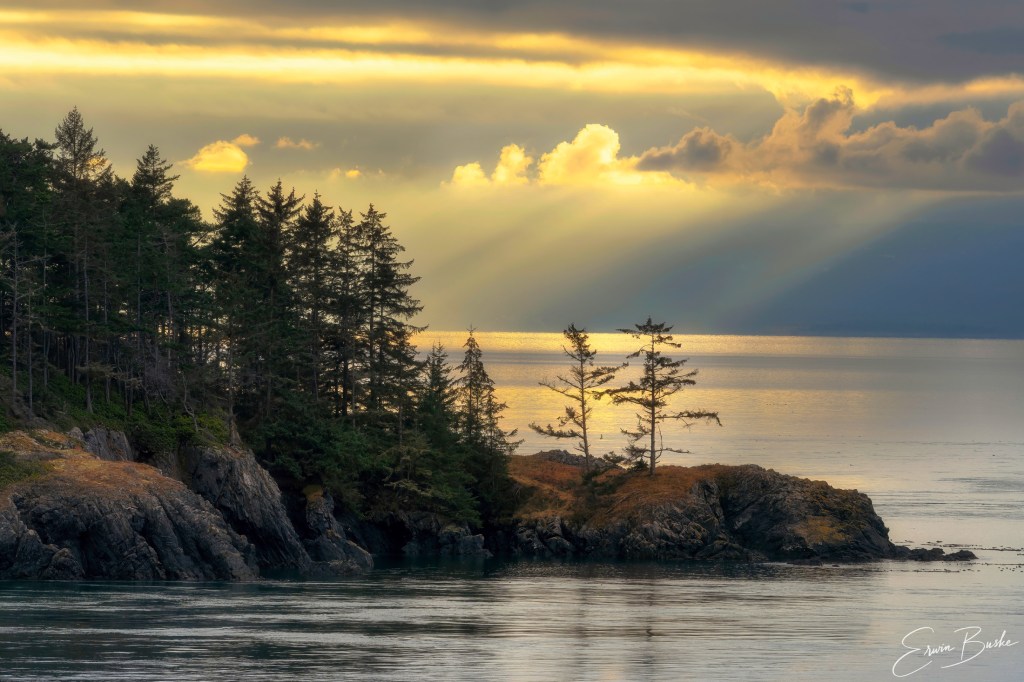
Two Tree Point

Before moving to Woodside, I used to live on Three Tree Point, but there were no Three Trees on the Point. In early December I was at Deception Pass Rosario Head at sunset looking out to Deception Island where there are Two Trees on the Point. My eyes were immediately drawn to these Two Trees with rays of light breaking through an otherwise cloudy day illuminating the Salish Sea and the two lovely trees. The two trees seem to be enjoying each other’s company underneath rays of light and hope! As Bob Ross always said, “Everyone or Tree needs a friend!”
2. By the Light of the Setting Sun and Rising Moon

By the Light of the Setting Sun and Rising Moon

A Waxing Autumn Gibbous Moon rises above Eunice Lake just as the sun is setting at Mount Rainier National Park. This was taken one day before the October Hunter’s Full Moon. From my perspective this is better than the Full Moon which rises well after the sun has set. This moon is at 97% and the convergence of sun and moon in the warm autumn atmosphere is spellbinding and simply amazing.

In the interests of full disclosure this image was taken with a very wide 12mm lens to capture both the red huckleberries and a large portion of the sky which also renders the moon very small. To get the moon to the size as our eyes see it, I took a second image at 105mm and blended the two images together in photoshop. Although both images were taken around the same time, in the time period between changing lenses the moon moved. I am not aiming at absolute accuracy but rather giving emphasis to how the scene impacted me at more of an emotional level, in other words I am shooting from the heart. Originally, I had the reflected moon offset more to the right and few individuals let me know that this is not possible from a physics point of view, so I corrected this. But in the end, I make no apologies that this is a time blend along with a focal length blend. Both were necessary to convey my personal vision. To me photography is not so much about documenting a precise moment, as it is about conveying my sensibility surrounding an experience. We do not experience the landscape through either a wide angle or telephoto perspective as our eyes quickly toggle from one to the other seamlessly as we process the scene both physically and at an emotional level. That was also my intention for this image that resonated so well with most of viewers, without a doubt my most popular image this year!

3. Touch of Autumn in Winter

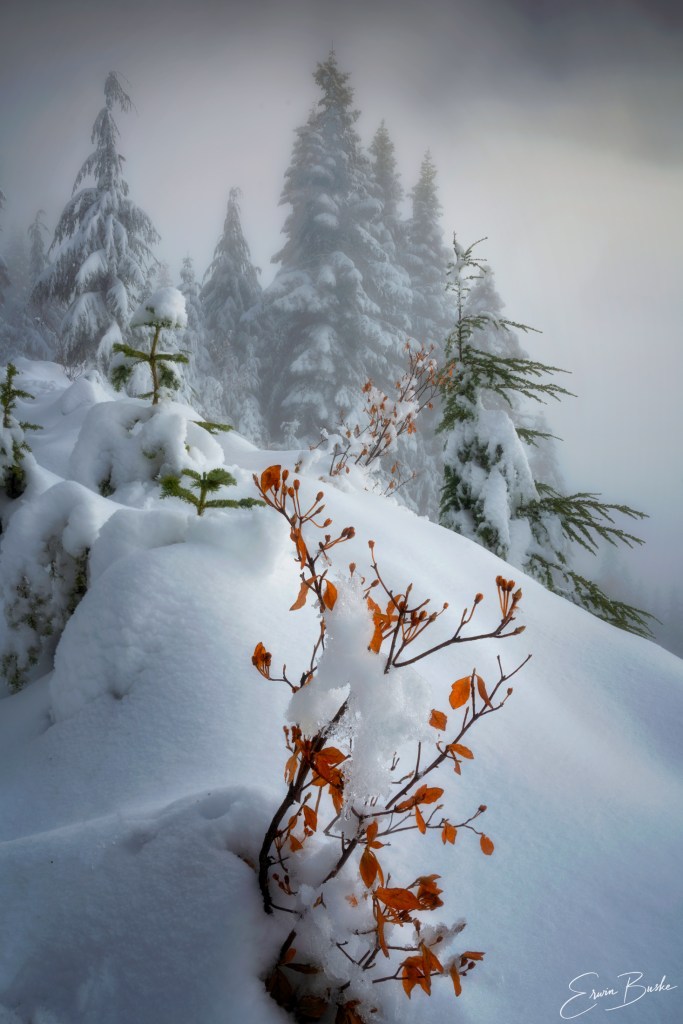
Touch of Autumn in Winter

In late November I hiked seven miles up an old, abandoned logging road. The higher up the road I went the narrower the path became. At first there was just a little snow but as I wound my way up the mountain the snow steadily deepened until I got to this point where further travel was not possible without snowshoes which I did not bring. Views were far and few between, so I just sat down and took in my surroundings. Snow helps make even the ordinary beautiful, seemingly brings a sense of calm and tranquil order to an otherwise chaotic forest and ground. My eyes soon gravitated to these beautiful orange leafed bushes holding on to Autumn even as Winter was firmly settling in. I knew this was the moment the capture the mood and feeling of this experience heading into the Winter Season with Autumn still on my mind!

Shortly after taking this image somehow my iPhone slipped out of my hands and vanished without a trace into the still smooth texture of the winter snow. I did not have a clue as to where it was because the snow was so white and fluffy it just absorbed the phone without making any imprint. As I started to gently comb through the snow to find it I began to think why I took this phone out in the first place. It was an automatic impulse to take it out without even thinking why I needed it. I began then to realize that this may be a signal to be a bit less dependent on this devise, especially when out in a beautiful place like this. I eventually found the phone, but only after about 20 minutes of effort!

4. Mother Goat and Kid

Mother Goat and Kid

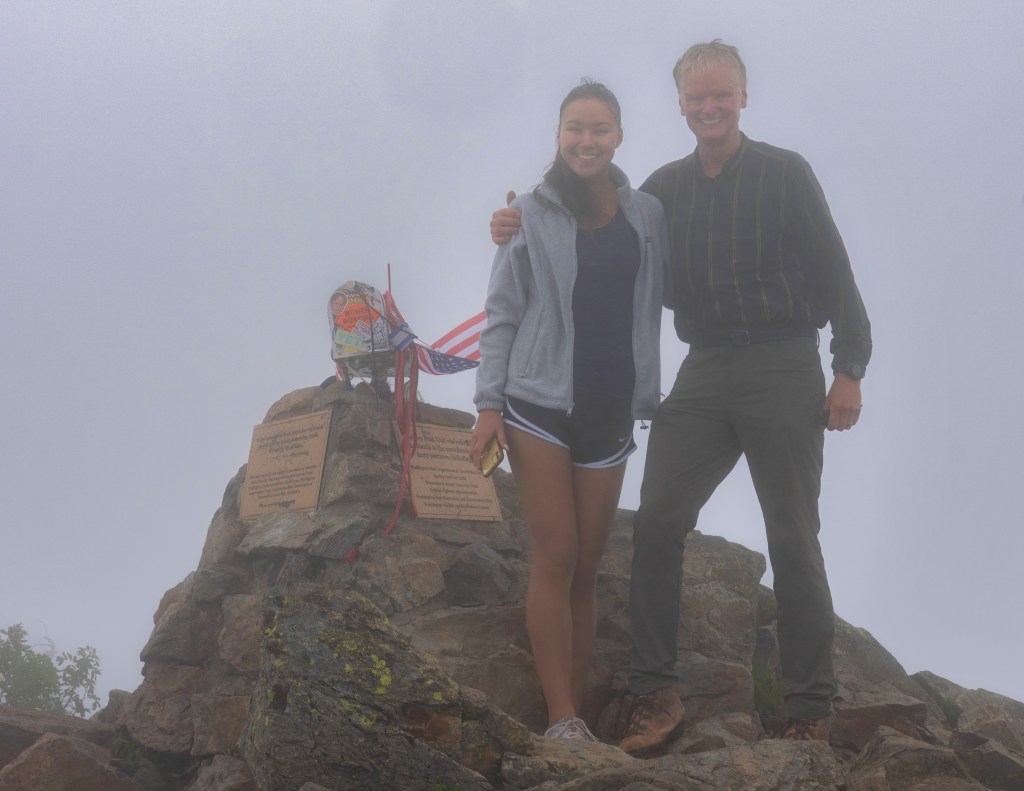
My Daughter Caroline and I last hiked together to the tope of Mailbox Peak when she was seven. As a Father’s Day gift, she offered to go up Mailbox with me again, this time at 18! We could not do the hike on Father’s Day because she was visiting her soon to be college at UCSD. But on this day in early June, although very foggy, it was the perfect day to make the trek! The bear grass was lovely, and we even had unexpected visitors, a Mama Goat and her Kid!

5. Rows of Green Stones at the Harbor

Rows of Green Stones at the Harbor

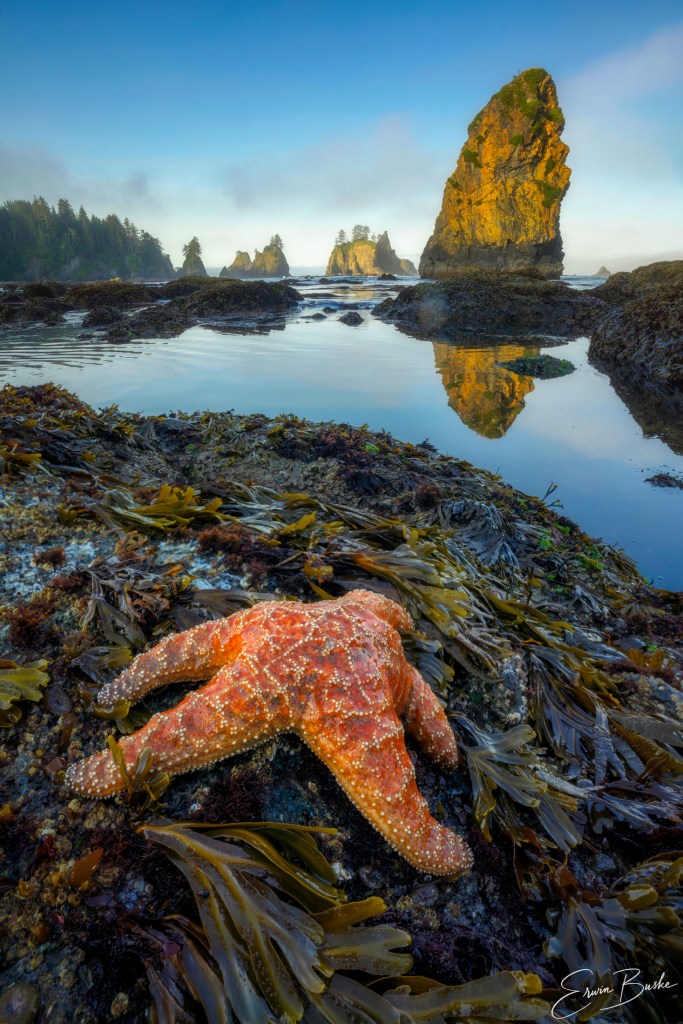
I am not sure what natural and organic marine and geologic forces created these lines of stones covered with seaweed at the Point of Arches. But they sure look like they were designed with intention reaching out to the gorgeous sea stacks also reflected in the calm waters of a natural harbor. This image was taken close to sunrise at a very low tide on my August backpacking trip to Shi Shi Beach.

This was my first trip to Shi Shi Beach and I am so surprised I have never been here before. I liked everything about it, from the long drive to Neah Bay on the northwest tip of Washington, the hospitality and friendliness of the Makah Tribe who provide recreational permits for access to their native land, the beautiful four mile hike through the woods and down onto the beach, to the camp sites close to the Point of Arches, not to mention the delicious smoked salmon to pick up on the return journey home!

6. You are my Shining Star

You are my Shining Star

At a very low tide at the Point of Arches, a starfish seemingly bathes in the sunlight until the tide rises. I think it is safe to say, at least for this period of time between tides, this starfish was a little “Laid Back”!

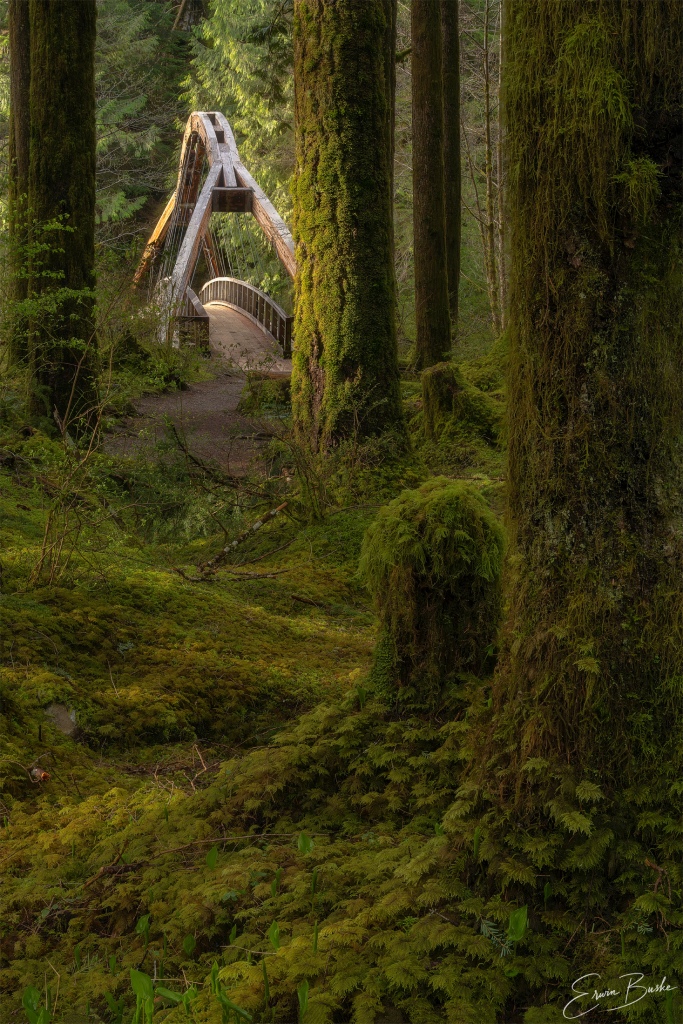
7. Middle Fork Bridge to the Spirit of the Shire

Middle Fork Bridge to the Spirit of the Shire

This has to be my favorite hiking suspension bridge and I return here often to visit this beautiful, lush forest of the wild Middle Fork of the Snoqualmie River. The forest approach of the Gateway Bridge reminds me so much of Tolkien’s world and the spirit of the Shire. I have tried to capture this feeling many times walking through this forest, and this is one of the few times I think I actually succeeded. Capturing the mood of a place and what it means to us personally, and still staying rooted in the reality of the experience is not nearly as simple as some would think. When the two come together then one gets the feeling of “magic”! Here what certainly did help were the spotlighting on the bridge, and the soft rays of overhead light filtering through the forest and onto the moss, tree trunks.

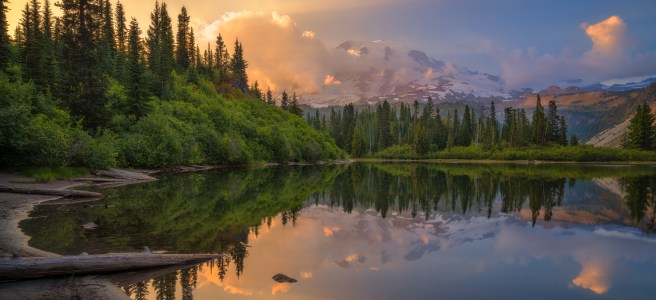
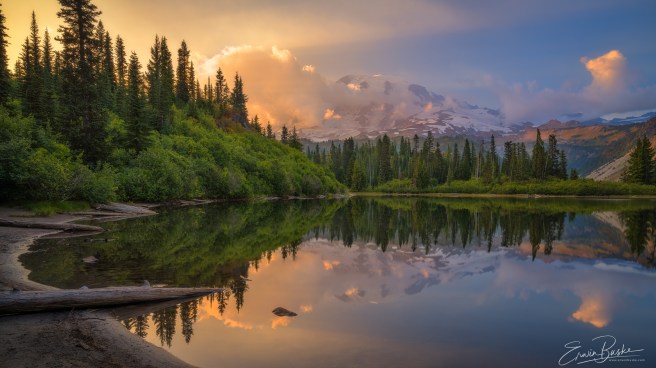
8. Indian Henry’s Reflection Pond

Indian Henry’s Reflection Pond

Indian Henry, known as Soo-Too-Lick, early on (1883) guided several familiar names to Mt. Rainier including the Hunting Grounds, these familiar names include James Longmire Philemon Beecher Van Trump and John Muir. Indian Henry was a Cowlitz Indian, beloved by many people.

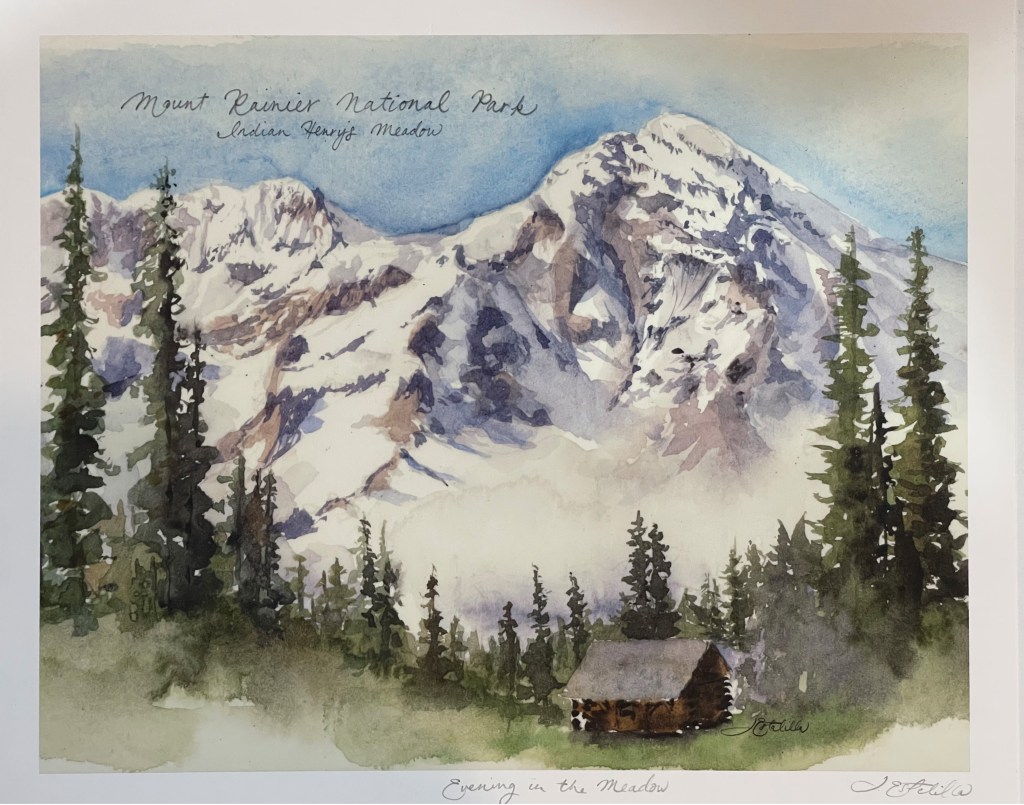
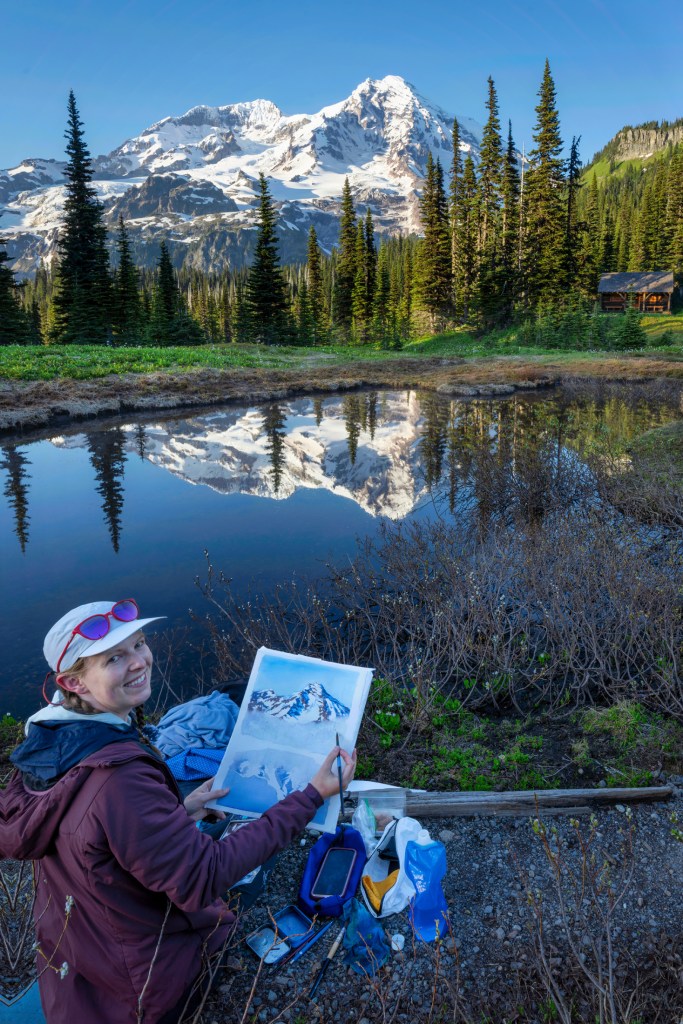
On this backpacking trip to Indian Henry’s Hunting Ground, I was joined by a small group of painting and pencil artists. We backpacked in from Longmire along the Wonderland Trail fording Kautz Creek. We arrived fairly early at Devil’s Dream where we had first pick of campsites. After setting up camp we then headed up to Indian Henry’s and Mirror Lake staying until sunset hiking back to camp with headlamp. Both Clair and Jodi created original works of art on site while I photographed the constantly changing mood and atmosphere of my all-time favorite place to be on Mt. Rainier! Claire also recorded an online training session for her Adventure Art Academy. We had some inspiring discussions on the trail and camp on the overlap of painting art and photography, similarities and differences. You can see more of Clair’s work and offerings at https://www.claireswanderings.com/ Also check out Jodi’s wonderful art at https://jomiekoart.com/

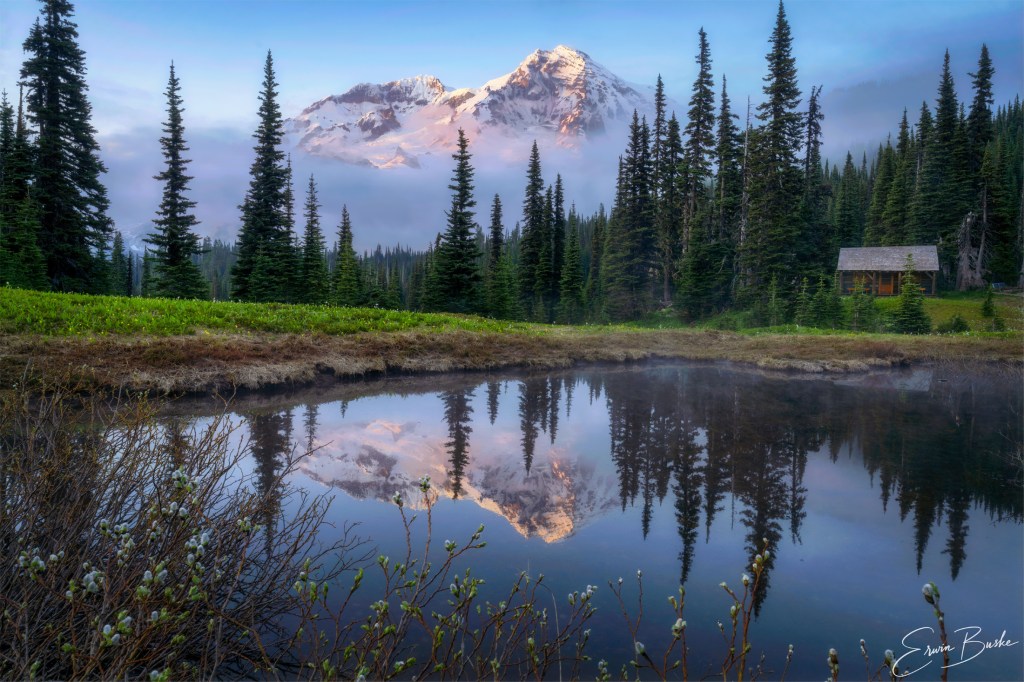
9. Going Home

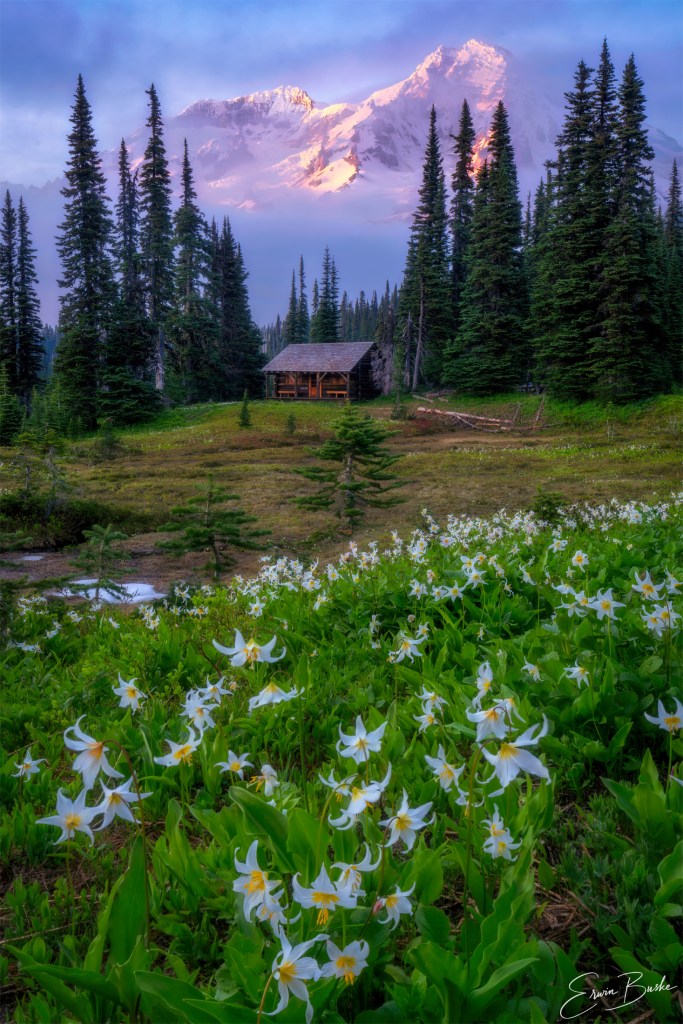
Going Home

This cabin is in as beautiful setting as I could ever imagine and is like walking into a dream. In this dream I am finding my way back to where I truly feel I am more at home, in Nature and the Wilderness. This is a common dream shared by many as was evidenced by the thousands of reactions I received from this image. Although this was late July, the Avalanche Lilies were at peak, about one month later than when they usually peak in June. We had an usually cool late spring and early summer causing snow to linger which impacted the bloom cycles in many areas.

10. Snow Lake Mountain Ash Sunset

Snow Lake Mountain Ash Sunset

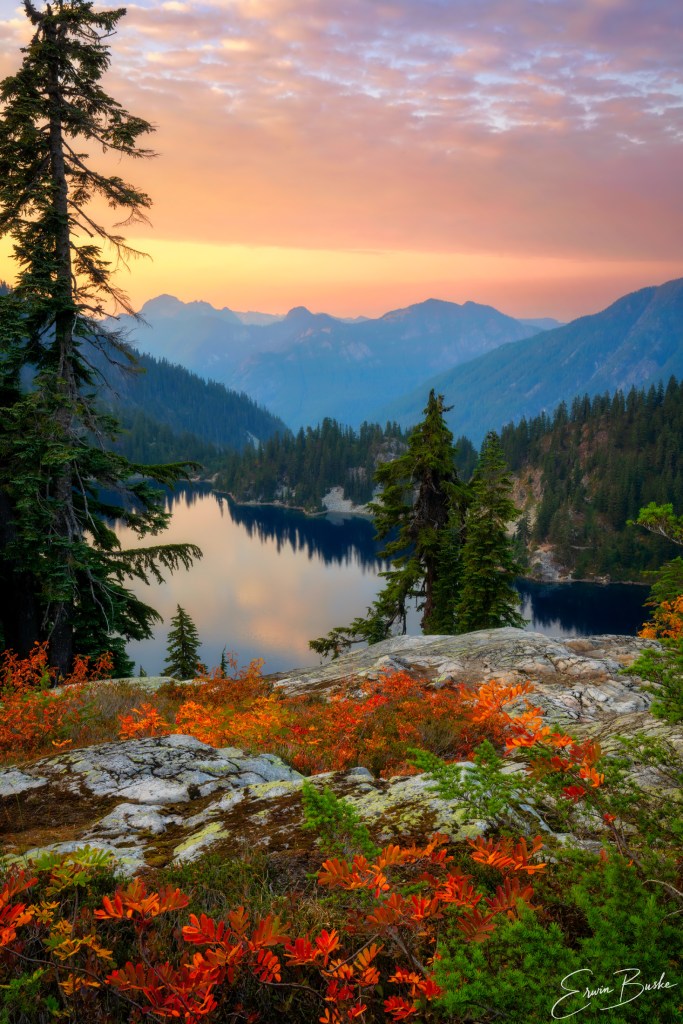
On a Sunday morning in the later part of September, I heard about the Snow Lake trail reopening and decided to check it out. The reports I heard that the trail was turned into a multilane freeway were definitely a huge exaggeration. What I mainly saw was the original trail refined in the upper part where there were rocks to climb over. The trail is now more or less smooth all the way to the top of the ridge and made for a more comfortable exit in the dark!

Snow Lake was crowded so I headed further to Gem Lake picking deliciously ripe and plump huckleberries along the way. For sunset, I made my way to what would be my evening home along the southern ridge overlooking Snow Lake. This is where I experienced this beautiful sunset with orange mountain ash in the foreground and colors ranging from purple, orange, yellow, and mauve in the sky-a most memorable evening and I am thankful I was able to experience it!

As the light changed steadily from the golden hour to right before actual sunset, I experimented with several compositions and vantage points before settling on this one. I needed to be low and close to bring attention to the orange mountain ash, but not too low because then I would lose sight of much of the lake. Although a wider angle would have given greater emphasis to the mountain ash, Snow Lake would have been rendered too small in size resulting in an unbalanced image. The soft light took on magical colors in the minutes just before actual sunset. I went all the way out to 35mm on my 16-35 zoom lens and did a focus stack of two images to render the entire scene sharp.

11. North Cascades Light of the Angels

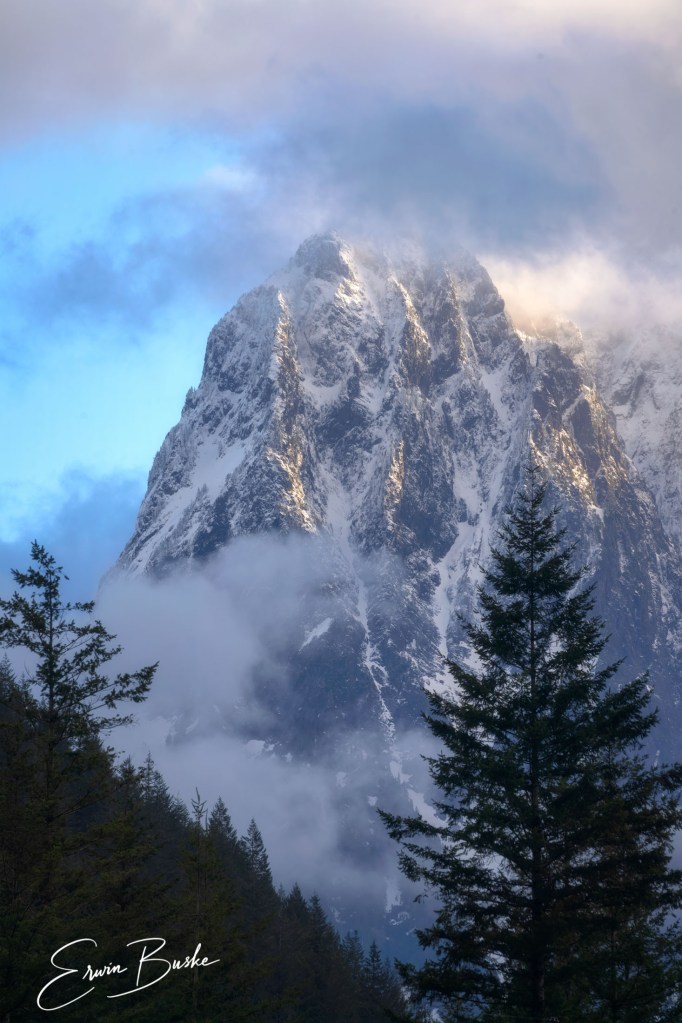
North Cascades Light of the Angels

On this trip to the North Cascades, I was looking for an entirely different composition about a half a mile from this spot. But it was hard to notice this clump of heather looking out toward this soft early evening angelic light settling over the western peaks. Several very well-known photographers who I have been so lucky to meet in person including Candace Dyar and David Thompson have shared “follow the light” as a guiding principle for choosing what to photograph and putting together a composition. That principle certainly helped here, and this ended up being my most successful and impactful image from this three-day trip.

12. Inner Glow

Inner Glow

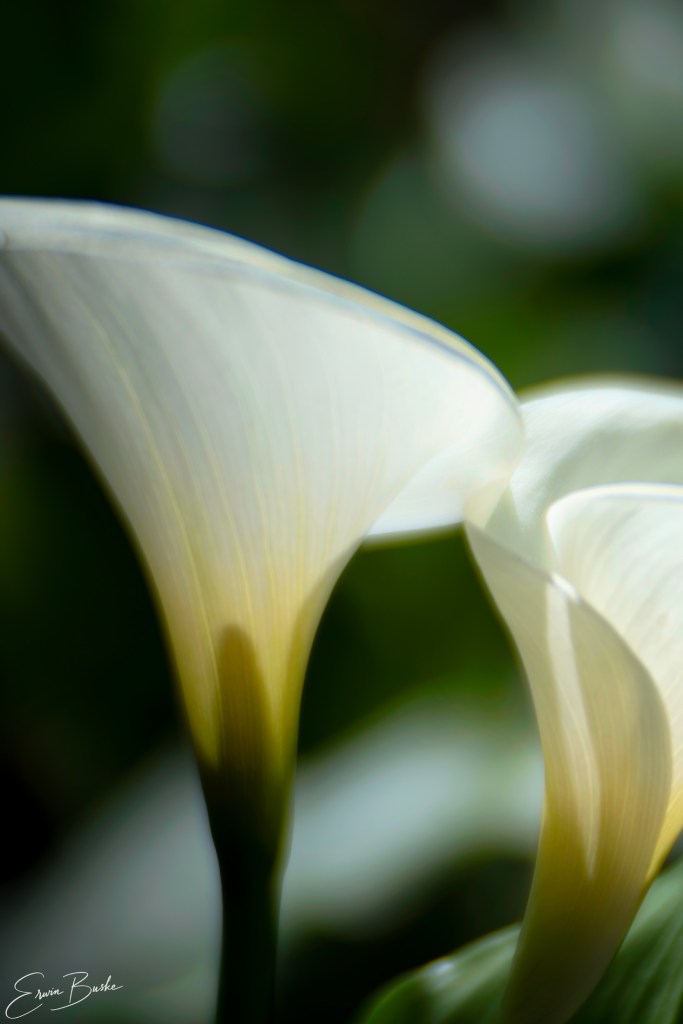
This was taken with a soft-focus lens at the Point Defiance Rose Garden which also has Calla Lilies. and provides another lesson in following the light. Although I normally do not take images in strong midday light, I loved how this light rendered the lilies almost translucent revealing their inner glow. In softer light toward the edges of the day this translucent inner glow would not have been nearly as well pronounced. It is acknowledged that use of my Lensbaby soft focus Velvet 85mm lens helped tame the harshness of contrasty midday light. Most of us landscape and nature photographers have been programed with the mantra to take pictures only during the edges of the day in the golden hours. Creativity, however, knows no such limit and invites us to explore the possibilities of light during all hours of the day.

13. Silver Falls in a Mossy Forest

Silver Falls in a Mossy Forest

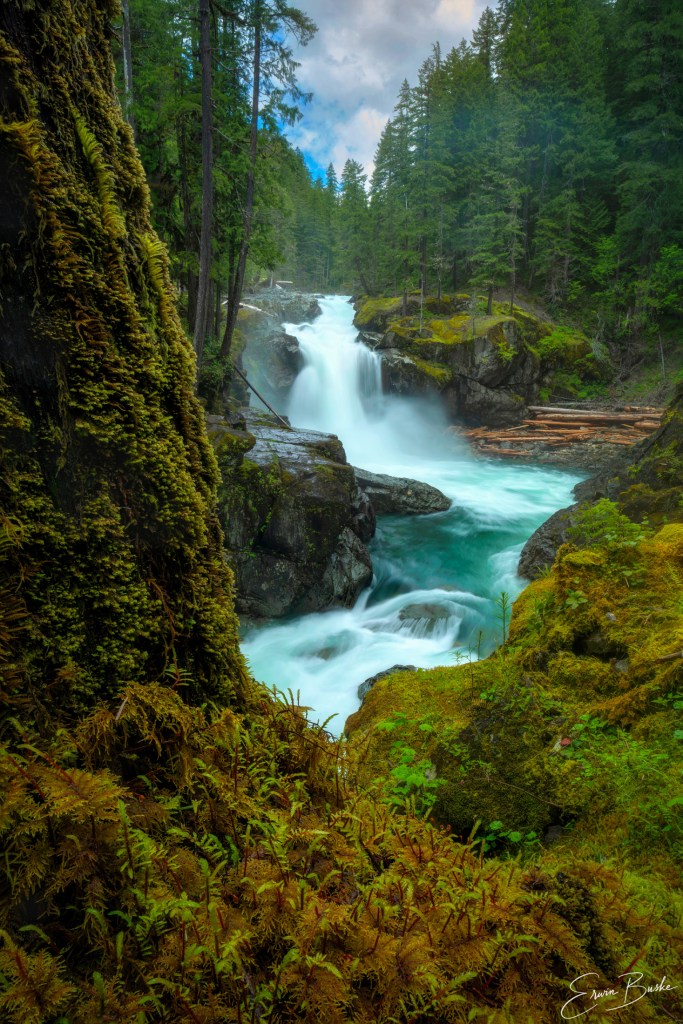
I always enjoy this Silver Falls loop hike in Spring when the water is running high! Silver Falls provides another example of breaking through the myth that good light is only to be found during the golden hours. The recessed rocky forested walls of this river valley are sufficiently high that during the golden hours little light penetrates down to the riverbed leaving just the blueish cast of deep shadows for images. I took this image more toward the middle of the day in broken clouds that helped diffuse the light but still allow the light to reach down into the river valley. The light reflects and bounces off the forested and rocky river walls further enhancing the effect. To me a major part of the appeal of this area is the mossy forest, so I emphasized that in the foreground while still looking out to the turquoise glaciated water running high at Silver Falls.

14. Autumn Flame

Autumn Flame

On a cool but sunny November Day, I headed down to Kubota for a picnic in the Garden and to pay a visit to one of my all-time favorite trees! Yes, I have lunch with trees! Photographing the brilliant backlit leaves of this tree also requires shooting toward the middle of the day. Much of Kubota Garden is at the base of a steep hill that blocks the westerly light toward evening. The position of this sun stars also depends on midday light. Getting a good exposure of course in these kinds of conditions is challenging due to high dynamic range between dark shadows and brilliant highlights. But with under exposure, the raw files produced by many of our modern camera sensors are up to the challenge. I just love the symmetry of this tree swirling and reaching out in all direction like octopus’s arms in a kind of chaotic order!

15. Sunrise through the Lupines

Sunrise through the Lupines

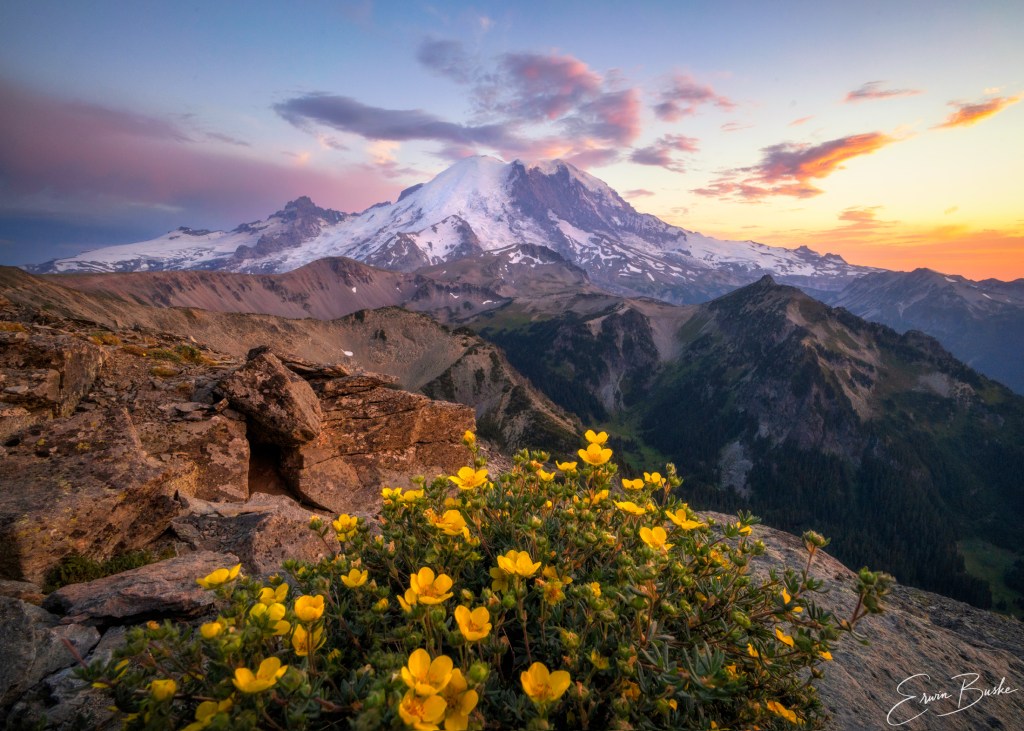
What a wonderful feeling it was to experience this sunrise looking through the Lupines and out to the Balsam Root at Rowena Crest. It’s a wonderful world! Although I have photographed this flower field overlooking the Columbia River many times at Rowena Crest, I thought this time was the first time I captured the delicate first rays of light subtly illuminating the lupine flowers in a way that is consistent with my experience of sunrise. Although the dramatic colors of sunrise in the sky are often what we hope for in our sunrise shots, equally and in this case even more important is what the light is doing to the foreground elements.

New Horizons

In photography as in any other creative art form, we must continuously reach out and extend ourselves into larger and larger circles. The price of not doing this is essentially withering on the vine, and the death of creativity. As artists we can never rest on our laurels and draw oxygen from merely yesterday’s accomplishments. We must continuously move forward and find breaths of fresh air. Some of the ways in which I moved forward this past year include forays into taking images of people (actually a Sun and Nature Goddess!) in the landscape, Bird Photography, Intentional Camera Movement, and new processing techniques I learned from David Thompson. I also extended my reach through visiting some new areas (at least to me) including the Redwoods of California.

16. Sun Goddess

Sun Goddess

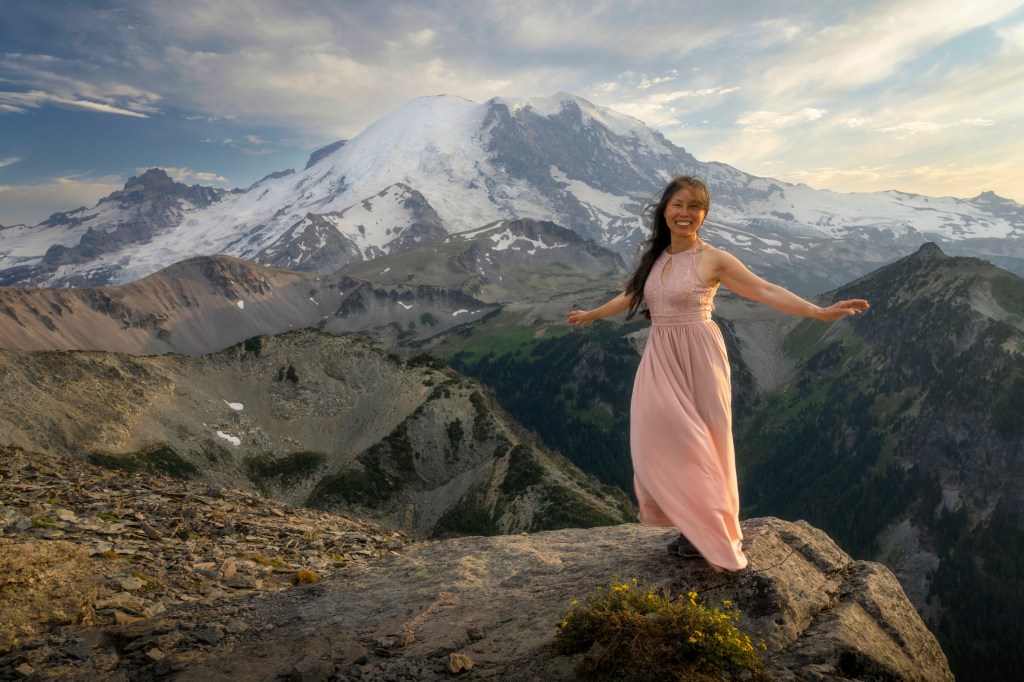
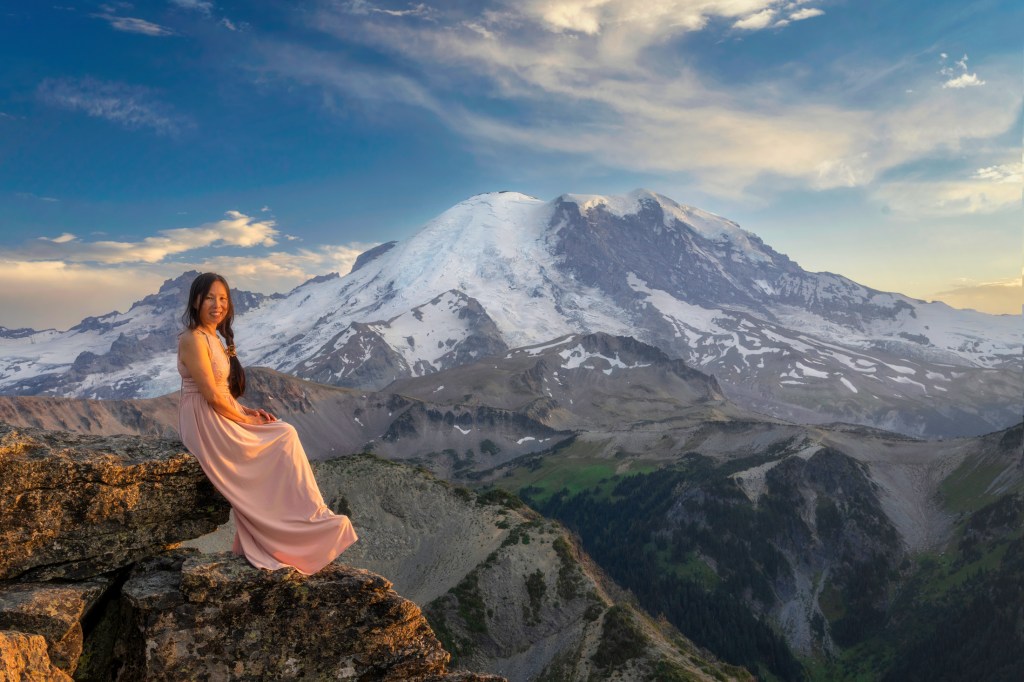
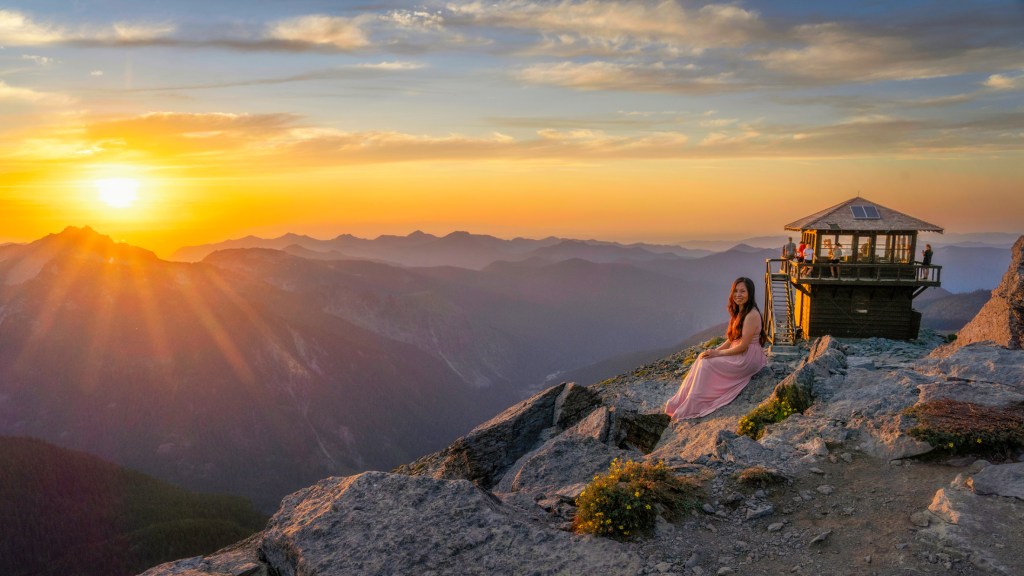
In August, my friend Shaping joined me for a sunset hike to Mt Fremont. Although when we started hiking it was a bluebird kind of a day and also very hot, as we approached the top a breeze moving down from the glaciers of Mt. Rainier helped keep us cool and comfortable. Wispy clouds slowly filled the sky. The wildflowers were still in peak form and Shaping in her beautiful dress reminded me of a Sun Goddess as the sun slowly dipped below the horizon.

Although I called this image the Sun Goddess, Shaping also represents to me the spirit of a “Nature Goddess”. When she wears this flowing dress and reaches out from Fremont Mountain to the sun she is celebrating and honoring mother nature. Shaping feels the same way. A few people confronted me when I originally displayed the series of images that this image is a part of and accused me of chasing Instagram popularity. I can assure you that that was the last thing on my mind. For me the event was completely unplanned and just arose spontaneously out of the happenings on this wonderful day. Sometimes I think some are too quick to jump to conclusions about other photographer’s intentions. Their accusations may be more of a reflection of their own inner state of mind than anything else.

17. Blue Heron and Turtle on a Log

Blue Heron and Turtle on a Log

When I visited the Union Bay freshwater estuary close to the UW campus, my eyes immediately gravitated to this scene. The turtle and blue heron almost seemed engaged in a kind of meditation, looking out toward tow bonsai like tree branches, where new life appeared to be rising from this old decaying log.

This image is one of my first Birding images. I decided to try out Birding after observing Shaping taking bird images on a few of our trips and decided to give it a try. I acquired a 200-600 Sony Lens that provided me the tool I long needed for birds and wildlife. I am looking forward to many more bird and wildlife images on my horizon!

18. A Walk in the Forest

A Walk in the Forest

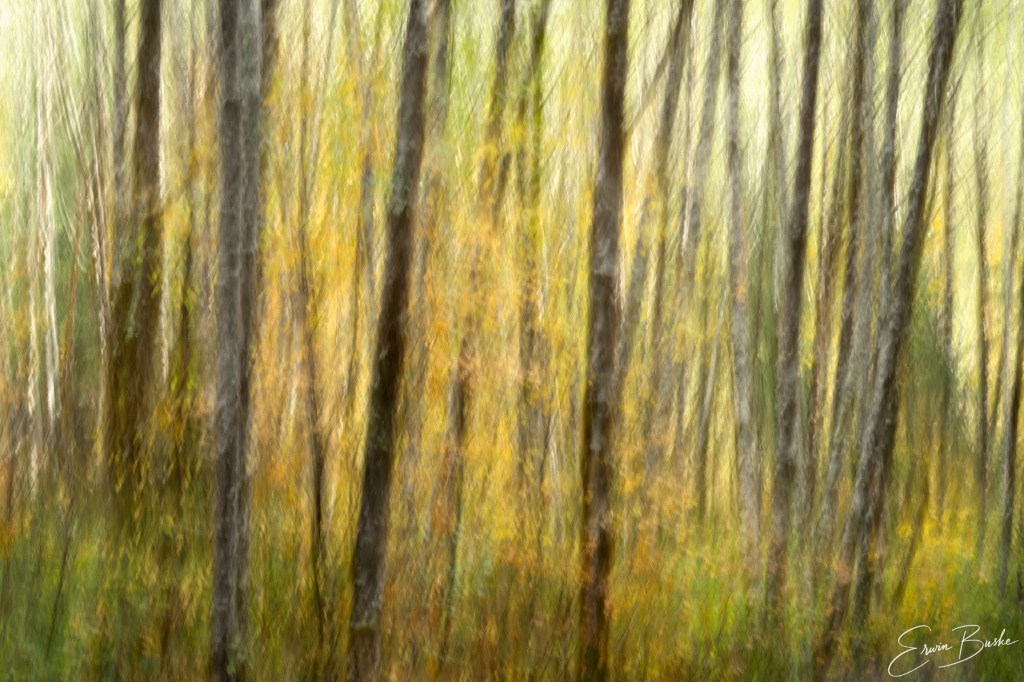
These white bark alders were lit by the diffused light reflecting off the walls of the Middle Fork valley on a beautiful Autumn Day, perfect for a walk in the forest. For this image I handheld the camera and gently panned up and then back down during .6 second time period. Intentional Camera Movement (ICM) can work great in the forest where a somewhat chaotic scene can be reduced down to the essence of lines, shapes, blotches of merged colors and tones yielding an effect the many have told me is like an impressionistic watercolor. Although this technique involves a lot of trial and error, successful ICM still requires careful selection of a suitable scene, previsualization, and good composition skills.

19. Autumn Fire in the Forest

Autumn Fire in the Forest

For this image I previsualized that intentional camera movement would simplify an otherwise chaotic forest scene into the basic elements of trees and blotches of colors that bleed into one another. I also eagerly anticipated that the orange vine maples would resemble flames rising from the forest floor.

20. Don’t You Feel Small

Don’t You Feel Small

On the trail through a mystical redwood forest filled with fog and mist, I pass ancient trees and an occasional rhododendron. I am in my happy place. Going to new places, or at least new to us, helps build a sense of excitement of visiting a place that we may have heard great things about but never have experienced firsthand in nature itself.  This was the case with me on my recent trip to the Redwood National and State Parks.  I had passed through these parts a few times before on road trips, but never had taken the time to get more intimately familiar with these ancient forests.  With my first few steps out of the car and out into the misty forest I felt my sense of enthusiasm starting to build.  These trees were like nothing I had experienced before—so tall, majestic and grand–a kind of life altering experience that goes straight to the heart.  There was seemingly no end to them and the deeper I went into the forest I felt like I was finding what could be a new home for many more photographic adventures.  I was most impressed by the amazing sense depth and scale of these forests. This in turn was a reflection of the enormous size of these trees, layers of fog and mist, naturally filtered light, and the beautiful undergrowth of Rhododendrons and Ferns. I began to see the world around me in a different way.  This location helped separate me from my habitual way of viewing the world which helped open the gate to fresh visions.

21. Green Goddesses with White Sails

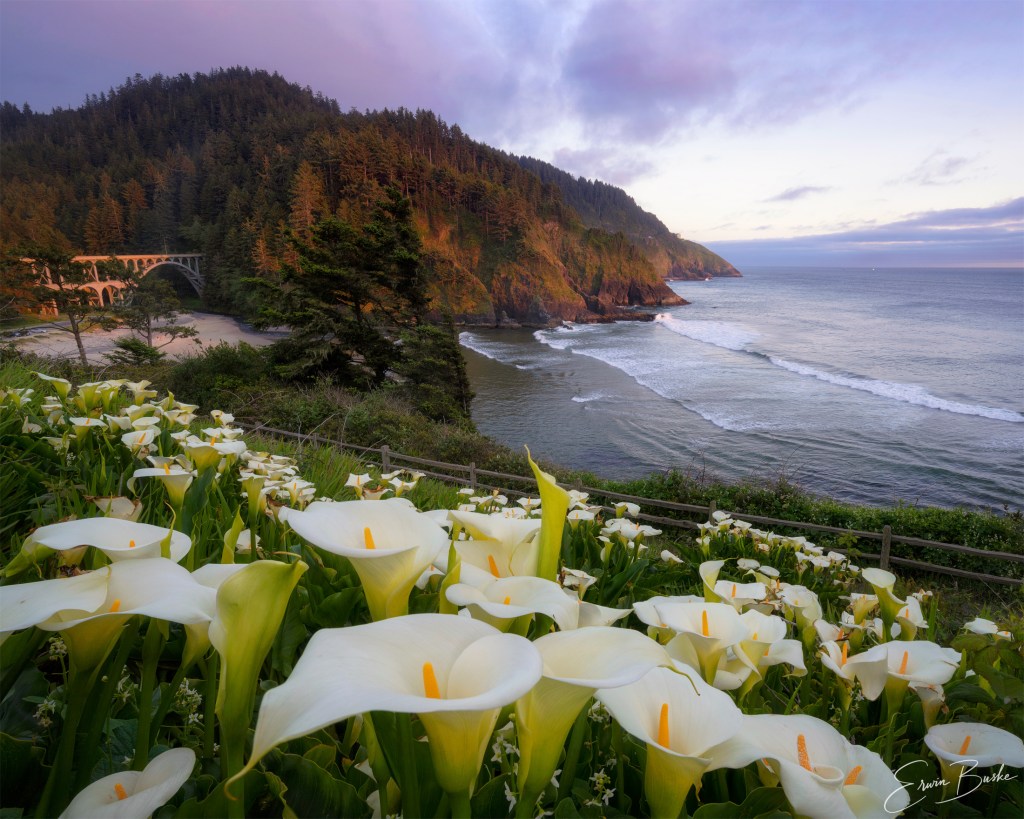
Green Goddesses with White Sails

Sometime ago I heard that Cala Lilies, while native to Southern Africa, have naturalized in California and also parts of the Oregon Coast. On my recent trip to the Southern Oregon Coast, I stumbled upon this patch. I love the way these flowers catch the light, seemingly changing their subtle hues as the sun sets. The center of the flower is deep and invites one to look inside, but their deep interiors are always still a mystery.

22. Irises and Islands in the Sea

Irises and Islands in the Sea

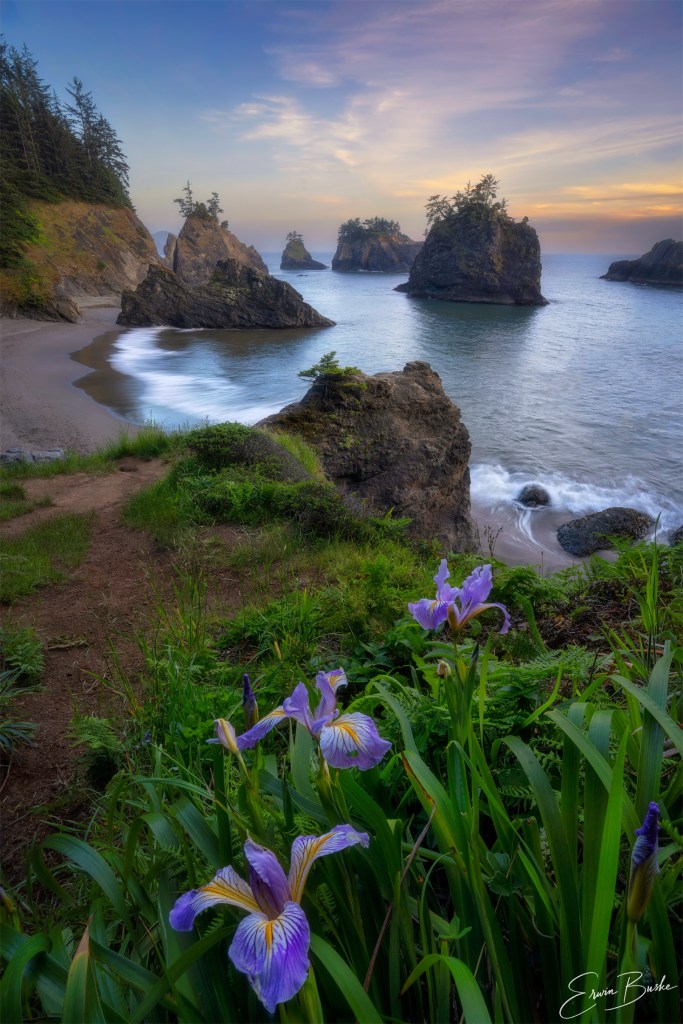
This was such a beautiful Spring evening along the Southern Oregon Coast, warm temperatures, a gentle breeze, waves gently moving across the shore, irises collecting the evening light of the setting sun, and islands floating on the sea.

23. Cattails

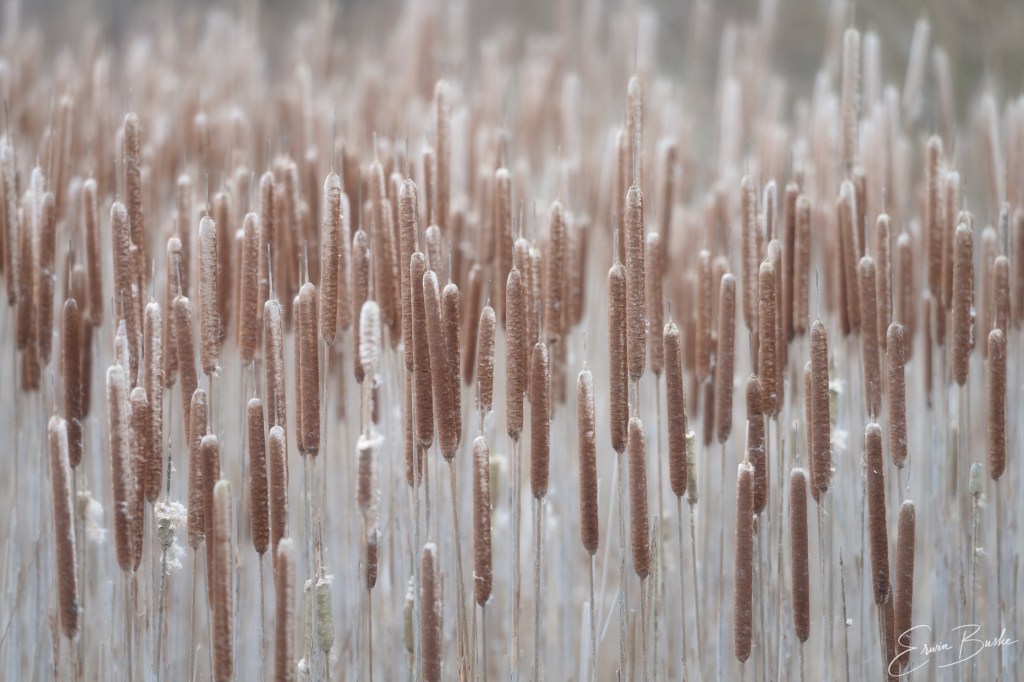
Cattails

Walking through the Fir Island estuary my eyes were drawn to the soft patterns of these winter cattails. I liked the simplicity of this composition and in processing I maintained a lower contrast high-key look with somewhat muted colors to match my visual experience of this estuary scene.

24. Snoqualmie River Foggy Morning

Snoqualmie River Foggy Morning

It’s a foggy morning along the Snoqualmie River. Sounds are muffled except for the gentle movement of the water. These quiet sounds almost seem amplified in the quiet of the new day.

25. Fire and Ice

Fire and Ice

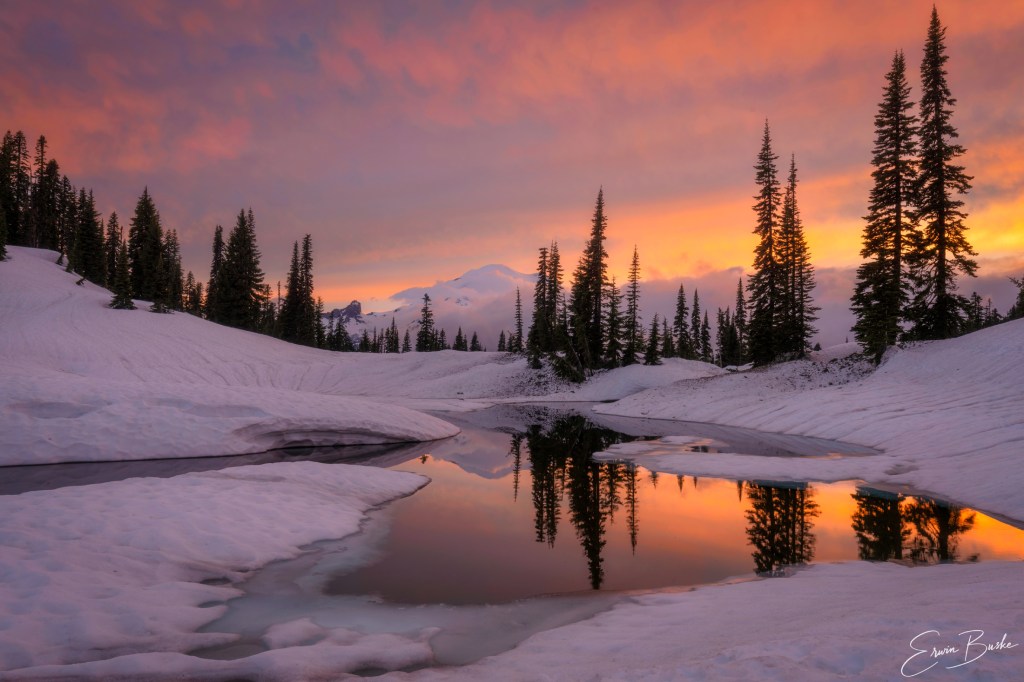
The afterglow of the sun that has just set spreads out over Mt. Rainier and Tipsoo Lake. Although the lake here is just starting to thaw, this is almost summer!

26. Pacific Northwest Lighthouse Moods

Pacific Northwest Lighthouse Moods

The Heceta Head Lighthouse casts a guiding light into a moody Pacific Northwest morning.

27. Mt. Si Boardwalk into the Fog and Mist

Mt. Si Boardwalk into the Fog and Mist

My favorite conditions for heading up Mt. Si are fog and mist which is what I found this morning in mid-June! I love this section of trail about half-way up. I later went to the peak where the mist turned more into a freezing rain, then crossed over to the Teneriffe connector trail and out through Roaring Creek to complete a loop. Wonderful day!

28. At Home Along the Ocean Shore

At Home Along the Ocean Shore

“We do not come into this world; we come out of it, as leaves from a tree. As the ocean waves, the universe peoples. Every individual is an expression of the whole realm of nature, a unique action of the total universe.”
Alan Watts

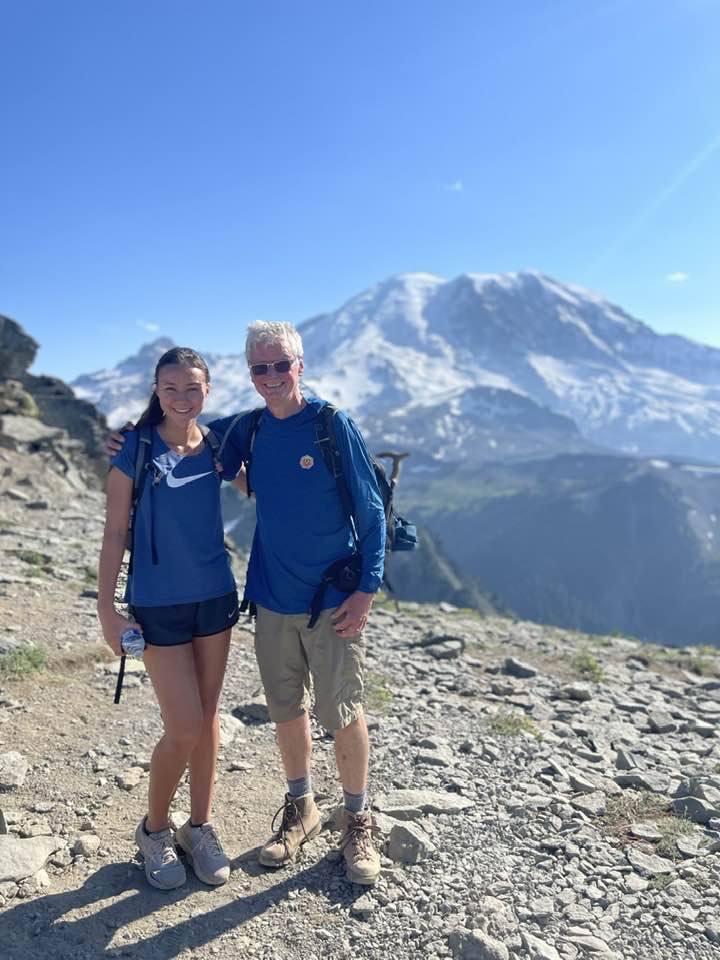
Father and Daughter Hike July

Thanks so much for reading and viewing the images of this blog post. I encourage you to share your reactions, thoughts, comments, impressions on this post here. If you think others would enjoy reading this post, please also share it with your friends and communities. The full resolution images from this blog post can be viewed on my website where they are also available for purchase. Here is the link  https://www.erwinbuske.com/Print-Store/2022-Beginnings-and-Endings-Lines-and-Circles/ . If you would like to see more content like this subscribe to the blog so you automatically receive future blog posts. To learn more upon my perspectives on nature be sure to check out my Ebook, the Hidden Landscape: The Inside Passage. This image rich book is 248 pages and provides insight how nature, mystery, the Tao, Zen, and the American Transcendentalism of Thoreau inform my photography and can provide sources for you own inspiration. Here is the link to the EBOOK along with a preview. https://payhip.com/b/FCI4z. Thanks again and happy trails!