Visiting and Photographing the Enchantments

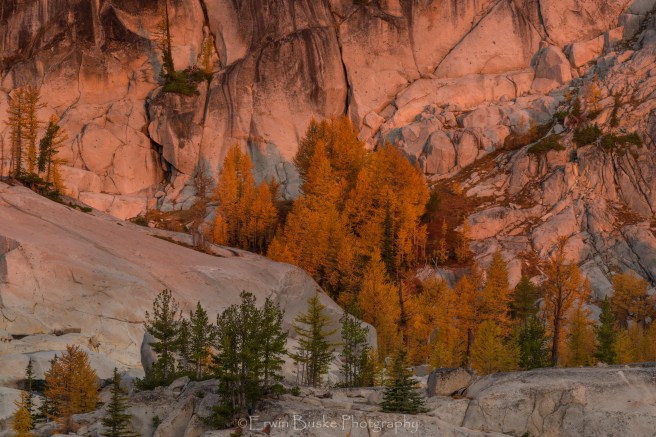
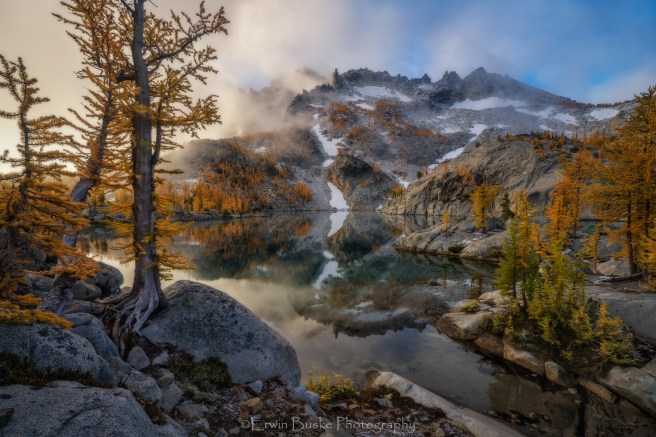
The Enchantments are calling!  This in an enchanted land of beautiful azurite and indigo blue high mountain lakes  with names like Leprechaun, Perfection, Inspiration, and Temple Lakes.  In Autumn, stunningly beautiful larch trees turn bright orange colors that glow in soft luminous light.  Large peaks made up of huge slabs of granite with names like Prusik, McClellan, and Little Annapurna rise high above the lakes and are reflected beautifully into the calm waters as the  sun rises and sets.  The granite rocks around the lakes almost look like they were placed there by the Gods to create leading lines and curves to transport us into the beauty of each lake and the surrounding landscape.  This in short is a photographer’s paradise, as close to heaven on earth as we will get in our mortal lives.

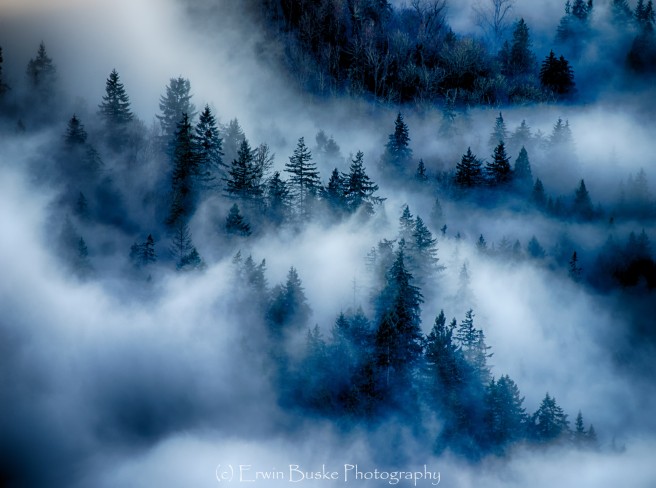
baseline-for-white-balance-changescompLarches in the Enchanted Mists

The Enchantments are located in the northeastern section of Washington State’s Alpine Lakes Wilderness Area, USA, close to the town of Leavenworth.  I consider the Enchantments are one of the wonders of this world and I harbor great memories of these beautiful blue and rock-bound lakes spanning the last four decades of my life. I have made a journey to this iconic site about every ten years since my late teens. When I received an email notice in CY 2015 that I had won the Enchantments Lottery I was totally stoked!  This time the trip felt like a return journey, somewhat like a spiritual pilgrimage to my roots–a pristine wilderness that has helped shape my photographic journey. With permit in hand, I organized a six-day backpacking trip as a photography oriented trip through the Seattle Mountaineers. Photography backpacks are much different from a typical organized backpacking trip. The pace and tempo of this trip is centered around photography. This meant frequent stops along the trail and organizing our schedule to be at the right places for at least a two to three hours window around sunrise and sunset. I deliberately kept the number of participants at a small number, five, to make sure each of the photographers had a quality experience and were not stepping over each other trying to get the image. Participants were also carefully screened as this is a physically challenging backpack.

I was even more thrilled the following year when a friend, Kris Harken, reached out to me with an invitation to join his team to visit the Enchantments once more in CY 2016.  This time I could capture all those compositions I realized I missed in the previous year!  I think it would take multiple lifetimes of annual trips to fully capture the beauty of the Enchantment, this area abounds in so much nuanced beauty.  On the last trip we were forced to leave early due to heavy and unrelenting snow so I did not shoot all the site I had previsualized.  Hopefully I will return to the Enchantments soon or perhaps in my next life!

caroline-buske-family-photo

Leprechaun Lake

In this post I will discuss visiting and photographing the Enchantments in Autumn including the following topics: Getting a Permit, Route, Conditioning, Cold Weather Preparations, Importance of Packing Light, Camera Gear, Compositions, Light, Wildlife, Larches, and the Magic of the Enchantments.

Getting a Permit

Going to the Enchantments requires a permit for overnight camping.  This requirement is strictly enforced by the Forest Service to reduce the environmental impact that comes with too many people loving this place to death.  From the Okanogan Wenatchee Forest Website: “Due to the overwhelming popularity of this unique area, all overnight visitors must obtain a limited entry FEE permit for trips planned between May 15 and October 31. Demand for overnight permits far exceeds the number available, therefore advance reservations are highly recommended. A pre-season lottery is held in February through early March of each year to allocate the majority of permits.  Following the pre-season lottery, remaining permits are available on a first come, first served basis through the recreation.gov advance reservation system. A small number of permits are available on an unreserved daily walk-in basis.”

Because this area is extremely popular, far more people apply for a permit than there are permits available, especially in Autumn.  Only 60 people are allowed in the Core Enchantment area at any one time.  The good news, however, is that a permit holder can lead a trip that includes as many as eight people.  So even if you are not lucky enough to get a permit, someone you known many be kind enough to invite you on their trip!  There are different Enchantment Lakes permit zones and the most desirable one is the Core Enchantment Zone because it allows you to camp at the lower Enchantment Lakes for up to eight nights.  Keep in mind that the lower Enchantment Lakes are about 7,000 feet high in elevation and offer the best views of large collections of larches.

Untitled_HDR2

Leprechaun Lake Sunrise

Route

For my last two trips to the Enchantments, we entered through the Snow Lake trailhead just outside the Washington town of Leavenworth along the Icicle Creek. The first day we climbed approximately 3,500 feet over five miles to the beautiful deep woods Nada Lake. Then on the next day we hiked past Snow Lakes then scrambled up the steep trail to the Enchantments Leprechaun Lake where we camped for three nights before returning through Nada Lake .  Although this route is longer and involves more elevation gain than going over Asgard Pass (the alternative route), generally it involves less steep climbing, traversing through scree and boulder hoping.  I love the sense of a journey that one gets taking the route through the Snow Lake trail entrance.  Camping at beautiful Nada lake offers a great transition zone between the sub-alpine and alpine helping whet the appetite for even greater beauty ahead.

Nada 32 Bit PS16bitNada Lake Outlet

2016 Enchantments0387compr1Nada Lake Sunset

Conditioning

Many people who are lucky enough to get a permit and very surprised at the difficulty of the trip once they embark on their adventure.  This multi-day backpacking trip requires extensive conditioning if you are going to enjoy the trip in comfort.  Before beginning your journey take multiple day hikes that involve elevation gain in the range of three to five thousand feet, for example in the Seattle area Mail Box, Granite Mountain, and Mt. Washington.  Also before launching off, go on a couple of overnight backpacking trips of six miles or more and two to three thousand elevation gain with a backpack in the range of 35 to 45 pounds.  There is nothing like actually hiking and backpacking for conditioning, and although time spent at the fitness center helps, this alone will not prepare you for the Enchantments experience.

Cold Weather Preparations

In most years peak season for the larches is the last week of September and the first week of October.  Go any earlier and one risks the larches still being partially green.  Go later and one risks the larch trees being stripped of their orange needles due to fierce wind storms that pass through the area.  Although during this time the Enchantments experience what is known as the Indian Summer with warm days and cool crisp nights under cloudless skies, this is punctuated by storms passing through the area that can bring freezing cold temperatures, dark gray moisture laden clouds, and snow.  It is not uncommon to wake up to 2 to 6 inches of snow and temperatures in the teens.  This happened on both of my recent trips.  So cold weather preparations or in order.  This means a four season tent, a sleeping bag that can go down to 15 degrees or below, multiple layers of warmth, head to toe water proof rain/wind gear, gloves, and a warm beanie type hat.
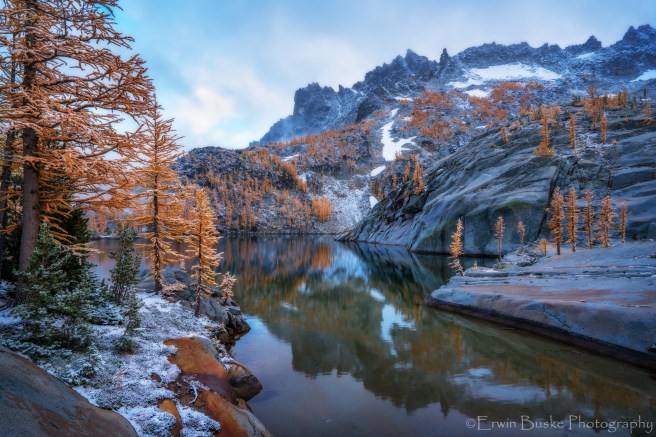
Winter LayerscompFusion of Fall and Winter at the Enchantments

Importance of Packing Light

Maintaining a good comfort level on a multi-day backpacking trip has everything to do with keeping weight of the backpack at a manageable level of between 35 and 45 pounds.  This challenge is doubly hard for us photographers because not only do we need to carry extra layers of warm clothing and a four season tent, but also we need to carry camera gear including a tripod.  One needs to think carefully through what one brings along because every ounce counts.  I strongly recommend to photographers to carry an ultralight sleeping bag, tent, rain gear, clothing etc.  But this does not mean accepting significant compromises in functionality. Three season tents will be crushed under the weight of a heavy snowstorm and a sleeping bag that only goes down to 35 degrees will not keep you warm when temperatures dip down into the teens.  Ultralight gear can be expensive, but there are deals to be  found at the REI Garage, Backcountry.Com and other outlets.

Camera Equipment

My recommendation is to  take only two lenses and at the most three.  The lens that is most useful at the Enchantments is a wide-angle zoom closely followed by a telephoto zoom.  I have never found the need for a standard zoom at the Enchantments except to take candid images of people and an I-phone will work just fine for that.  On my last trip I brought a Sony A7R2 mirrorless camera, a Zeiss 16-35 4.0 lens, and a Zeiss 70-200 4.0 telephoto zoom.  The wide-angle will work great for including important foreground detail in the grand landscape composition and the telephoto zoom works perfectly for small area compositions, abstracts, a compressed perspective,  wildlife and even macro.  One may want to supplement this with a small fixed focal length 2.8 manual focus wide-angle lens for stars.  I brought the Zeiss Loxia 21mm 2.8 for this purpose.  My entire system including the Induro Stealth carbon fiber tripod weighed in at about seven pounds.  Bringing a mirrorless system brought the weight and form factor down considerably .  If I brought my much more bulky and heavy Nikon D810 DSLR and equivalent lenses I would have easily carried an additonal three pounds.   It is noted that it is not just the weight that one needs to keep at a minimum but also the bulk of items, because with less real estate one does not need as big of backpack to carry all the equipment.  Bigger backpacks tend to be heavier and also do not balance weight as good as a smaller backpack.  Mirrorless cameras and most lenses designed for mirrorless are much smaller than their DSLR counterparts.

Compositions

The lower Enchantment Basin consists primarily of boulders and slabs of polished granite. For grand wide-angle landscapes, one of the keys to finding a successful composition involves finding one of these granite slabs or collection of slabs and boulders that provide leading lines and curves that transport the viewer into the larger scene that will often include a lake and a prominent peak.  This is also how to make your composition unique.  There are literally hundreds of these slabs and boulders surrounding each of the lakes.  Out of any one slab, I could make literally hundreds of different compositions simply by getting closer to the lake or moving further away, changing focal length, and rising and lowering the camera and the direction of the lens ,  working with the ever-changing light.  You do not need to worry about stomp comping here if you work the scene as just described and follow your own intentions for the scene in executing your personal style and vision.

0497EnchantmentsAnd8morer2Stepping Stones to Enchanted Autumn

In the above scene notice the stepping-stones in the foreground leading down to the lake. In the next image I decided to follow one of the granite slabs to an area above Leprechaun Lake and this created an optimal viewing platform and foreground that transported my eyes down the mountainside to the lake and McClellan Peak beyond.  There is a strong line going from the right side of the image to the left that also forms a U shape curve in the lower right section of the image.  The key is to make sure the foreground is well-integrated with the larger scene and do not just select the foreground because it is appealing in its own right.  Orienting the scene around foreground will often make the composition look forced rather than bringing a more organic and free flowing feel to the image.  Look at the scene and how it effects your mood and emotions, determine your intentions, and only then start working the technical details of focal length, specific foreground details, tripod placement, ISO, F-stop and shutter speed.

Slopping Rock CompEnchantments Sliding Rock

1620Enchantments_HDRRock Formations

The classic composition in the Enchantments typically involves one of the prominent peaks reflected beautifully in the water of one of the lakes.  But you can make yours more unique by also including attractive foreground elements and framing of the peak and reflection such as I was able to accomplish in the next image.
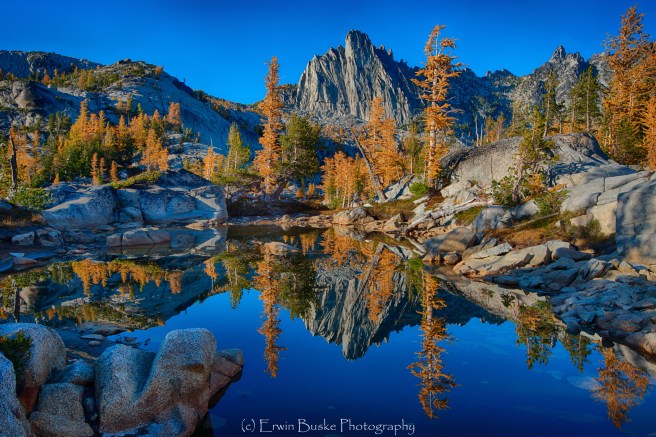
1031Enchantments_HDR

A telephoto zoom lens is indispensable for smaller area compositions that feature the lines and patterns of the granite slabs and boulders punctuated by blazing orange larch trees..  It takes some training of the eye to isolate an area of the larger scene that will make a good composition but it is well worth the effort because these compositions will be very unique and help balance out an Enchantment Lakes portfolio that is heavy on lake images.  This is an area I plan to work far more in future visits to the Enchantments.
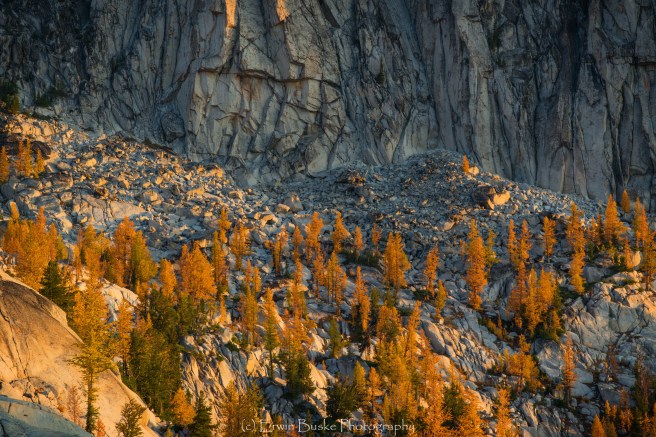
1566Enchantments as Smart Object-1

0818EnchantmentscompAutumn Larches below Granite Cliffs

A telephoto lens can also be used to capture even smaller subjects and details such as this next image of a snow-covered larch branch.
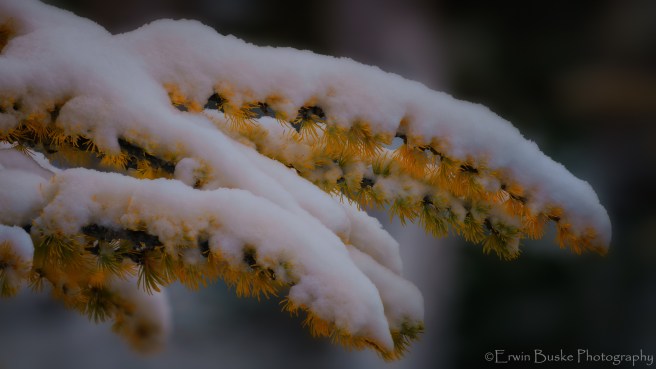
Stackedcomp

Lighting

Most of the featured images I have seen of the Enchantments are taken at sunset which is a great time to capture soft light, and colorful dramatic clouds and skies.  This, however, in my opinion is not the best time to capture well illuminated larches.  I have found the best light to actually be about an hour after sunrise and about an hour  before sunset.  Digital enhancement and painting on light can only go so far if the light was not there in the first place.  The lower Enchantment basin is deeply recessed beneath the towering peak and it is only then the light will penetrate low enough to sufficiently illuminate the larches to get the desired effect.  The lighting will also be far more nuanced in this time period with areas of light and shadow.  If there are clouds and mist in the area and the sun can still get through, the effects will be even more splendid.

Leprechaun Sunset  Leprechaun Lake at Sunset

larches-with-character-compEpiphany (Leprechaun Lake one hour after sunrise)
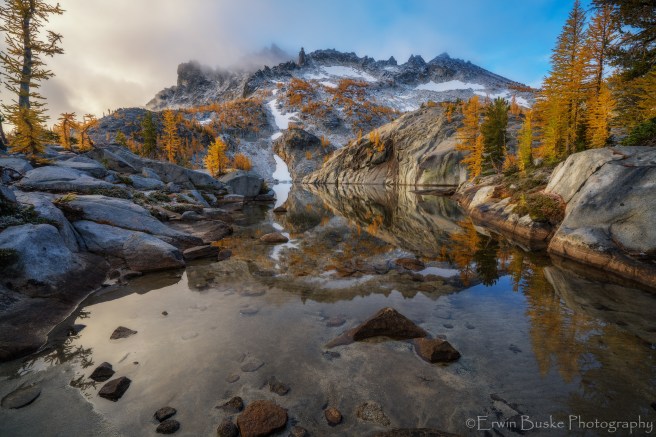
Tidelands no StackCompLeprechaun Lake Tidelands (One hour after sunrise)

Fish and Wildlife

The lower Enchantment Lakes are teaming with trout, and this area is one of the best in the Alpine Lakes for the sports fisherman.

Caroline Buske Family PhotoKris Harken’s Lucky Day

There are Mountain Goats in abundance at the Lower and Upper Enchantment Lakes.  You can expect them to wander into your campsite in the mornings and evenings creating multiple opportunities for both wide-angle and telephoto capture.

2016 Enchantments0001Guardian of the Camp

0270EnchantmentsMama and Kid Goat checking out the intruders!

Larches

About one hour  after sunrise and one hour before sunset the Larches are at their best.  In this next image I captured a beautiful collection of side-lit larches reflected in a small tarn.  It is also possible to find single specimens to capture the beauty and character of an ancient larch.
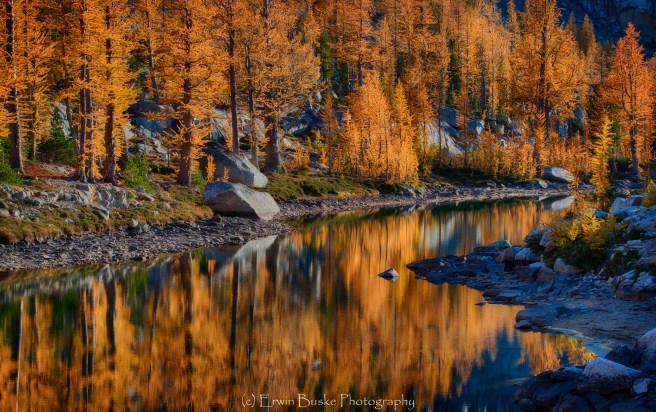
0009Enchantments_HDRr1

The Magic of the Enchantments

In this post I have  expressed my own perspective about capturing the magic of the Enchantments.  I hope some of what I wrote here will  provide you some helpful guides as you follow your own instincts, personal vision and style in creating your own images that capture the Magic of the Enchantments.   Thanks for looking, sharing and your comments are always greatly appreciated.

Utopia, Costa Rica, and Peace on Earth

Imagine there’s no countries
It isn’t hard to do
Nothing to kill or die for
And no religion, too
Imagine all the people
Living life in peace.

You may say I’m a dreamer
But I’m not the only one
I hope someday you’ll join us
And the world will be as one
Lyrics from JOHN LENNON’s Imagine

Last week my wife Julia, our daughter Caroline and I flew to San Jose, Costa Rica for a 8 day tour of this beautiful country with Caravan Tours.  I am not much for guided tours, but we heard good things about Caravan and thought it would be a great way to introduce ourselves to Costa Rica.  On the tour bus heading to our first stop at the Poras Volcano National Park, I chatted with a tour participant about Costa Rica.  I said that we heard that Costa Rica is a tropical paradise, a stable democracy, educated, and relatively affluent for a Central American Country.  She said YES, this place is UTOPIA!   Utopia–hmm, the last time I thought about Utopia was back in the sixties (which for me was really the seventies) when “Give Peace a Chance” was a mantra for a anti-establishment generation fed up with wars in Southeast Asia.  Many  of us focused our attention on finding a more perfect green, and peaceful world only to later to be co-opted into a me generation more focused on career growth and the trappings of rising affluence and status.  Utopia, lets hold that thought while I introduce the first stop along our tour!

Costa Rica924

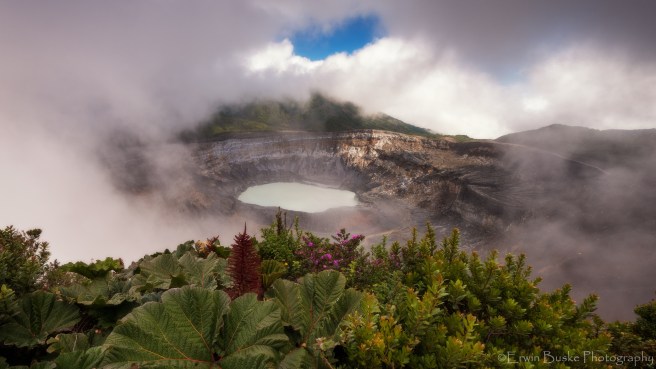
Poas Volcano Crater and Lake

I feel lucky that during our brief visit to Poas National Park that we were able hike through the cloud forest and see the Poas Volcano Crater and Lake. The Volcano and Lake are only visible about 30% of the time, so one is throwing the dice with a brief visit. Poas has erupted 39 times in the last two centuries and is a very active volcano. The crater is over 8,000 feet in elevation.

Costa Rica is one of the most progressive nations on earth when it comes to protecting its wild areas with over 30% of the nation consisting of National Parks. By way of contrast the US is about 14% with much of that land in Alaska. Everywhere I went in Costa Rica it was evident the Government and People were going through great lengths to protect the natural environments and endangered species.  Costa Rica was twice ranked the best performing country in the New Economic Foundation’s (NEF) Happy Planet Index, which measures environmental sustainability, and was identified by the NEF as the greenest country in the world.  Costa Rica officially plans to become a carbon neautral country by 2021.  So Costa Rica, while perhaps not exactly Utopia, ranks high as a country that has gone farther than others in taking steps to ensure environmental sustainability, protection of natural beauty and habitat, and reducing its environmental footprint.

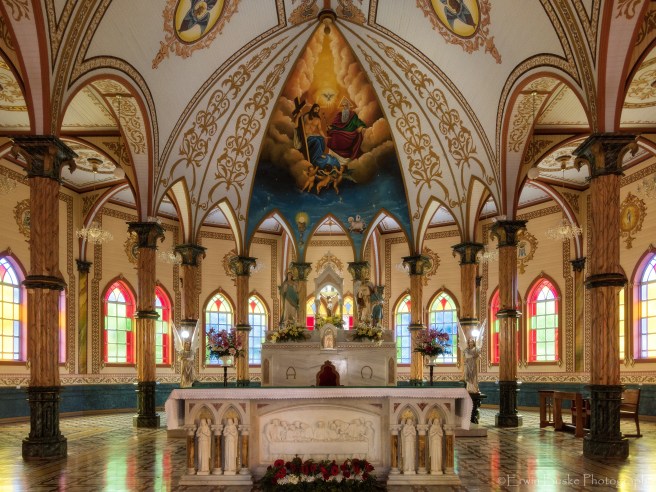
After the Poas Volcano we headed toward Fortuna and the home of another beautiful Volcano, Arenal.  Along the way we stopped a beautiful church, the  Iglesia de San Rafael, located in the mountain village of Zarcero, Alajuela.  I just loved the effect of the afternoon light coming in through the stained glass windows.  This church and many others that dot the countryside also serve as a reminder that this nation is overwhelmingly Roman Catholic, a unifying cultural influence.  If this place is Utopia, religion still has a strong role in the lives of the people.

Costa Rica982.jpg

Iglesia de San Rafael

Along the way we also passed through coffee, banana, guava, and pinapple plantations-a reminder that although tourism plays an important role in the Costa Rica economy, so does agriculture.  Increasingly, however, Costa Rica uses immigrant labor from Nicaragua to harvest their crops, as the pay is not adequate for most Costa Rican’s who have grown accustomed to the highest standard of living in Central America.

Costa Rica943

Banana Flower Blossom

Our next stop and home for two nights was our hotel in Fortuna, located right at the base of the Arenal Volcano National Park.

Final Revision for Layered Look comp

Arenal Volcano at Sunset

Arenal is one of seven historically active Costa Rican volcanoes along with Poás, Irazú, Miravalles, Orosí, Rincón de la Vieja , and Turrialba and is considered one of the ten most active volcanoes in the world. It has been studied by seismologists for many years.The volcano is located at the center of Arenal Volcano National Park in the northern part of the country.  In 1968 it erupted unexpectedly, destroying the small town of Tabacón.  This serves as a reminder that although in certain conditions this country looks beautiful, calm and peaceful, there are explosive volcanic and potentially destructive forces lurking underneath the ground that at anytime can erupt and change forever the landscape as we know it.

The next day we were back on the bus for a field trip to a Rio Frio river cruise through the Costa Rican jungle and the Cano Negro Wildlife Refuge, way up north toward the Nicaraguan border.  Along the way our tour guide Rebecca informed us that Costa Rica is a nation without an Army.  In 1948, Jose Figueres, then president of Costa Rica, made a fiery and eloquent speech, after which he took a sledgehammer and bashed a hole in a huge stone wall at the nation’s military headquarters, Cuartel Bellavista. Its imposing towers and massive gates had loomed over the capital city of San Jose since 1917, the country’s premier symbol of military power and the home of the “Tico” military establishment.

Figueres was not just being a showman; he was announcing something truly extraordinary: Henceforth, Costa Rica would take the almost unheard-of step of renouncing its military. At the conclusion of the ceremony, he publicly handed the keys to the minister of education, announcing that Bellavista would be transformed into a national art museum and the nation’s military budget would be redirected toward healthcare, education and environmental protection.

Figueres was painfully aware that Costa Rica’s military, like that of other Central American states, had been used to suppress domestic uprisings and undertake coups, especially against governments perceived to be left-leaning like his (even if they were actually more middle of the road).  Eliminating the military would also eliminate the possibility of military coups.  But how does a country surrounded by unstable neighbors protect its borders without a military?.  Somehow Costa Rica has managed.  When Nicaragua made a territorial claim to a Costa Rican island on the Carribean side of the nation, kicked out the Costa Rican residents, and built a military airport things got testy. But a simple meeting at a San Jose hotel conference center between Daniel Ortega of Nicaragua, the President of Costa Rica and Obama was enough to diffuse this crisis. Nicaragua gave up its claim and Costa Rica gained a new airfield.  I kept thinking to myself that if more nations eliminated their military the world would be a much more peaceful place and once again I started dreaming of utopia.  The Utopian vision may never be fully reachable, but it is a vision that can help guide us to a more evolved world with fewer if any military engagements.  Realistically this may not be possible for superpowers like the USA, but it is certainly possible for the nations of Central America, and without exception they would be better off.

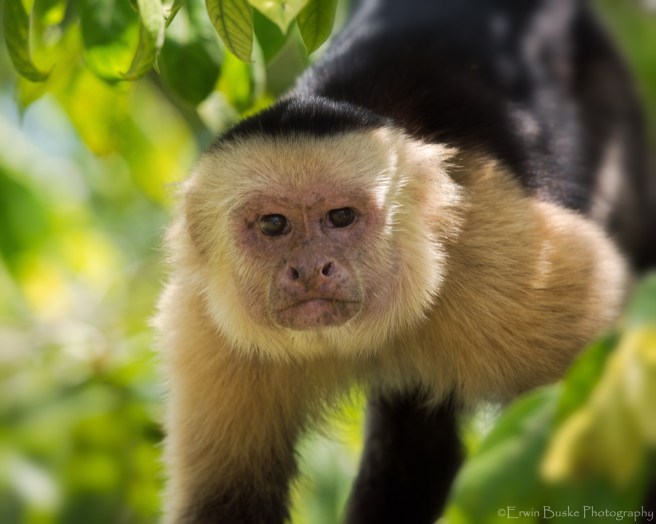
Time to awaken from this Utopian dream and get back to reality.  We are on the river cruise through the jungle and we come to the banks of the Rio Frio River where there is a group of White Face Monkeys.

Costa Rica1143

White Face Monkey

This Alpha Male White Face Monkey separated himself from a pack of monkeys playing on the river bank. He walked out on small tree branches close to our boat, aggressively started banging branches toward our boat and making loud noises signaling for us to go away. The captain only staid here a few brief moments, during which time I was able to capture this shot.

The next day we enjoyed fresh Costa Rican coffee at sunrise and headed out to the JW Marrior Resort at Guanacasste Beach along the Pacific Ocean.  We felt blessed to see the volcano in full view as the chance of seeing this is no greater than about 30%.

Costa Rica172

Arenal Volcano in rare full view at Sunrise 

Guanacaste Beach is located along the Pacific Ocean in an area that a lot of Americans have chosen as their new home in retirement. Although attractive, this dry and hot area would not be my first choice and I preferred the cooler jungle areas around the Arenal and Poras Volcano’s. I can understand the attraction, however, for the scores of American Baby Boomers who call or are planning to call Costa Rica their new home.  They can find their piece of near Utopian beach paradise for a fraction of the cost of places such as California, Florida and Hawaii.

Costa Rica340 Sunrise North Step Three comp

Guanacaste Beach Sunrise

One Tree comp

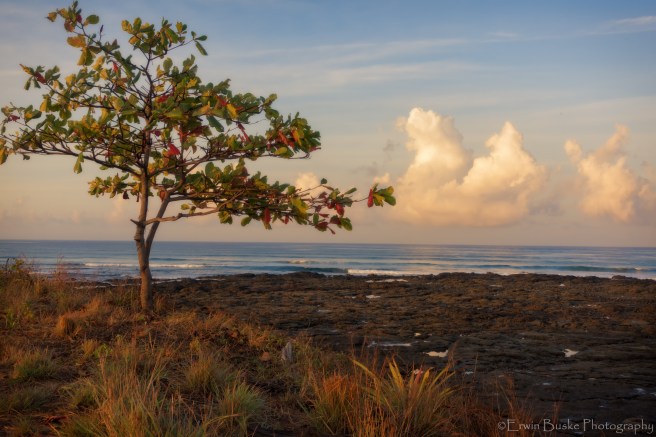
Lone Tree Guanacaste Beach 

After leaving Guanacaste Beach we headed south toward Panama for another jungle cruise and a chance to see crocodiles in the wild along the Tarcoles River.

Costa Rica583-Pano

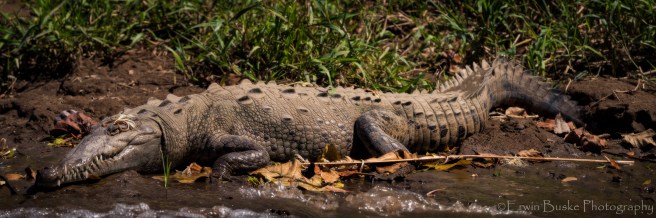
This Croc is patiently waiting for his lunch. How would you like to be the dental hygenist responsible for cleaning this guy’s teeth?!  While Costa Rica may be as close to Utopia as one can get here on earth, there is danger lurking in the waters of the rivers, and I would not recommend swimming!

Nest up on our tour and final destination is the San Bada Hotel just steps away from Manuel Antonio National Park.

Costa Rica679

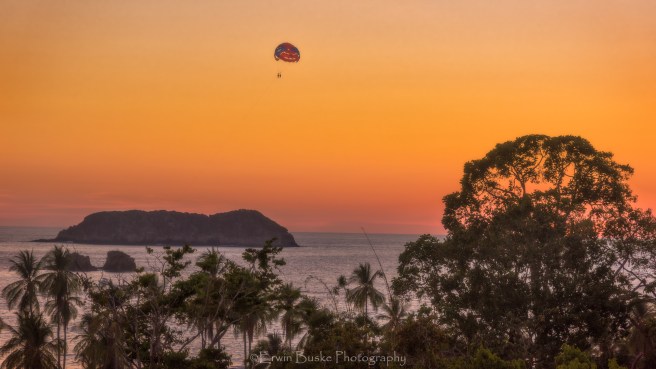
Floating Free as a Bird 

Here is a sunset view from the roof top of the San Bada Hotel, where we just arrived after a long drive and were in desperate need of refreshment. This also just happened to be happy hour with unlimited complementary Pina Coladas! How would you like to be the paraglider gliding through this scene?

So back to our opening question: is Costa Rica utopia?  Well after an eight day tour through the country and doing some of my own research, I would say not.  There is still crime in this country and also there is a significant number of people are living close to the poverty line. But the nation is blessed with a climate, natural beauty, culture and government that has brought the country closer to the Utopian vision than just about any other place on earth. For a young Costa Rican coming of age, I am certain that it is comforting to know that their nation has undertaken the right decisions to ensure that they are not only prosperous now but also that the beautiful environment in which they live is sustainable not only for the immediate future but also for future generations.  It is also comforting for them to know that their nation’s resources are not being used to support a military that historically has worked against the evolutionary development of the nation, but instead these resources have been directed toward education and the well being of its  citizens.

Thanks everyone for taking time to read this blog.  Your comments and feedback are always greatly appreciated!  Thanks again for looking!

Wilderness Gone Viral

Are we loving our wilderness and natural areas to death?  Social media is creating an increased awareness among photographers, backpackers and hikers of new opportunities to visit beautiful locations in our National Parks, Forests and Wilderness Areas.  Thanks to Facebook and Instagram this information now travels like wild fire, especially when someone posts a beautiful image of a previously not so well known location.  Some of these images come from professional photographers, but they also come from people who have developed the knack for taking awesome images with their cell phones including selfies against a background of nature’s infinite splendor and beauty.

franklin-2017-redo

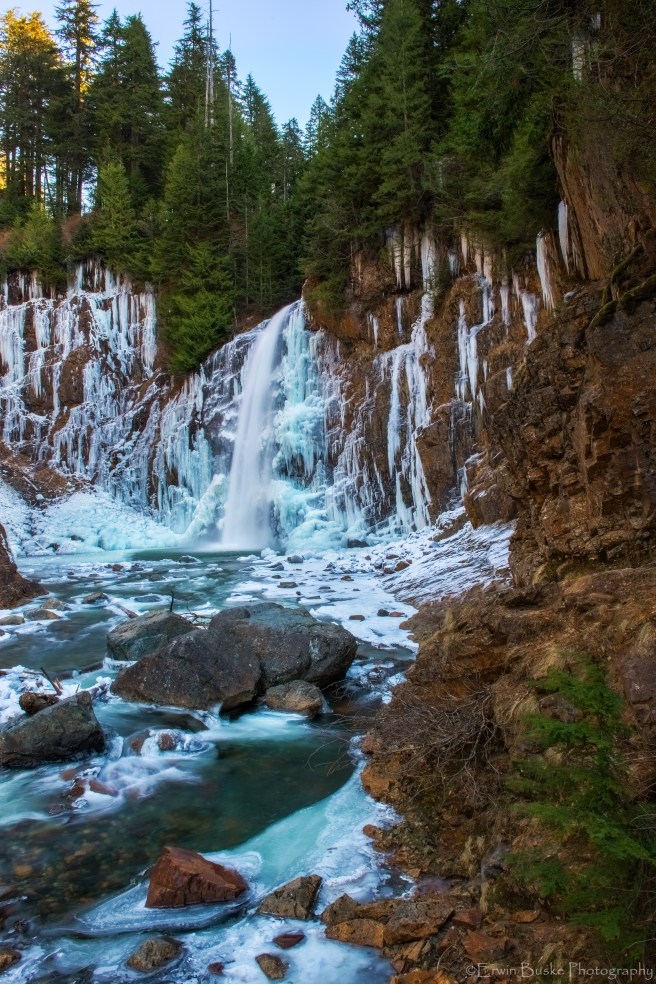
Franklin Falls Love and Death

Above is an image from a couple years back of Franklin Falls. During the year I took this image I showed up at these Falls a couple of times and in both instances there was absolutely no one there, just the sound of the water, otherwise silence and solitude. No such luck anymore! This landmark close to Washington State’s  I-90 has become the latest hot-spot to attract throngs of visitors including some groups approaching fifty or more people. I have seen a few images this year where there were literally over a hundred people around the Falls, one was recently published by the Seattle Times. Now it is easy to understand why this is so, this place is absolutely beautiful, especially in Winter. Everyone has an equal right to go there. Social media increased awareness of the site, now everyone wants to go and shoot that precious selfie with the ice covered falls in the background!

rattlesnake-ridge-088

A multitude of people at Rattlesnake Ledge on a Sunday Afternoon

All of this raises an interesting dilemma for photographers. Do I let people know precisely where an image was taken, or should I just be general and not share important details? For the most part I have chosen to share the detail and am likely at least partially responsible for throngs of people loving certain sites to death.  Anytime I have an image that goes viral, I notice a definite uptick in people going to that very same location.  Now of course I am not that only one that contributes to this and there are photographers with far more influence than me who also contribute to making sites go viral.  But as others go to the same site, they encourage still others to go, and so on and so forth as droves of people head to a trending site.   The sites we are talking about, however, are not only online but also occupy physical space in the great outdoors!

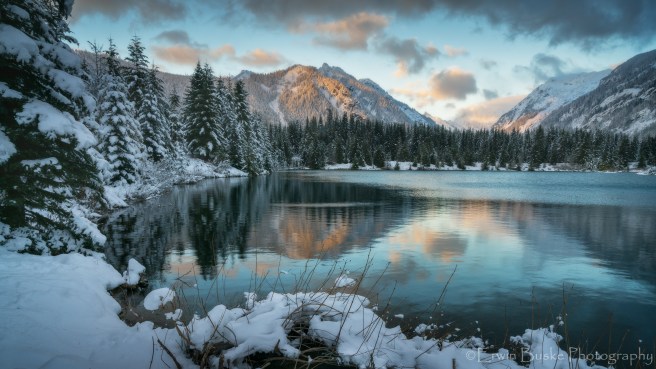
gold-creek-pond-eastside180-pano-for-sharp

Gold Creek Pond (I have seen about a twofold increase in visitors this year)

What is a photographer like me to do?  Should I stop  posting pictures on Facebook so at least I do not help nurture too much awareness of a beautiful landscape?  For the most part I have chosen to not do this and here is the reason why.  Awareness is one of the best ways to protect a beautiful landscape.   The most dedicated and passionate supporters of our natural areas are people who visit them on a regular basis.  So in one sense the more people that visit a natural area (National Parks, other Public Lands, and even Private Lands), the better.  But although awareness is one of the best ways to protect a beautiful landscape, it is also potentially the cause of lowering the quality of the wilderness experience.

Some of you may ask: “Erwin-should not we keep our secret spots private and not let others know about them?”  In part I agree with this and I have a few places that I keep secret also.  But if you are going to post images of these private spots on social media I doubt they will be secret for long.  People can use an image as a basis to search and make a correlation with google earth to find out the exact spot.  This search process is similar to face recognition except in is site recognition.  The cat almost always finds its way out of the bag!  So if you truly want to keep it secret, do not post an image on Facebook or Instagram at all!  One of the only ways to currently capture images that have not been posted too much already on social media is to go to difficult to access areas.  Many well known photographers are doing just that in order to keep themselves in the social media limelight.  It is just my opinion, however, that the ultimate test of an accomplished photographer is not getting images where few have gone before, but rather their ability through creative photographic and processing techniques to make even the seemingly mundane and familiar look beautiful.  Nowhere is this ability more needed than with raising awareness of the need to protect public lands because if the truth be known much of the vast expanse of lands that are public are not considered very attractive or interesting at all. Photographers can help in this regard by presenting even these areas in the most favorable light.

It is encouraging to know that we can have a high level of awareness of a landscape and still control the number of visitors if a government agency reduces the number of visitors into an area through the adoption of a permit system.  This is what has been done for backpacking at both the Enchantment Lakes and also Mt. Rainier National Park.  Both of these areas are considered environmentally sensitive and simply cannot absorb the impact of an uncontrolled number of backpackers.

baseline-for-white-balance-changescomp

Larches in the Enchanted Mist (Enchantment Lakes Core Area)

Mt. Rainier National Park has done a great job over several decades in not only reducing any further environmental impact caused by uncontrolled visitation, but has actually manged to restore meadows and shorelines in many parts of the back country.

mountaineers-mt-negative-enhance500px

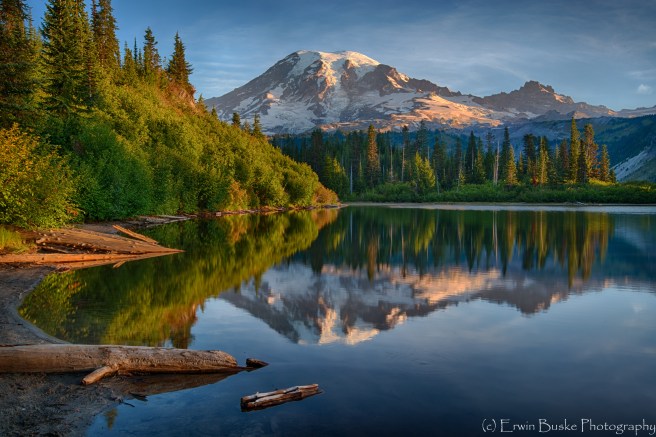
Bench Lake Early Morning (Mt. Rainier National Park)

Although a great job has been done in reducing environmental harm at both the Enchantments and Mt. Rainier there are still problems.  The Enchantments allows an unlimited number of through hikers that make the arduous trek in through Aasgard Pass and out through the Snow Lake Entrance.  While anyone making this trek in a single day deserves recognition for this accomplishment, there are just too many people doing it. When I was at the Enchantments last year there was literally a steady procession of people all day long hiking through the enchantment lakes core area.  At some point, unfortunately, a permit will also need to be required for the through hike in order to maintain a good quality wilderness experience and minimize damage to the environment. When I was at Mt. Rainier to take the above image of Bench Lake there was a group of young men camped right out at the lake shore which is strictly forbidden.  Why were they there?– to get that precious image of the feet hanging out through the tent door looking out to the lake and Mt. Rainier!  When we confronted them they pleaded ignorance, but I think they knew exactly what they were doing wrong and should receive the maximum fine of $5,000 and 6 months in jail.  I might be a little extreme here!

Personally I think everyone in our nation has the right to visit our national parks, forests, and wilderness areas.  Any kind of allocation scheme for providing permits needs to treat everyone fairly.  It my opinion it is elitist to think that one person has more of a right to visit an area than another, including photographers.  If the right to enter into a wilderness landscape is restricted through a permit process, there needs to be alternatives for the scores of people that need to have contact with natural areas on a regular basis.  This means that some areas cannot be subject to the permit system.  Mt. Rainier has adopted this policy in the areas around Paradise, Sunrise, and Tipsoo Lakes.  Access is only limited by the number of parking places for vehicles.  Areas that are not environmentally sensitive likely should also not be restricted.

Social Media has also increased awareness of beautiful sites where access to the site is over private property.  Such is the case with Washington’s Spirit Falls close to the Columbia Gorge.

spirit-falls_0234-1r1comp

Water Spirits in the Forest (Spirit Falls)

The White Salmon River is a designated national scenic river and therefore has certain protections.  To the best of my knowledge property owners do not own the river itself. When hundreds of people began making the journey to the falls, spurred by Facebook and Instagram photos, private property owners clamped down and cut off access to the primary route to the falls.  Personally I do not feel that even a private property owner has the right to prohibit access to such a beautiful site, and it will be interesting to see how this one plays out in the future.

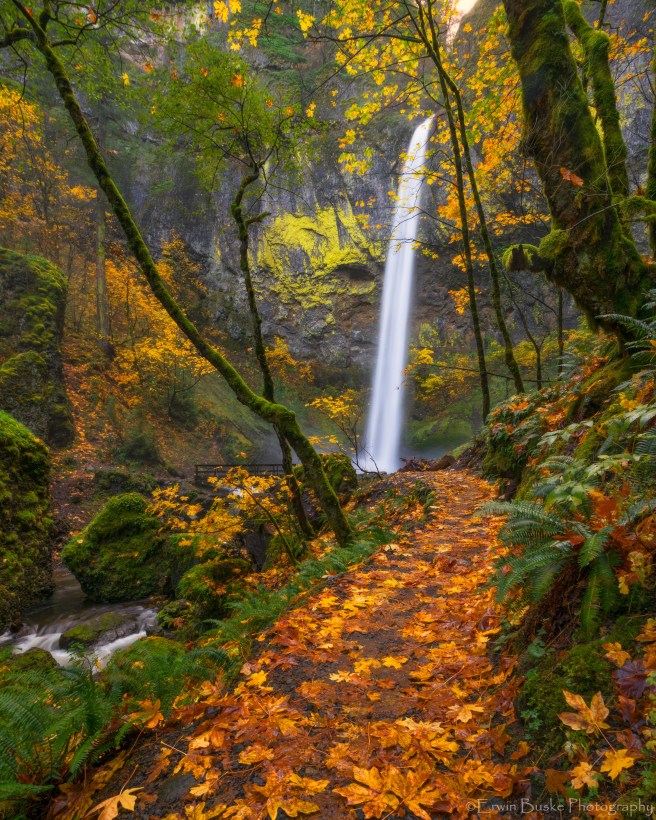
Landscape photographers when conducting photographic workshops can also contribute on a larger scale to a lower quality wilderness experience for others.  I have personally witnessed this at locations such as the Columbia Gorge and Zion National Park where large groups of photographers participating in workshops commandeer the best viewing areas for themselves.  At a recent trip to Elowah Falls there were so many unattended tripods in front of my viewing area where I set up my tripod earlier I had to just give up.  There were also non-photographers in this area that wanted desperately to take in the same scene but could not do so.  Also at Mt. Rainier I have seen large areas of freshly trampled flowers soon after a workshop vacated the area.

 elowah-falls

Elowah Falls

Most national parks and forests closely regulate conducting workshops within their borders but there is loose enforcement and even when photographers get permits they do not always adhere to the rules and regulations.  Many do not even bother with permits, and associated requirements for first-aid certifications and insurance.  Personally I do not think there is enough wilderness bandwidth to accommodate the huge number of photographers on the workshop bandwagon and there will need to be some kind of lottery system to allocate permits for certain areas along with better enforcement of current rules and regulations.

Our nation is entering into a challenging time where some elected officials would like to make our National Parks and Public Lands available for commercial use including drilling for oil.  Advocacy and direct political involvement, although critically important, are not the only ways to help protect and preserve our wild areas.  Increasing public awareness of our wild areas exerts a powerful influence even if there is a potential downsides of people loving a place to death.  As more people visit our wild areas it will become increasingly important to share knowledge through social media of good environmental stewardship and there will also likely need to be an expansion of the permit system.  Environmental stewardship is key and I will discuss this in a future blog post.  Thanks everyone for reading this blog entry and let me know your thoughts and concerns along with your honest feedback!

Going Wide, Going Narrow, Creating Layers of Beauty

In Landscape Photography today, it seems like the most popular focal length involves the use of an ultra-wide angle lens at its widest focal length.  In full frame photography this means a focal length of either 14mm or 16mm.  With a cropped sensor camera this means about 11mm and with Micro 4/3 this means about  7mm.  It is easy to understand why this is so.  An ultra-wide lens allows one to easily bring in layers of beauty with a prominent foreground such as flowers and or rocks, a pleasing mid ground such as a lake and island, and an attractive background such as distant peaks and dramatic skies.  An ultra-wide angle worked great for the feature image of this blog post titled “The Eye of the Crater” (also shown below) taken at sunset at Oregon’s Crater Lake with a full frame focal length of 16mm.

eye-of-the-crater

Eye of the Crater 16mm f-16

But is an ultra-wide angle perspective always the best choice when creating layers of beauty in nature and landscape images?  This blog post will examine some of the factors I consider when choosing the best focal length to fulfill my vision for the image including the creation of layers of beauty.

elowah-falls

Elowah Mystery of Autumn 16mm f-11 (focus stacked)

Although ultra-wide angles are great for capturing near far relationships in the landscape, I find that they are not always the best choice.  I always try to achieve a balanced and realistic perspective when rendering near far relationships.  We have all seen the images so popular in social media with the flower on steroids looming large in the image foreground with a gigantic mountain in the background, a perspective achieved through the use of different focal lengths including extreme wide angles, composite imagery and warping.  Although this is sometimes done with believable subtlety, in most cases it is not and at least in my opinion results in an image that only exists in fantasy.  Often the photographer will rationalize this approach by saying it is more consistent with how one sees a image in real life, but I do not buy this.  It is primarily done to create shock value in social media.  But one can also bring attention to ones images in social media by creating photographs that are refreshingly believable.  There is a strong appetite for believable imagery in this age of digital trickery!

mazama-ridge-rock-comp Mazama Moment 28mm f-8 (focus stacked)

In the above image, Mazama Moment, I found that a 28mm moderate wide angle full frame lens was the best choice for balancing foreground, mid-ground and background elements. Had I used instead 16mm lens, Mt. Rainier would have been rendered minuscule, completely out of proportion with the rest of the scene and inconsistent with how one would typically see the scene if at the site.  The foreground still looms reasonably large in this image featuring important details of the red Huckleberries and the granite boulder, but they are not in your face.  The mid-ground featuring the play of light and shadow of the early evening light provides a wonderful transition to the peak and surrounding ridges.

It is best not to set up one’s tripod right away when trying to determine the best focal length because using different focal lengths usually also involves either moving further back or getting closer to achieve the optimal balance.  Typically I do not even use a camera at all when initially determining the best focal length.  I allow my eyes to wander and pay close attention to how they are going wide or going narrow in best taking in the beauty of the scene.   Zooms can make one lazy if one is merely checking out different focal lengths on a tripod at the same location.  One needs to move around!  Sometimes even inches can make the difference.

With the advent of focus stacking one can create tack sharp near far relationships even at the longest end of the wide-angle spectrum.   This next image of Picture Lake was captured at a 35mm  focal length.

picture-sunset-day-2compr1crop  Picture Lake Mountain Ash Purple Mountain Majesty 35mm f-11 (focus stacked)
In this image I wanted to feature the autumn colors of the Mountain Ash and its orange berries but still render Mt. Shuksan reasonably large.  The choice of a 35mm focal length helped me reach by goal of balancing the many layers in the image including the Mountain Ash, grassy areas leading up to the lake, Picture Lake, the distant forest, Mt. Shuksan and the sky.

One of the most common uses of a telephoto lens (I am defining the telephoto perspective as 55mm or above) is to isolate a subject with pleasing bokeh (out of focus areas around the subject).    Such a perspective can be seen in the next couple of images.  This perspective is typically achieved by combining a telephoto focal length with an aperture of f-2.8 to f-5.6 and shooting sufficiently close to the subject to blur the area before and behind the in-focus subject.kubota-easter778

Tulip Tree 170mm f-4.5

big-horn-sheep-banff

Big Horn Sheep 200mm  f-5.6

The just beyond normal to extreme telephoto focal length range and longer telephoto lengths extending up to the extreme, however, can also be used to balance near and far relationships and create layers of beauty.  Maintaining sharp focus throughout the image will require using an aperture typically in the  f-10 to f-16 range or using a focus stacking technique and a more wide open aperture consistent with the peak performance of the lens.  Using apertures in the f-18 and above range is nor recommend because it results in diffraction that can actually cause the loss of sharpness.  This next image titled “Kendall Winter Wonderland” from a recent snowshoeing trip was taken with a 55mm fixed focal length lens.

kendall-peak048

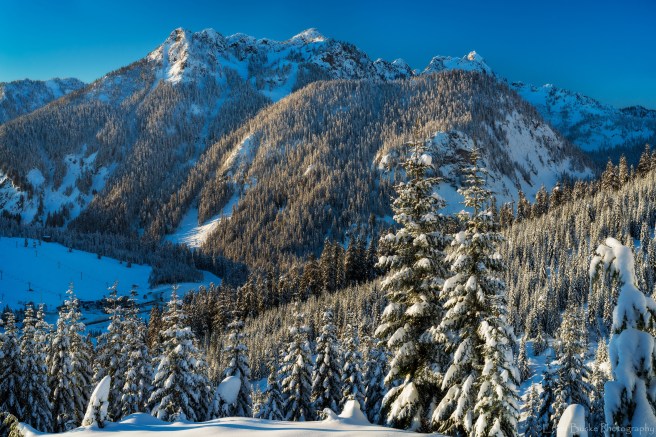
Kendall Winter Wonderland 55mm f-14

Even at 55mm one can see the definite effect of the slight compression of the various layers of beauty in the image.  At first I attempted to frame the image with my wide angle zoom but it became apparent quickly that this was not the best choice, providing too much emphasis to an uninteresting foreground and rendering the mid-ground and distant peaks insignificant.  55mm was perfect for the effect I was trying to achieve.

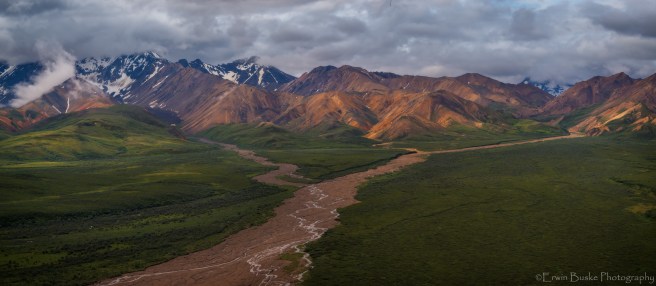
In this next image Polychrome River Delta Y going wide would have been absolutely the wrong choice because it would have rendered the distant Alaska range small and uninteresting.  A wide angle like emphasis on the foreground was actually best achieved with an 82mm focal length with two images stitched as a panorama.

denali-batch-4210seqn-pano

Polychrome River Delta Y 82mm f-10 (2 image panorama)

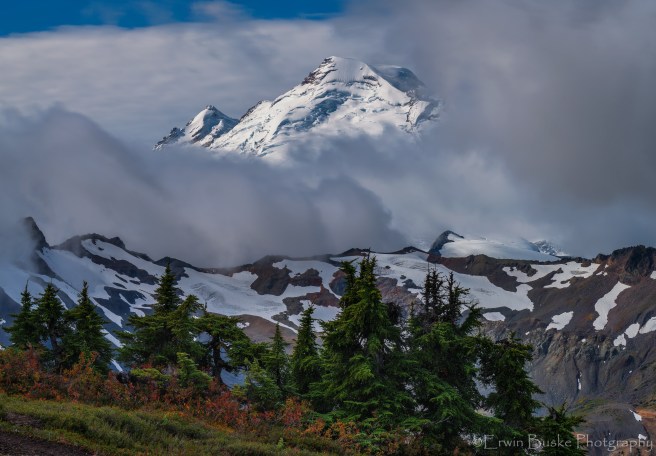
In the next image “Mt Baker Rising” I wanted to include some important foreground detail to provide a better sense of time and place.  This image was taken in Autumn from Table Moutain.

baker-in-cllouds-layers-large-formatcomp

Mt. Baker Rising 94mm f-16

The 94mm focal length at F14 allowed me to capture the layers of meadow, red huckleberries and trees in the foreground offering a transition to the mid-ground ridges and lower fog/clouds, ant the distant mountain and sea of clouds.  In this image I did end up slightly warping the top  of the image to make the mountain somewhat bigger, but this was done with restraint and subtlety always keeping my goal in mind to capture the scene in a manner consistent with how I experienced it.  In this next image I needed to go all the way up to 300mm to capture a similar effect.

denali-batch-2_2297-comp

Denali Rising 300mm F10

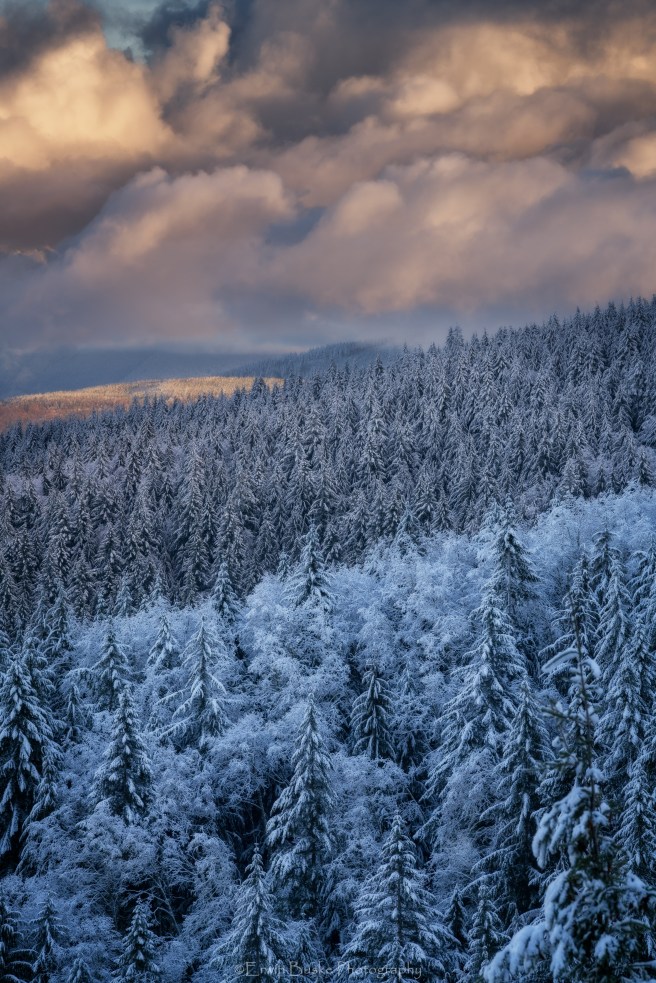
In this next image titled “Tiger Mountain White Forest” I wanted to bring good emphasis to the first layer of deciduous trees covered in snow and ice.

Tiger Mountain 2016057.JPG

Tiger Mountain White Forest 200mm f-14

For this image I found that 200mm was perfect for bringing this lower layer to a prominent position in the foreground and balancing the scene with two other distinctive layers, the snow covered evergreen forest in the mid-ground and the distant dramatic and luminous clouds.

As we go up the focal length scale often we can capture an isolated area of a lot larger more chaotic scene and render the entire scene acceptably sharp by choosing an f-stop between f11 and f14.   Such an image may contain multiple layers of beauty all carrying equal weight thereby establishing a pattern in the layers of beauty.  This can be seen in the next image titled “Secrets of the Forest” taken at 370mm full frame equivalent focal length.

secrets-of-the-forest

Secrets of the Forest 370mm f-10

In this coming year I am going to challenge myself to use Telephoto focal lengths more often to balance near and far relationships and create layers of beauty in the landscape.  I challenge you to also consider alternative focal lengths when creating your own layers of landscape beauty!


Storytelling

Its now 2017 and I have made my resolution for photography, to tell more stories to go along with my images.  Last year my resolution was to take more macro and small area images.  I was very successful in carrying out this resolution and I have no doubt I will be successful this year in sharing more stories about my images.  There is something about publicly making a positive affirmation through making a resolution that helps provide the energy to make things happen!

One thing I have noticed during this past year through social media is that when I combine a story with an image, the image is usually always more successful.  Viewers love a good story even if it is brief.  Most of my stories for landscape images have to do with the challenges that often come with getting the shot.  But there are also stories that have to do with the history of a landscape/land mark.  Sometimes the story relates to how a landscape awakens an experience at a personal level that is often shared by others as well, such a journey to one’s ideal home.  These stories are more archetypal in nature and point to common experiences.  Other times the story itself is in the image, for example images of trailscapes or approaching weather.  With all types of stories, the story helps lead the viewer not only into the image, but what the photographer was thinking and feeling at the time of capture.

In this blog post I will share some of my images and the original stories that went along with them from last year.  The first image is Snow Lake at Sunset and is titled “Its a Bugs World after all!”

heather-snow-vertical-sunsetcompr1

Snow Lake Sunset: Its a Bugs World after all!

“Yesterday I decided to take an impromptu trip to Snow Lake to watch the Sunset. I had scouted this composition out earlier in the week and wanted to return in more optimal light. Shooting the sunset at this location is challenging, not because of the steepness of the terrain, but because of the tempestuous and annoying buys that are everywhere. Every time the light got better, the bugs came out in ever increasing force creating zigzags in front of my camera lens and landing on the glass for in depth exploration as if it was a flower! And did I mention the biting! I attempted to swat them to clear them out of the area but this just caused them to come back with more vengeance as their high pitch humming sound got louder and louder. At one point I broadcast bug spray over the entire area but the spay fell back on my lens element interrupting my workflow some more! I resorted to speaking only in tongues and expletives. Finally i found my cool and I resigned myself to the fact that I was going to get eaten alive taking this sunset image and that I best take multiple images of the same scene in hopes that one would escape the wrath of the bugs, and that one shot is this one here! In spite of all the trouble, I am pleased how this turned out-it is such a beautiful spot! The pink heather dotting the landscape, the afterglow of the sun that just set, the warm color of the water and sky, were all just amazing that night!”


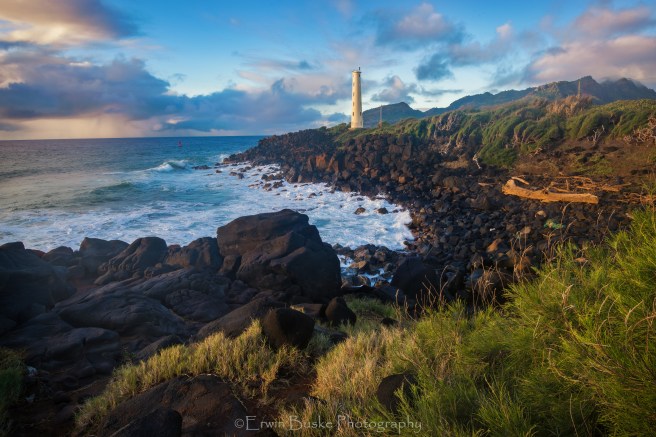
The next image is titled  “Nawiliwili Lighthouse” and is from a Father and Daughter vacation in February.

lighthouse-sharp

Nawiliwili Lighthouse

“This image is of the Nawiliwili Lighthouse in the early morning light. The Nawiliwili Lighthouse is located close to Lihue and the Marriot Beach Resort on the island of Kauai. It is about a mile and a half walk from the Marriot Hotel where I was staying across a maze of roads and golf paths. On my first couple of adventures to this location I had not figured out the right way to get here and with headlamp trekked across the manicured golf greens close to the cliffs above the ocean in route to my obvious destination. Eventually I was approached by the attendant who told me this was strictly private property. After my next adventure, this time through head high abandoned sugar cane fields I finally set out to find the correct path through the maze which led me to this fine location and vantage point for Nawiliwili Lighthouse. Photographing at this spot is quite a memorable experience. If you arrive before dawn, you will enjoy the sound of not only the waves crashing on the shore but also of numerous bird calls including in infamous Kauai Roosters crowing one right after the other! The clouds move in an around the lighthouse quickly creating a constantly changing venue making possible always unique compositions.”


This next image is called “Going Home” and is from Indian Henry’s Hunting Ground at Mt. Rainier National Park, Washington State.

patrol-cabin-for-calendar

Going Home

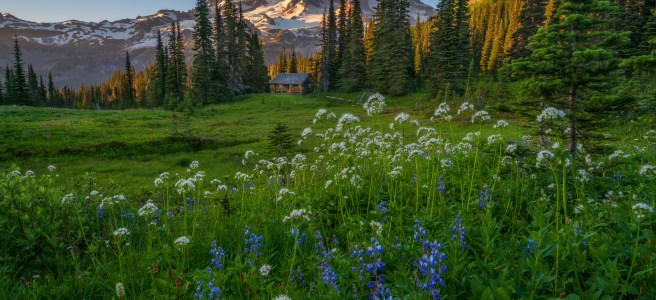
“This image is looking through a natural bouquet of flowers out to Indian Henry’s Ranger Cabin and Mt. Rainier in the distance. I do not know about you, but I would work for free to stay at this cabin at Mt. Rainier’s Indian Henry’s Hunting Ground for the summer months! Heck, I might evern pay! This cabin has to be everyone’s dream and fantasy of a home in an ideal setting, a universal archetype for a mountain cabin in a setting of a lush meadow with flowers and Mt. Rainier looming above. Needless to say, we met the ranger on this trip and he seemed quite content with his position, and very laid back also! Where is your special dream cabin located?

This image is from the recent series of wildflower hikes I led for the Seattle Mountaineers. Indian Henry’s is about a 12 mile round trip hike with about 3,500 feet elevation gain, making it somewhat challenging for a sunset hike with return by handlamp (this is what we did).”


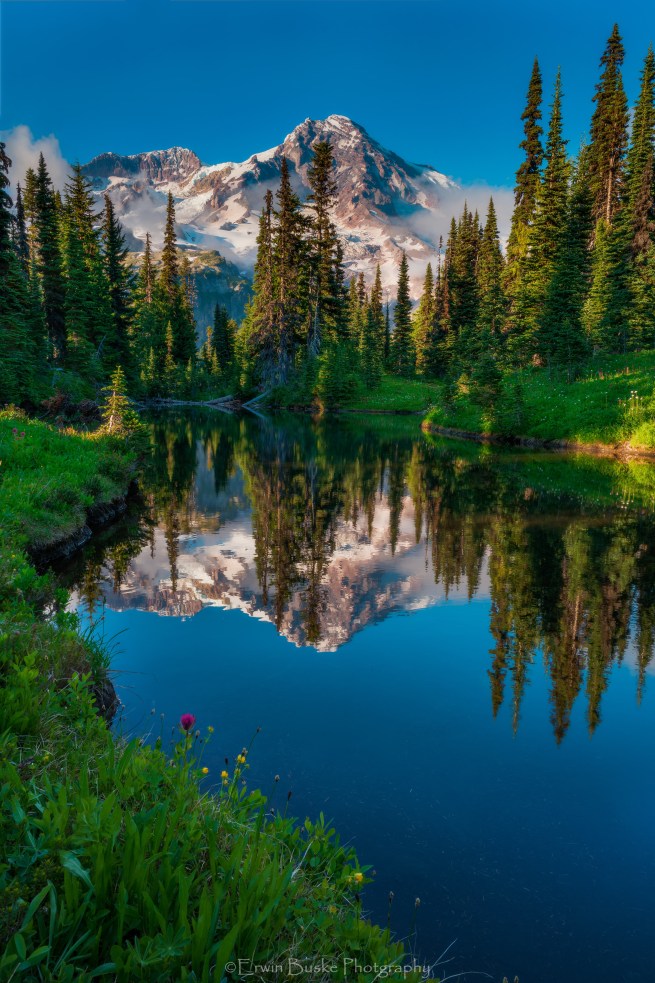
The next image is titled Mirror Lake and is also from Indian Henry’s Hunting Ground at Mt. Rainier National Park.

blended-mirror-imagecomp

Mirror Lake

“This image is of Mirror Lake in the evening light at Indian Henry’s Hunting Ground, Mount Rainier National Park. Indian Henry, known as Soo-Too-Lick, early on (1883) guided several familiar names to Mt. Rainier including the Hunting Grounds, these familiar names include James Longmire Philemon Beecher Van Trump and John Muir. Indian Henry was a Cowlitz Indian, beloved by many people. Thanks to Celine Cloquet for helping uncover some background on Indian Henry.”


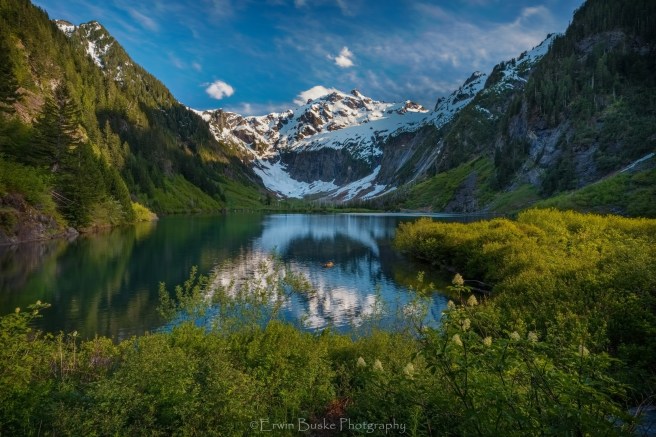
The next image is from a day hike to Goat Lake that I took in late Spring and is called “Refuge”.

comp-comp

Refuge

“From my hike yesterday, this is Goat Lake in evening light with Cadet Peak in the distance. Goat Lake is located in the north central cascades with the trail accessible at the end of a short forest service road that departs from the Mountain Loop Highway. The hike is about five miles one way, but it is an additional mile, sometimes beating the bush, to where this image was taken at the far end of the lake. Goat Lake is only about 3.100 feet high and is one of the first lakes to become easily accessible and snow free in May. The bush is very thick and dense around the lake, making it difficult to find suitable places to properly frame an image. After scouting out the area for some time, I found an elevated boulder where I could place my tripod, the only issue is that I had to bunch the three legs close together making the balance somewhat precarious. Plus the tripod was situated higher than i could see clearly the LCD or EVF so I had to balance on my tiptoes on top of the narrow boulder also! Not a bad place, however, to perform acrobatics and a balancing act with no spectators.”


This next image is from my families vacation at the end of the road at Denali National Park and is called : “Dreams of the Great One”.

blend-pieces-flatcomp

Dreams of the Great One

“Denali basks in the calm atmosphere of the warm early morning light and also reveals itself in the waters of iconic Reflection Pond. Although this is an iconic site, very few people get to see it due weather and restrictions on access. The typical state of affairs in July are clouds and or rain with only occasional and brief moments of clearing. On my first trip to this location, I feel so blessed that there was an opening early on this morning. Cars are not allowed this far into the park, but the Backcountry Lodge, where I was staying, agreed to shuttle me out there in the early morning as long as I would walk back. As we rounded the bend of a steep and winding road the mountain suddenly became visible, and the beauty of the peak was spell binding, to the point I almost forgot I came here to take images. The beauty first and foremost must be experienced for what it is in the moment. Images come second. Denali at 20,310 feet is the largest in North America and when measured from the base to the top is 18,000 feet making it the highest mountain in the world. The flowers in the foreground along with the clouds and atmosphere helped me frame this image in a somewhat unique way.”


This next image is titled “Like a Bridge Over Troubled Water”

gorge-2016-autumn0047

Like a Bridge Over Troubled Water

“” Like a bridge over troubled waters, I will ease your mind.” With all stress and anxiety that many have been feeling over the past couple of weeks or so I thought I would feature an image that takes us to to calmer place. This image is from my recent trip to the Columbia Gorge and is of Mist Falls along the Wahclella Falls trail. These falls normally do not have much of a flow, but in late October there were heavy rains in the Gorge making these falls really stand out.”

This final image is titled “On the Trail to Elowah” and tells its own story.

gorge-2016-autumn0323

On the Trail to Elowah

Here is to telling more stories to go along with my images in CY 2017.  What stories will you tell in the coming year?  I look forward to hearing them and will be sharing many of my own in the days ahead!

Christmas, Hanukkah and Diwali Festivals of Light

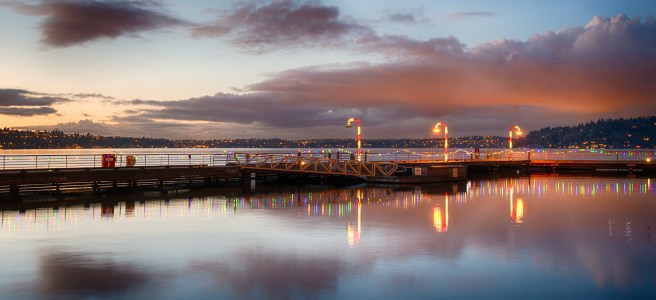
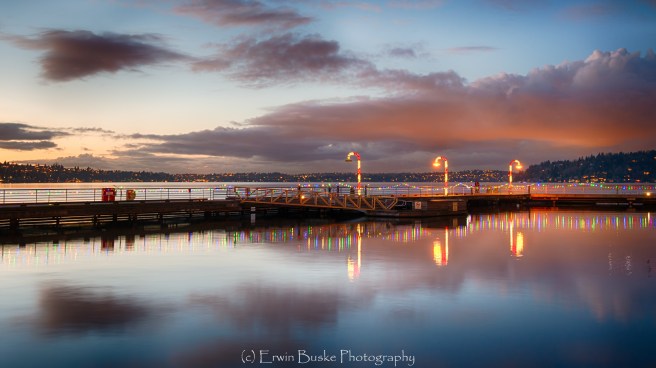
One of the things that I love the most about the Holiday Season are the Christmas Lights. Christmas celebrations coincide closely with the Winter Solstice, the day of the year when we have reached the peak of darkness in our days and every day beyond that point offers a little more light.  Putting up lights helps celebrate this important turning of the seasons symbolically offering hope to all the world.

This year due to predicable variations in the solar lunar calendar,  two of the world’s major religions fell into sync on Saturday, when the first day of the Jewish festival Hanukkah begins at sundown, the same day celebrated as Christmas Eve for most Christians.  Hanukkah, also known as Chanukah, is the Jewish Festival Of Lights.  It is no surprise that a little earlier in time and coming from the Hindu tradition Diwali is celebrated.  Diwali, meaning array of lights, is a Hindu light festival. It symbolizes the triumph of light over darkness.

coulen-park-lights0087_hdrr1

As a Landscape Photographer I am of course very much attuned and aware of these seasonal changes in light.  Starting with the Summer Solstice and gaining momentum as we approach the heart of the Autumn Season, moving into greater darkness is combined with the warm colors of fall foliage.  For many including myself this encourages an inner exploration of the darker parts of my soul and psyche.

emerald-sharpened-for-crop

Exploring these parts of myself set the stage for awakening in the days following the Winter Solstice.  Each day gets a little longer, helping gradually awaken these parts of myself.

gold-creek-december072

Merry Christmas everyone, and may lengthening of the days bring Light, Peace, and Joy to your world, friends and family!

Gold Creek Snowshoe, Photography and Fun

The Gold Creek Basin, located about one hour from Seattle, is a premier location for snowshoeing, photography and fun with friends and family.  The snowshoe route includes multiple beautiful sites along the way including Gold Creek Pond, Creeks and Rivers, Heli’s Pond and Bridge,  and sweeping valley views.  All of this can be done in a round trip snowshoeing trip of less than six miles and an elevation gain of only about 500 feet.

gold-creek-december060compr1skylightburn

Winter’s Gold

Getting to the Trailhead

Drive Interstate 90 east to Exit 54, 2 miles east of the Snoqualmie summit.  Exit I-90, turn north, crossing under the freeway.  A few hundred feet north of the highway interchange, turn right onto a narrow paved road (FR 4832) and drive east parallel to the freeway for 1 mile.  This section of the road in the winter will have compact snow and ice but can usually be driven with just about any vehicle, but I have seen cars and trucks get stranded in this section.  All or 4 wheel drive vehicles, and front wheel drive vehicles will have no problem.  Later in the Winter the road to the trailhead will be closed at this point and you will need a Sno Park Permit to park along the side of the road.  Before the deep snow falls you can now turn left on Gold Creek Road 142 (all wheel drive advised) and go another .3 miles to the Gold Creek Pond Parking Lot where a US Forest Pass is required for parking.

gold-creek-december341-pano-starting-precompr1

Helli’s Pond Bridge

Preparations

Preparations for a snowshoe trip will be quite different than a typical spring, summer or fall hike.  Early in the Winter you may be able to get by with just some Yak Tracks or Micro Spikes for traction.  But as the snow gets deeper snowshoes will be needed to keep from sinking deep into the snow.  The snow, however, in Western Washington is different than many of the areas that the designers had in mind when releasing their products.  Around here one needs a smaller snowshoe that has saw tooth like rails on the underside to pierce the typically frozen crust of snow and ice that forms the top layer of snow.  It is rare that one encounters deep powder snow on western Washington snow trails.  I have found the MSR (located in Seattle) moderately priced EVO snowshoes work excellent at Gold Creek.  Just say no to the great big monster snowshoes, they are hardly ever needed around here!

ttps://www.rei.com/product/875159/msr-evo-snowshoes

You will also need to be prepared for a variety of weather conditions, everything from wind, cold, and snow, to warm sunshine, and perhaps even freezing rain.  This means that one must pack layers, rain gear, gaiters, warm hat and gloves.  I  recommend having a map, compass, cell phone, and GPS.  The reason for this is that if it snows your route back will no longer seem quite so straight forward and it is easy to get confused when trails are covered with fresh snow and ones visibility only extends a short distance due to snow and fog.

I also recommend having at least one trekking pole.  A trekking pole comes in handy to see how solid the snow is in an area off trail that one wants check out in hopes of finding a better photo perspective.  One of the most common accidents in the snow is stepping into a hole close to a tree and falling underneath the snow.   Forget using your bladder and a hose for water, it will freeze during the trip.  Just carry conventional plastic bottles and store one of them in your pack.  With all of your gear, you will likely need a somewhat bigger pack than is used for summer day hikes.  Although a luxury, if with kids and family, I recommend taking a small stove and boiling pot for hot drinks, and perhaps even a lightweight plastic cloth to serve as a place for preparing food.  Always bring at least a small first aid kit.

digital-blending-workflow500pxr1srgb

 Gold Creek Early Morning Light

Destinations

From the trail head and no more than a half mile walk, the first destination you will come to is one of the tributaries of Gold Creek as shown in the above image. I have found this makes an excellent image around sunrise.

pond-tree-116bitreeditspots

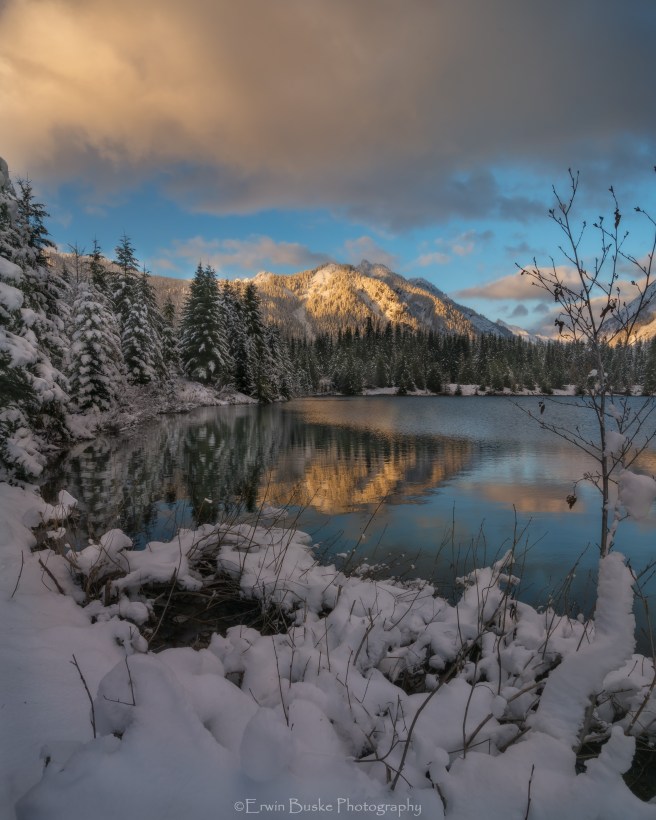
 The next destination is Gold Creek Pond as shown on the above image.  By the middle of Winter the pond will likely be frozen creating unique photographic opportunities.  Even if the pond is frozen there will usually be a fairly large section of the pond on the north side close to the inlet that is unfrozen yearlong creating opportunities for images with reflections.  Follow the trail clockwise around the pond until you get to the north side of the pond, about one mile from the trailhead, and you will get to the site of the next image.  Notice the small ducks in the water-they are permanent residents of the pond!

gold-creek-pond-sunset-ducks16bitspots

 Winter Impressions at Gold Creek Pond

Keep following the trail around the pond and you will eventually find a sign that says Gold Creek Trail.  Turn left and go up the hill to an access road for cabins.  Follow the road for about another half of mile paying close attention to signs at road junctions that direct you to the Gold Creek Trail.  You will arrive at a major junction with a sign that says Heli’s Pond.  Go left on a short spur path and trail to beautiful Heli’s Pond.

gold-creek-december0105_hdr

Bridge of Frozen Silence

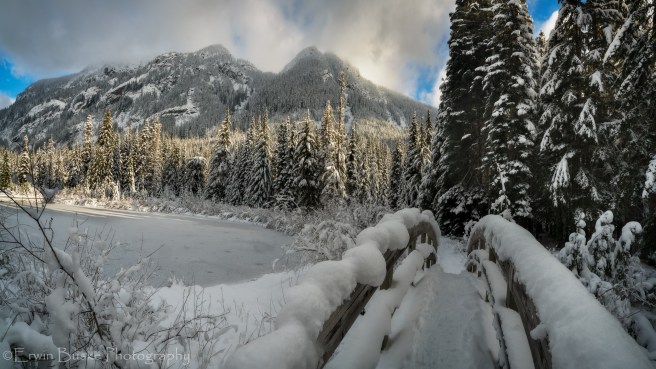
There is a beautiful curved bridge at the outlet of Heli’s Pond.  Also take the short trail completely around the small pond to find more vistas and potential photo ops looking out to Kendall Peak and Rampart Ridge.  Return to the main trail.  At about two miles you will leave the road and start following the actual Gold Creek trail.  After about a half mile or so  you will come to an opening presenting a beautiful view looking up and across the Gold Creek Valley toward Kendall Peak as shown in the next image.

gold-creek-december0098

Gold Creek Basin

This may be a good turn around spot if there is heavy snow because from this point on the trail passes through avalanche shoots that may not be safe.  But earlier in the winter or if there is not much snow, one can go about another half mile to where the trail crosses Gold Creek and there is a beautiful spot next to the creek where one can have lunch next to the snow covered boulders looking out to the creek and mountains beyond.

gold-creek-pond1002_hdrr1nosofty

Snow Covered Boulders

Photography Tips

There is one big problem when it comes to shooting snow: Snow is white.  Your camera’s metering system wants to meter everything as middle gray.  As a result, the pristine white snow becomes dull and dirty snow.  Conventional wisdom says that one should overexpose images that include snow.  The problem with this is that although it leaves the snow looking white, there may be little definition in the snow nor preservation of subtle color tones on the snow.  Especially in the early morning and around sunset, the snow will take on some of the color cast of the sunlight that is coming from low angles.  One may actually wish to accentuate these subtle color tones rather than to just render them white.

My approach typically involves taking several images, about three to five, both under and over exposed.  Typically I will select a slightly underexposed image and work with a raw editor (I use adobe camera raw but the same thing can be done with lightroom), to edit the image with both global and local adjustments.  For global adjustments I will work to get a somewhat neutral image, neither warm no cool, moderate opening of shadows and controlling highlights, moderate contrast, and conservative adding of vibrance and or saturation.  I will work with the HSL panel to enhance subtle color tones that are not represented accurately in the raw image, such as a purple or mauve hue.  With local adjustments I will further adjust white balance in selective parts of the image, this (along with local area exposure adjustments) will help insure the snow is the color you want it to be.  This is necessary because winter images usually include both warm and cool areas and therefore this local adjustment is essential to creating a natural looking image.  Using local adjustments in the raw editor, I will further adjust shadows and highlights to better expose for dynamic range.

final-sunset16bitfinaledits

Good Night Gold Creek Pond

In the above image notice the subtle mauve/purple hues on the snow in the foreground.  You will notice similar subtle tones in the next image.

gold-creek-to-eastnik

Daybreak at Gold Creek

gold-creek-december072

Early Winter Magic

In the above image notice the cooler tones of the shaded areas contrasting with the warmer tones of the areas still illuminated by the setting sun including Kendall Peak and the Clouds.  The transition from cool to warm tones is not abrupt because of the presence of soft magical evening light.  When taking wide angle images always look for interesting foregrounds to help draw the viewer into the image.

adobe-hdr16bittry2crpspot

Snow Mounds

Once I open the image from the raw editor as a TIFF in Photoshop, I will complete the editing process using luminosity masks for perfecting contrast and adding a slight Orton effect, along with subtle adjustments for micro contrast using an NIK filter.

Fun with Family

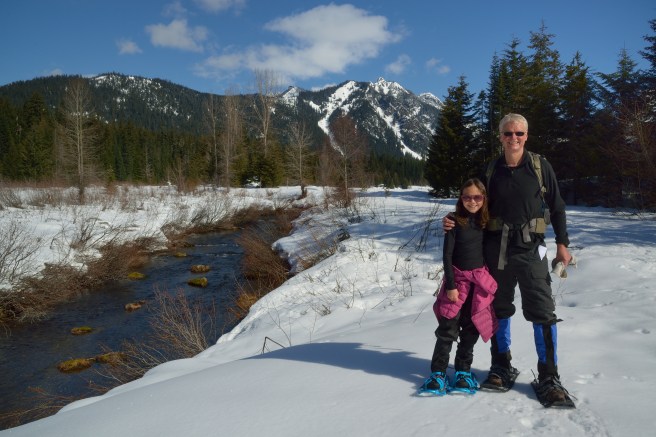
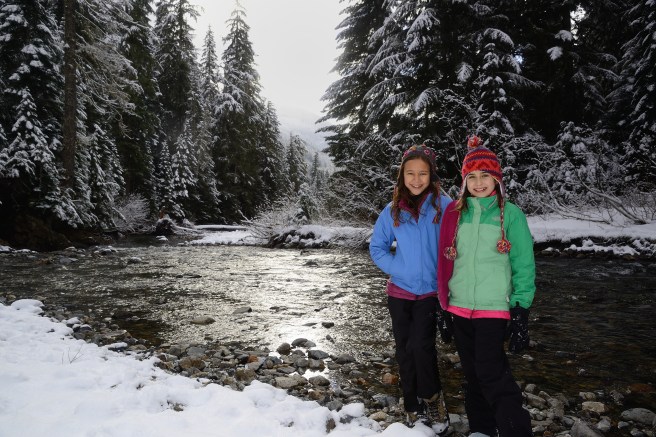
Not all of my snowshoeing trips are oriented strictly around landscape photography and I have brought my family up here about once a year as my daughter Caroline was growing up.  This is a great snowshoe for family and friends and because in the winter light is at a low angle all day long, there are many opportunities for capturing some awesome handheld images along the way.   Here are a few of Caroline and I and her friend Emma.  Kids always find a way to have fun playing in the snow and throwing an occasional snow ball at each other!  Happy snowshoe trails everyone!

gold-creek-spring-snowshoe0023

gold-creek-december0059


End


Waterfalls of Cougar Mountain

Often I get asked if I can provide some guidance about learning about photography.  One of the best pieces of advice I can provide is drawn directly from my own experience.  Practice taking images at local parks that you can go to with a short drive and can return frequently.  Although these parks may lack the spectacular beauty of the more iconic sites such as Mt. Rainier, the Grand Canyon, and Grand Tetons-you will learn more to sharpen your photographic skills at these more modest local parks than you ever will by just shooting the iconic sites.  Anyone can shoot a reasonably compelling image of Mt. Rainier’s Reflection Lake in good light, but taking a compelling image of a waterfall at Cougar Mountain Regional Wildland Park, that will challenge you to grow your photographic skill set in ways that will provide downstream benefits when you actually go to the more iconic sites.  The image below if of beautiful Coal Creek Falls in the mid morning light of an Autumn day.coal-creek-falls

The Cougar Mountain Wildland Park is only a little over 3,100 acres and is almost entirely surrounded by suburban communities.  But nestled within this Park are four beautiful waterfalls that can be reached with hikes ranging from just a couple of blocks to about three miles.  In fact if you are ambitious one could hike to all four in one day!  The next image is of North Fork Falls which can be reached by crossing the street from the Red Town Trail head and walking about a couple of blocks along the Coal Creek Park trail to this beautiful gem.  It is only about 20 feet high, but nevertheless looks quite impressive when there is a good water flow.  coal-creek-falls-two

Far Country Falls can be reached by following the Indian Trail from the Red Town Trail Head for about two miles.  I have found that this waterfall looks more interesting from the top down than from the more typical waterfall perspective of looking from the bottom up.  untitled1

The fourth waterfall, Doughty Falls, at Cougar Mountain will take a little longer to get to, about a three mile one way hike.   Doughty Falls is very small, but beauty often comes in small packages!  doughty-falls

Happy Trails!  Start your photographic journey to your local parks today!  Here is a link to access points and maps to trails at Cougar Mountain.   http://www.kingcounty.gov/services/parks-recreation/parks/parks-and-natural-lands/popular-parks/cougar.aspx